


Long before electrolyte powders came in little tear-open packets, Hollywood was sipping their own version – vegetable broth.
In the 1920s, actresses including Greta Garbo and Gloria Swanson sought the care of physician Henry Bieler, author of “Food Is Your Best Medicine” and a recipe for mineral-rich broth that circulated for decades.
Bieler’s Broth, as it came to be known, was made from an unseasoned blend of green beans, celery, zucchini, Swiss chard and spring water.
It’s not a yummy culinary soup – it’s more of a “medicinal” recipe that’s often used in the spring as a gentle seasonal cleanse. It’s pleasant, but a bit bland, and lately I’ve been craving a mineral-rich blend that I’d actually look forward to drinking.
Although broths made with other vegetables, potato peelings and even kitchen scraps never became quite as famous as Bieler’s Broth, they work on the same basic principle: as vegetables simmer, many of their minerals – plus other water-soluble nutrients – are released into the broth.
This recipe takes a more flavorful approach than some earlier recipes – it incorporates veggies, herbs, aromatics and a little seaweed for a savory, deeply comforting flavor.
Basically, it’s soup for the soul – with a mineral-rich twist.
🥣 What Is Potassium Broth?
I’m a huge fan of nutrient-dense bone broth – which is rich in collagen, amino acids and other goodness – but veggie broths can serve an important purpose, too.
Many traditional vegetable broths are made with foods that naturally contain a significant amount of potassium – typically potatoes or potato peels, leafy greens, carrots, celery and other vegetables – which is how potassium-rich vegetable broth became its own little category.
Potassium is an often underrated mineral in wellness circles – and many of us don’t get enough of it – so prioritizing it in broth makes sense for a lot of us.
That said, there isn’t one official recipe. Some versions rely heavily on potatoes and leafy greens, while others incorporate a wider mix of vegetables, herbs, spices and seaweed.
So, does simmering veggies really draw out minerals? Yep.
Researchers looking for ways to lower the potassium content of potatoes have found that boiling can reduce the amount that remains in the potato by about 50-75%, as some of the potassium moves into the cooking water. (1)
Normally, if that water gets poured down the drain, the potassium goes with it.
With broth, you do the opposite: you keep the cooking liquid. And that doesn’t necessarily mean tossing the vegetables afterward – I’ll share a few ways to use them later, along with a version made mostly from kitchen scraps.
That’s part of what makes vegetable broth such a practical way to make use of minerals released during cooking – especially when it’s made with potassium-rich ingredients like potatoes, leafy greens and other vegetables.
One important caveat: I don’t think it’s possible to accurately tell you that one cup of homemade potassium broth contains X milligrams of potassium without having that particular broth analyzed. The amount will vary depending on the vegetables used, how much of each is added, how finely they’re chopped, the amount of water, cooking time and other factors.
So I think of this as a potassium-focused food, not a precisely dosed potassium supplement.
Why Potassium Matters (A Lot)
Magnesium has almost gained celebrity status in the wellness world, and for good reason. It’s vital to so many processes, and stress increases how quickly we burn through our stores.
Potassium tends to get less attention, but it’s doing plenty of important work behind the scenes.
Most of our potassium is kept inside our cells, with much lower concentrations outside them. In fact, the concentration of potassium inside our cells is about 30 times higher than it is outside them. (2) Maintaining that difference is essential for:
- Normal nerve transmission
- Muscle contraction
- Healthy heart function
- Fluid balance
- Normal kidney function
Potassium also has an important relationship with sodium. Higher potassium intake can increase sodium excretion and may support blood vessel relaxation, which is one reason potassium-rich dietary patterns have been studied so extensively for cardiovascular health and healthy blood pressure.
And most of us could stand to pay a little more attention to it.
The FDA’s Daily Value for potassium – the number you’ll see used on Nutrition Facts labels – is 4,700 mg per day. (2) However, current National Academies recommendations are a little different: the Adequate Intake is 3,400 mg daily for adult men and 2,600 mg for adult women, with slightly different amounts during pregnancy and breastfeeding. (2)
Those lower numbers aren’t an RDA or a newly established “optimal” intake. Researchers concluded there wasn’t enough evidence to determine a precise physiological requirement for potassium, so the newer Adequate Intakes were based largely on amounts consumed by apparently healthy populations.
There’s still some uncertainty around exactly where the sweet spot lies, but what we do know is that average U.S. potassium intake falls below current recommended amounts.
Potassium And Sleep
I’ve noticed that when I eat a lot of potassium-rich foods, I tend to sleep better.
And because I am deeply committed to anything that might help me sleep better, I decided to find out whether that connection had actually been studied.
Turns out, it has – although the research is still pretty limited.
In a small randomized, double-blind crossover study, young men eating a low-potassium diet had better sleep efficiency and spent less time awake during the night after initially falling asleep when they were given potassium supplements. The researchers described the results as suggesting improved “sleep consolidation,” while also noting that larger studies were needed. (3)
A much larger observational study looked at 727 adults and found that people with lower 24-hour urinary potassium – which researchers used as a marker of lower potassium intake – had about 50% higher odds of poor sleep quality after researchers adjusted for other factors. (4)
And this is weirdly relevant: when researchers looked at men and women separately, the association held up in women but not men. They don’t yet know why – differences in sleep risk factors between men and women may play a role, and the study also included fewer men, which made it harder to detect an effect in that group.
More recently, researchers have started looking at potassium in relation to some of the hormones involved in sleep. A 2024 trial in people with diabetes and insomnia found that potassium supplementation was associated with improvements in insomnia along with changes in cortisol and melatonin. (5)
I wouldn’t make too much of that finding yet – it was one study in a very specific population, so it’s too early to say that potassium improves sleep by changing those hormones for everyone.
Still, taken together with the earlier research, it makes my own little n=1 observation seem a lot less random.
Fresh Vegetable Potassium Broth
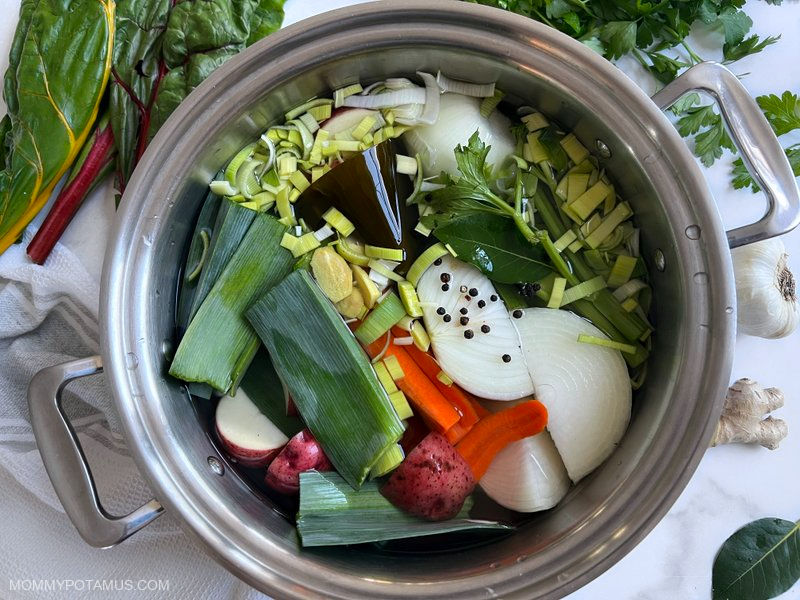
This is the version I make when I’m starting with whole veggies instead of scraps.The seaweed provides natural umami, while onion, garlic and ginger round out the flavor. Carrots and celery give it that classic mineral-broth character.
Prep Time 20 minutes
- 12 cups filtered water
- 1 strip of kombu (about 1×3 inches)
- 12 ounces red potatoes, scrubbed and cut into large chunks (about 3 small to medium potatoes)
- 1 medium yellow onion (peeled and quartered)
- 1 large leek, white and light green parts, thoroughly rinsed and sliced into large pieces (or ½-1 additional medium yellow onion))
- 2 large carrots (cut into large pieces)
- 3 medium celery stalks (including the leaves if you have them)
- 4 cloves garlic
- 1 inch fresh ginger (peeled and sliced)
- 1 bay leaf
- ½ tsp whole black peppercorns
- 1-2 large Swiss chard leaves with stems (roughly chopped)
- ¼ bunch flat-leaf parsley
- Unrefined sea salt, to taste
Stovetop Instructions
-
Add the water and kombu to a large pot and let it sit for about 20-30 minutes while you prep the vegetables.
-
Add the potatoes, leek, onion, carrots, celery, garlic, ginger, bay leaf and peppercorns.
-
Bring to a gentle simmer, cover and cook for about 45 minutes.
-
Add the Swiss chard and parsley and simmer for another 10-15 minutes.
-
For a clear broth, strain everything through a fine-mesh strainer.
-
For a thicker, soup-like version, remove the kombu and bay leaf, then blend the remaining vegetables, broth and seasonings until smooth.
-
Season with salt to taste.
Instant Pot Instructions
- Note: This is a fairly large batch. Make sure the ingredients and liquid stay below your Instant Pot’s pressure-cooking maximum fill line. An 8-quart model should give you room for the full recipe.Add the water and kombu to the Instant Pot and let them sit for about 20-30 minutes while you prep the vegetables.
-
Add the potatoes, leek, onion, carrots, celery, garlic, ginger, bay leaf and peppercorns.
-
Secure the lid and cook on High Pressure for 8 minutes, followed by a 15-minute natural release. Release any remaining pressure.
-
Add the Swiss chard and parsley, replace the lid without sealing it, and let them steep in the hot broth for about 15 minutes.
-
For a clear broth, strain everything through a fine-mesh strainer.
-
For a thicker, soup-like version, remove the kombu and bay leaf, then blend the remaining vegetables, broth and seasonings until smooth.
-
Season with salt to taste.
Slow Cooker Instructions
-
Add the water, kombu, potatoes, leek, onion, carrots, celery, garlic, ginger, bay leaf and peppercorns to the slow cooker.
-
Cover and cook on LOW for about 4 hours.
-
Turn off the slow cooker. Add the Swiss chard and parsley, cover, and let them steep in the hot broth for about 15 minutes.
-
For a clear broth, strain everything through a fine-mesh strainer.
-
For a thicker, soup-like version, remove the kombu and bay leaf, then blend the remaining vegetables, broth and seasonings until smooth.
-
Season with salt to taste.
Nutrition values provided are estimates only and reflect the composition broth before straining. Salt is not factored in.
Serving: 1batch | Calories: 441kcal | Carbohydrates: 101g | Protein: 13g | Fat: 2g | Saturated Fat: 0.4g | Polyunsaturated Fat: 1g | Monounsaturated Fat: 0.1g | Sodium: 450mg | Potassium: 2729mg | Fiber: 16g | Sugar: 20g | Vitamin A: 29777IU | Vitamin C: 94mg | Calcium: 329mg | Iron: 7mg
🌊 A Note About Kombu
Kombu is a mineral-rich seaweed traditionally used in Japanese cooking to add savory, umami flavor to broths and stocks. It’s naturally rich in iodine, so if you’ve been advised to limit iodine-rich foods, feel free to leave it out.
Iodine levels in kombu can vary considerably, which is why I don’t estimate the iodine content of this homemade broth.
♻️ Don’t Want To Throw Away The Vegetables?
No problem, you definitely don’t have to. When eating a normal meal, I’m a big fan of eating the vegetable itself. Fiber matters, and whole foods offer a lot more than one particular mineral.
After making the broth, you can remove the bay leaf and kombu, then blend the remaining vegetables with enough broth to make a simple vegetable soup.
However, there are times when broth fills a different need.
It’s warm, hydrating and easy to sip. It can be especially nice when you’re recovering from a stomach bug or something similar and your appetite hasn’t quite returned yet – or when you simply want something warm and savory between meals.
So if you prefer a clear, thin broth but don’t want to toss whole veggies, there’s another option that may make even more sense:
Make the broth from vegetable scraps in the first place.
🥕🧅🧄 Zero-Waste Potassium Broth From Vegetable Scraps
Keep a reusable gallon storage bag in the freezer for clean vegetable trimmings that might otherwise go into the compost or trash. When it’s full, make broth.
Good scraps for this recipe include:
- Potato peels
- Carrot peels and ends
- Celery ends and leaves
- Mushroom stems
- Parsley stems
- Zucchini ends
- Swiss chard or kale stems
- Onion ends
- Tomato cores and ends
For the best flavor, I wouldn’t use large quantities of cabbage, broccoli, Brussels sprouts or cauliflower scraps because they can become overpowering or sulfurous when simmered for a long time.
Scrap Broth Formula 🫚🥣
Use approximately:
- 6 cups loosely packed vegetable scraps
- 8-10 cups filtered water
- 1 strip of kombu (about 1×3 inches)
- 2-3 smashed garlic cloves
- 1-inch piece ginger
- 1 bay leaf
- ½ teaspoon peppercorns
Cook using any of the methods above.
Taste after straining and add salt until the broth is flavorful and savory.
Potato note: Don’t use green, heavily sprouted or bitter-tasting potato peels. Glycoalkaloids such as solanine are concentrated in the peel and particularly in green and sprouted portions of potatoes.
How To Store Potassium Broth
After straining or blending, divide the broth into smaller containers so it cools quickly. You can place them directly in the refrigerator – I set mine on a thin towel first to create a little buffer between the hot container and the cold shelf.
Store the broth in the refrigerator for 3-4 days, or freeze it for longer storage. USDA food-safety guidance recommends using refrigerated leftovers within about 3-4 days.
I like freezing individual portions in freezer-safe mason jars so there’s always a mug-sized serving ready to go.
Just make sure the jars are rated for freezing and leave plenty of headspace for the broth to expand as it freezes.
A Quick Note About Potassium
Potassium-rich foods are a great fit for most people, but some people need to be more careful about how much potassium they get.
If you have impaired kidney function or take a medication that affects how your body handles potassium, you may have been given specific guidance about how much to include in your diet.
If that’s you, a broth intentionally built around potassium-rich ingredients may not be the best fit without checking with your healthcare provider first.
For everyone else, this is one of those simple recipes I love because it manages to be comforting, practical and nutrient-rich all at once.
Warm mug, cozy blanket optional.
Sources
- Bethke, P. C., & Jansky, S. H. (2008). The Effects of Boiling and Leaching on the Content of Potassium and Other Minerals in Potatoes. Journal of Food Science.
- National Institutes of Health, Office of Dietary Supplements. Potassium: Fact Sheet for Health Professionals.
- Drennan, M. D., Kripke, D. F., Klemfuss, H. A., & Moore, J. D. (1991). Potassium affects actigraph-identified sleep. Sleep, 14(4), 357–360.
- Li, M., Heizhati, M., Wang, L., et al. (2022). 24-hour urinary potassium excretion is negatively associated with self-reported sleep quality in the general population, independently of sleep-disordered breathing. Journal of Clinical Sleep Medicine, 18(11), 2589–2596.
- Khalid, S., Bashir, S., Mehboob, R., Anwar, T., Ali, M., Hashim, M., Waseem, H., & Basharat, S. (2024). Effects of magnesium and potassium supplementation on insomnia and sleep hormones in patients with diabetes mellitus. Frontiers in Endocrinology, 15.


