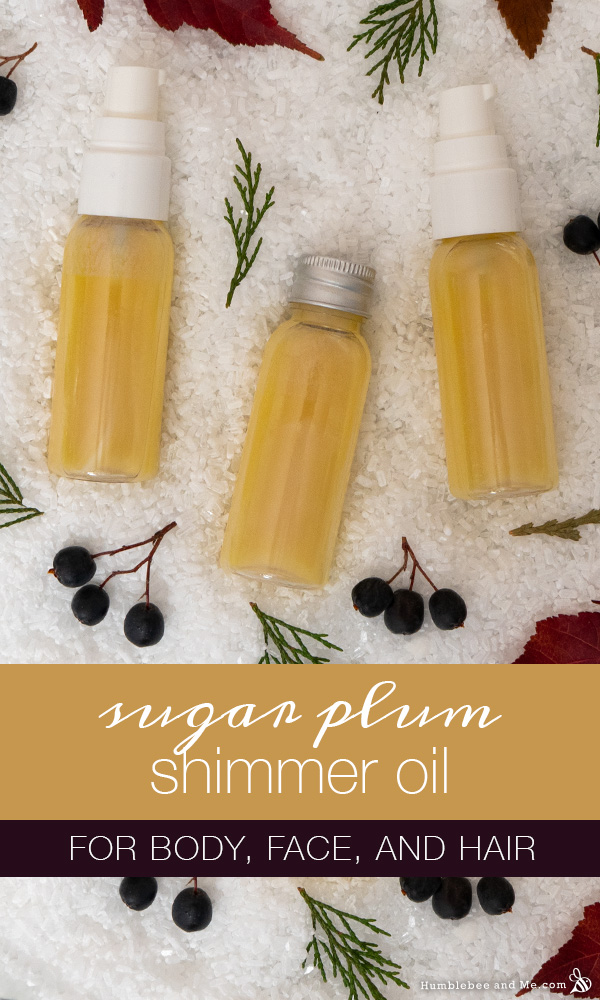
Sugar Plum Fairy Shimmer Oil

Sugar Plum Fairy Shimmer Oil

Today we are making a beautiful, fragrant, versatile shimmer oil that is perfect for winter skincare! I’ve given mine a “Sugar Plum Fairy” holiday theme, but you can easily theme yours differently with a few small changes. You can also have some fun with what “type” of oil this is; I initially designed this formulation as a body oil, but you can absolutely use it as a facial oil serum or even a rich hair oil—it’s up to you!

Want to watch this project instead of read it?

Watch Now

The bulk of this shimmer oil is—no surprise here—oil! Two oils make up 97% of the formulation.

Our star is plum kernel oil; the oil expressed from the kernels of plums. What could be more perfect for a “Sugar Plum Fairy” themed formulation? The super special thing about this oil is its scent: it smells wonderfully of marzipan, and that comes through in the finished shimmer oil. You can let the scent shine on its own, but it will also mingle beautifully with a thoughtfully chosen fragrance or essential oil.

The downside of plum kernel oil is its price; it isn’t cheap. If you adore the scent of marzipan and are ok with a bit of a splurge, it will last a long time if you keep it in the fridge. I’ve had the bottle I’m using for seven years now, and it’s still fresh! Thankfully, if you don’t have plum kernel oil, you can easily swap it for the second carrier oil in our formula: apricot kernel oil. I chose apricot kernel oil because its fatty acid composition is quite similar to plum oil, but it’s a lot cheaper. Of course, you will obviously lose that beautiful marzipan-y scent if you don’t use plum kernel oil, but you might prefer that if you don’t want to roll with the same “Sugar Plum Fairy” theme—and you can still make your shimmer oil smell wonderful a fragrance or essential oil!

The remaining 3% of the formulation is where we get our shimmer, the rest of the scent blend, some antioxidant goodness, and the magic that keeps the shimmer from drifting to the bottom of the bottle to form a sad layer of sparkly sludge. There’s a lot happening!

The plummy mica I used in an earlier batch.

For that “Sugar Plum Fairy” shimmer, you’ll need a fine mica—that is, one with a small particle size. It should look “glowy” rather than glittery or sparkly, and if the data sheet mentions a particle size, ideally it’ll be below 50 micrometers. This will help prevent the mica from clogging a mister/spray top (if you opt to use one) and creates a subtle shimmery/glowy appearance on the skin. I made one version using a rich plum-coloured mica, and a second using a duo-chrome mica that looks silver-white at first, and then shifts to violet when the light catches it. That colour changing, iridescent loveliness brings to mind ballerina’s tutus and the beauty of freshly fallen snow in low light. Sugar Plum Fairy perfection!

The colour-shifting mica I used in the video.

Another note on mica: make sure you only purchase ethically sourced micas as some is mined in truly horrific conditions. This information is usually in the FAQ of a shop’s website, and if it isn’t, ask before purchasing. TKB Trading, Bramble Berry, and YellowBee all sell exclusively ethically sourced micas.

When it comes to scent, there’s plenty of room to have fun + use what you have (and love)! I’m using the gorgeously juicy and complex Spicy Plum Pudding fragrance oil from Bulk Apothecary, which melds wonderfully with the natural scent of plum oil. For other sugar-plummy ideas, I think something vanilla-y would be great with the scent of plum oil, or something with a bit of a ‘spice’ note. I think it could be really fun to infuse your apricot kernel oil with vanilla beans for an indulgent, all-natural scent blend!

You can also adjust how much scent you use. If you’re planning on using this as a facial oil serum, I’d drop the fragrance entirely and replace it with more apricot oil—but if you’re using it as a hair oil, you might want to double the fragrance to 1% for more of a scent kick. Whatever you use, make sure it is safe at whatever usage level you go with for whatever sort of product you’re making. And if you’re using plum oil, make sure it’ll work with that marzipan smell!

Want to watch this project instead of read it?

Watch Now

Our last ingredient is the one that keeps the shimmer floating in the oil rather than sinking down to the bottom of the bottle: TKB Trading’s Crystal Clear Wax (INCI: Caprylic/Capric Triglyceride (and) Polyurethane-79). This really neat ingredient thickens the oil a tiny bit, but its real super power is its incredible suspending abilities.

If you look closely you can see the ghostly blobs of Crystal Clear Wax at the bottom of the beaker.

Just because an ingredient thickens doesn’t necessarily mean it’s good at suspending. If you’ve ever tried to use a small amount of solid fatty thing, like a bit of cetyl alcohol or a touch of a butter in a liquid oil to suspend a mica, you’ll know those ingredients eventually precipitate out of the oil as hard little fatty blobs and sink to the bottom along with the mica. Crystal Clear Wax’s ability to suspend mica in oil this well is rare, so I’m afraid I don’t have a good substitution for this ingredient. If you don’t have it or don’t want to use it, you can go the non-shimmer route by replacing both the mica and the crystal clear wax with more apricot kernel oil. You can also keep the mica, knowing it’ll sink to the bottom, and shake the bottle before every use. Or you could make a shimmery body butter bar instead—where the mica can’t settle out because it’s suspended in a solid bar. I think this body butter bar formulation would be a lovely choice to shimmer-ify.

This is the oil after it’s been heating for a while. See the tiny clear bits? That’s not-quite-melted Crystal Clear Wax, so the oil needs to be heated for longer.

To make the oil all you’ve got to do is melt the heat phase ingredients together, stir until cool, and then mix in the cool down phase ingredients. Easy peasy! Enjoy

Relevant links & further reading

Sugar Plum Fairy Shimmer Oil

Heated phase
20g | 20% plum kernel oil (USA / Canada / UK / Bulgaria / Aus / NZ)
77g | 77% apricot kernel oil (USA / Canada)
0.5g | 0.5% Crystal Clear Wax

Cool down phase
1g | 1% Sugar-Plummy coloured mica
0.5g | 0.5% Spicy Plum Pudding fragrance oil
1g | 1% Vitamin E MT-50 (USA / Canada)

Combine the heated phase ingredients in something you’ll be able to heat directly. I find this formula needs to get up to ~100°C (212°F) to melt, and that’s a tall order for a water bath.

If you don’t have beakers and a lab hot plate that you can set to a reliably low(ish) temperature, you can put everything in a small saucepan and melt it on low on your stovetop. Alternatively, combine the ingredients in a heat resistant glass measuring cup, put that on a cookie sheet, and then bake it in a ~100°C (212°F) oven. No matter how you heat the mixture, make sure you keep an eye on it as you don’t want to scorch your oils!

Once you think the Crystal Clear Wax has melted, examine the mixture really closely to ensure it has—stirring around and pulling up your spoon to see if you can find any blobs. It’s so clear it vanishes into the oils even if it’s still a semi-solid blob.

When you are certain the Crystal Clear Wax has melted, remove the beaker from the heat and stir in the mica.

Stir the mixture occasionally until cools to room temperature to ensure a uniform final product.

Weigh in the cool down phase, stir to combine, and package the oil in a bottle some sort of orifice reducer cap like a treatment pump, a spray cap, or a disc cap.

To use, apply to your skin and massage in. Enjoy the shimmer! You can also use this as a hair oil, but apply sparingly—this formula is nearly pure oil, so it’s very rich.

Shelf Life & Storage

Because this product does not contain any water, it does not require a broad-spectrum preservative (broad spectrum preservatives ward off microbial growth, and microbes require water to live—no water, no microbes!). Kept reasonably cool and dry, it should last at least a year before any of the oils go rancid. If you notice it starts to smell like old nuts or crayons, that’s a sign that the oils have begun to oxidize; chuck it out and make a fresh batch if that happens.

Substitutions

As always, be aware that making substitutions will change the final product. While these swaps won’t break the formulation, you will get a different final product than I did.

  • As I’ve provided this formulation in percentages as well as grams you can easily calculate it to any size using a simple spreadsheet as I’ve explained in this post. As written in grams, this formulation will make 100g, which will fill three or four 30mL (1 fl oz) bottles, depending on how much you fill each bottle.
  • To learn more about the ingredients used in this formulation, including why they’re included and what you can substitute them with, please visit the Humblebee & Me Encyclopedia. It doesn’t have everything in it yet, but there’s lots of good information there! If I have not given a specific substitution suggestion in this list (Crystal Clear Wax!) please look up the ingredient in the encyclopedia before asking.
  • You can customize the oil blend; I recommend sticking to relatively lightweight “real” oils like sweet almond, grapeseed, or safflower oil.
    • If you’re looking for oils with a fatty acid composition close to plum oil, try sweet almond oil, apricot kernel oil, or peach kernel oil.
    • If you want to include more delicate oils like rosehip oil, add them with the mica rather than heating them to 100°C.
  • Please have fun with the scent! What makes sense for a “sugar plum fairy” theme to you? You can use any essential oil or fragrance oil you like that is safe for use at 0.5% in IFRA category 5A, 5B, and/or 7B (depending on how you plan to use the formula). If you aren’t sure how to check those guidelines, please read this blog post.
  • You can replace the fragrance with more liquid oil for an unscented product.
  • I recommend keeping the vitamin E as this product is primarily made from oils that can and will oxidize (aka go rancid and start smelling disgusting). Vitamin E will slow that process down.

Gifting Disclosure

The vitamin E and apricot kernel oil were gifted by YellowBee.
The mica and Crystal Clear Wax were gifted by TKB Trading. Links to TKB Trading are affiliate links.
The fragrance was gifted by Bulk Apothecary. Links to Bulk Apothecary are affiliate links.
The plum oil was gifted by Essential Wholesale. As of 2025, Essential Wholesale has been purchased by NourishUs Naturals, and they do not sell plum oil.
Links to Amazon are affiliate links.


Similar Formulations

  • Sugar Plum Body Oil

    This is our second Sugar Plum recipe for holidays 2018 making, and it makes for a delightful gift (or, you know… keep it for yourself!).…

  • Argan Plum Body Oil

    This simple, all-natural Argan Plum Body Oil features two of my favourite carrier oils and some stunning antioxidants for an ultra-lovely skin treat that you…

  • Sugar Plum Conditioning Body Butter

    I’m having a hard time deciding if I can give this Sugar Plum Conditioning Body Butter away. I mean… it’s just so nice. I really want to…
Tags: , , , ,
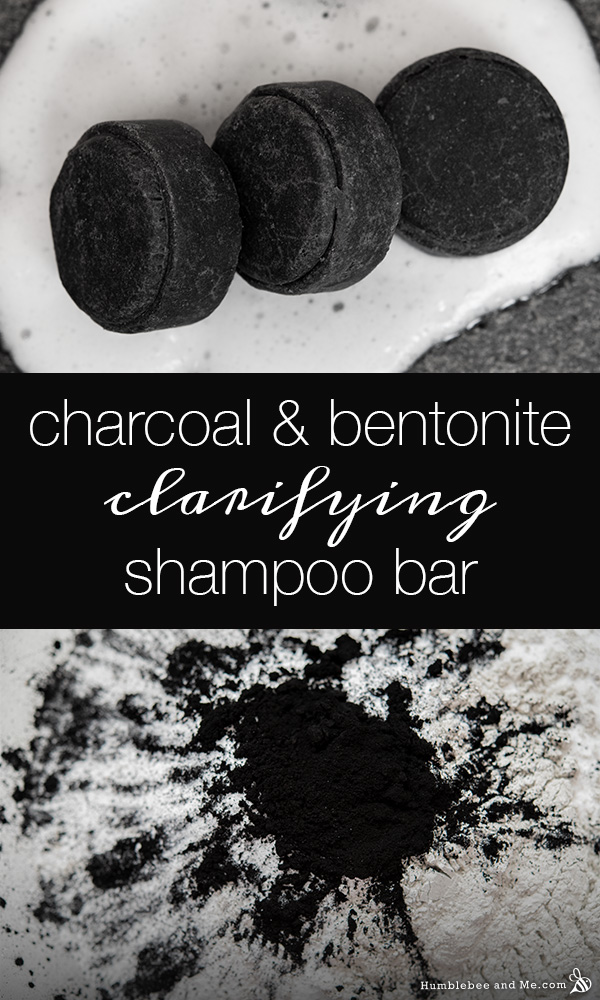
Charcoal & Bentonite Clarifying Shampoo Bar

Charcoal & Bentonite Clarifying Shampoo Bar

Today I’m sharing a formulation for some intriguingly dark, rock-hard shampoo bars that star two natural ingredients that are long-time favourites in the DIY space: activated charcoal and bentonite clay. I’ve had tons of requests to use these ingredients in a shampoo bar over the years, and since both are super popular in detox-type DIYs, I thought a clarifying sulphate-free shampoo bar was a perfect fit! These bars are fast & easy to make, don’t require any fancy equipment, and make amazing gifts.

Want to watch this project instead of read it?

Watch Now

What is a “clarifying” shampoo?

Clarifying shampoos are designed to “reset” your hair, removing product build up and excess oil. If your hair is feeling limp or looking dull, it could be time for a clarifying wash. I try to clarify regularly (every 3-ish weeks), or whenever my waves just aren’t styling and cooperating the way they usually do.

In order to “reset” the hair, clarifying shampoos need to be really effective cleansers, so they tend to be stronger than “regular” shampoos and shouldn’t be used for every wash. It’s common to find stronger surfactants in them, like sulphates, as well as lower levels of re-fatting ingredients.

When formulating a clarifying shampoo, the challenge is in making sure it does a great job of cleansing without leaving the hair stripped and feeling like straw—and I find this bar does that really well!

The dry phase

Most of the cleansing in this bar comes from a blend of two of my favourite sulphate-free surfactants; this pair creates gorgeous dense, velvety lather, that cleanses effectively, but gently.

The other two ingredients in the dry phase work with those gentle surfactants to really make this bar clarifying: bentonite clay and activated charcoal. If you’ve made shampoo bars with me before you’ll know I’ve used SCI and SLSa in lots of “every day” type shampoo bar formulations—the bentonite and charcoal make a big difference in the clarifying power of this formulation, even at low levels.

Bentonite clay

Bentonite is a really unique clay; compared to kaolin and French clays, it’s much heavier, and when combined with water it turns into more of a gel than a creamy paste. It’s also very absorbent, explaining its cleansing-boosting powers.

Learn more: Bentonite Clay and DIY Beauty, an interview with Ian Hutcheon, Professor Emeritus in Geochemistry

Activated charcoal is what gives these bars their inky colour. What make activated charcoal “activated” (and not just smashed up drawing charcoal) is its surface area—it has a TON of it! That’s what make it super duper absorbent. In fact, it’s so absorbent that it’s used to refine raw shea butter!

Learn more: Activated Charcoal in Skincare: The Science from Lab Muffin

Now, there isn’t evidence that activated charcoal does anything super special in skincare or haircare products—Lab Muffin explains it could theoretically work, but it’s not proven. Evidence or not, though, brands like Living Proof, K18, and Briogeo all sell highly rated (and expensive!) clarifying shampoos that include activated charcoal, and I do think it makes a difference in this formulation.

The wet phase

The wet phase is a blend of ingredients designed to prevent that overly clean, straw-hair feel as well as get the pH of these bars to land in a hair-friendly zone.

Cocamidopropyl Betaine, a gentle amphoteric surfactant, helps boost lather and make the overall bar milder. Vegetable glycerin and hydrolyzed rice protein counter the drying effects of cleansing, and the protein also helps structure the hair.

Jojoba oil provides much needed re-fatting, which is essential to ensuring your hair doesn’t feel disgusting after shampooing. This is more oil than I thought I’d need in this bar, but after testing it I didn’t want to go any lower as my hair was very clean and I didn’t want to stray into “straw” territory. If you don’t have jojoba oil you can definitely use a different liquid oil your hair loves.

To preserve the bars I’m using Geogard® ECT; an all-natural preservative that’s also very acidic. That acidity works in our favour here as bentonite clay is quite basic, so we need to pull the pH of the bars down to a good-for-the-hair mildly acidic level. As I developed this formulation I found the preservative alone wasn’t enough to get the pH where it needed to be, so I also included some citric acid (it dissolves easily in all the water in the Cocamidopropyl Betaine).

And lastly, to scent the bars, some fragrance! You’ve got room to play on the scent front. What do you think a lump of coal should smell like? Surely not like actual coal, ha. Something else that’s black—like anise/liquorice? Vanilla and anise? Something warm and deep? I’m using Cheirosa 40 from Bulk Apothecary—their version of the Sol de Janeiro scent of the same name. It’s not the famous Sol de Janeiro “bum bum” scent, but if you love that one, I’m pretty confident you’ll love this one, too. It’s similarly deep, rich, sweet, and intoxicating. Swoon!

Make ’em

Turning these ingredients into bars is simple; just stir together the powders, add the wet ingredients, and then mix and knead until you have a smooth, uniform dough. Shape that dough into bars, leave them to dry for a few days, and you’re off to the races!

I used a small hand press from YellowBee to shape three of the bars, and then leaned into the “lumps of coal” theme that inspired this formulation and shaped the last two into coal-y lumps that I’ll drop into some stockings

Want to watch this project instead of read it?

Watch Now

Charcoal & Bentonite Clarifying Shampoo Bar

Dry phase
160g | 40% Sodium Lauryl Sulfoacetate (SLSa) (USA / Canada)
104g | 26% Sodium Cocoyl Isethionate (SCI) (USA / Canada)
20g | 5% Bentonite clay
2g | 0.5% Activated charcoal

Wet phase
4g | 1% Geogard® ECT (USA / Canada / UK / Germany / Aus / NZ)
52.4g | 13.1% Cocamidopropyl Betaine (USA / Canada)
0.4g | 0.1% citric acid (USA / Canada)
8g | 2% vegetable glycerine (USA / Canada)
3.2g | 0.8% fragrance
8g | 2% hydrolyzed rice protein (USA / Canada)
38g | 9.5% jojoba oil (USA / Canada)

Put on your dust mask (USA / Canada) and weigh the dry phase into a bowl. Stir until uniform.

Add the wet phase to the dry phase. Put on a pair of nitrile gloves and blend thoroughly with your hands. Once the mixture is uniform, you’ll be left with a stiff, easily-mouldable dough.

If your dough is too sticky, you’ll need to add more clay. If your dough is too dry, you’ll need to add a little bit more distilled water.

Now it’s time to shape or press the bar! I used a small hand press from YellowBee, lining the top and bottom with rounds of parchment paper. Please watch the video to see this in action.

You can also use a powered press like The Bath Bomb Press, a hard-sided cavity mould (a measuring cup works nicely!), or simply hand shape the bars.

Carefully un-mold the bars, tidy them up if needed, and leave them to dry for at least 3–5 days before using.

To use, massage the bar into soaking wet hair to work up a rich lather, work through the entire length of your hair, and rinse thoroughly. Follow up with a rich hair conditioner or rinse-out mask to replenish your freshly clarified hair. Enjoy!

When made as written, the pH of these shampoo bars comes out to around 5, which is great.

Shelf Life & Storage

Because these shampoo bars will regularly come into contact with water, I recommend including a broad-spectrum preservative to ward off microbial growth. These bars should easily last 6 months in the shower; I’ve never had a shampoo bar spoil on me, and I’ve had several live in my shower for over a year.

Substitutions

As always, be aware that making substitutions will change the final product. While these swaps won’t break the formulation, you will get a different final product than I did.

  • As I’ve provided this formulation in percentages as well as grams you can easily calculate it to any size using a simple spreadsheet as I’ve explained in this post. As written in grams, this formulation will make 400g. You can divide this into as many bars as you want; I made five 80g bars.
  • To learn more about the ingredients used in this formulation, including why they’re included and what you can substitute them with, please visit the Humblebee & Me Encyclopedia. It doesn’t have everything in it yet, but there’s lots of good information there! If I have not given a specific substitution suggestion in this list please look up the ingredient in the encyclopedia before asking.
  • The wet/dry balance of this formula is really important; if you change anything (especially any of the three ingredients in the dry phase) you may need to re-develop the formulation to get a workable dough.
  • If you change any of the ingredients—though especially the surfactants—this will change the pH of the bar. This means you should start with a 20g batch. Test the pH, see where it lands, incorporate more (or less) citric acid, and make a new 20g batch. Once the pH is right you can scale the formulation up and make a larger batch.
  • Do not substitute the bentonite clay or activated charcoal. If you don’t want to use them, follow one of the many shampoo bar formulations I’ve shared that do not use these ingredients.
  • If you’d like to learn more about the surfactants used and compare them to ones you might already have so you can make substitutions, check out this page and read this FAQ.
  • You can substitute the jojoba oil with a different liquid oil your hair loves.
  • You can try a different liquid amphoteric surfactant or a non-ionic surfactant instead of Cocamidopropyl Betaine.
  • If you’re like to use a different preservative, please review this FAQ and this chart. This bar is pretty easy to preserve, so I’d feel pretty comfortable using a different preservative assuming it doesn’t have any direct conflicts with the formulation.
  • If you’d like to incorporate an essential oil, please read this.
  • You can use a different fragrance oil or essential oil if you want to, just be sure its usage rate for IFRA category 7A formulations is 0.8% (the amount used in this formulation) or higher.
  • You can use a different acid to adjust the pH, but this will require re-formulation.
  • You can use a different liquid hydrolyzed protein, like Hydrolyzed Oat Protein or Hydrolyzed Quinoa Protein.
Tags: , , , ,
5 things to mix in milk for quick hair growth

5 things to mix in milk for quick hair growth

Methi is that humble kitchen spice your grandmother always swore by and rightly so! Fenugreek seeds are rich in protein, iron, and nicotinic acid, all of which strengthen hair follicles and prevent thinning. They’re also packed with lecithin, which deeply nourishes the scalp and reduces dandruff, one of the hidden causes of hair fall.

To make a methi-milk blend, soak one tablespoon of methi seeds overnight, grind them into a fine paste, and mix it with a glass of warm milk. Alternatively, dry roast the seeds, powder them, and add a spoonful to your morning milk. It may not be the tastiest drink, but it’s a true beauty elixir from the inside out.

Pro tip: Drink it three times a week and complement it with a methi hair mask once a week for visibly stronger, longer hair.

Tags: , , , ,
Best oLive
Privacy Overview

This website uses cookies so that we can provide you with the best user experience possible. Cookie information is stored in your browser and performs functions such as recognising you when you return to our website and helping our team to understand which sections of the website you find most interesting and useful.