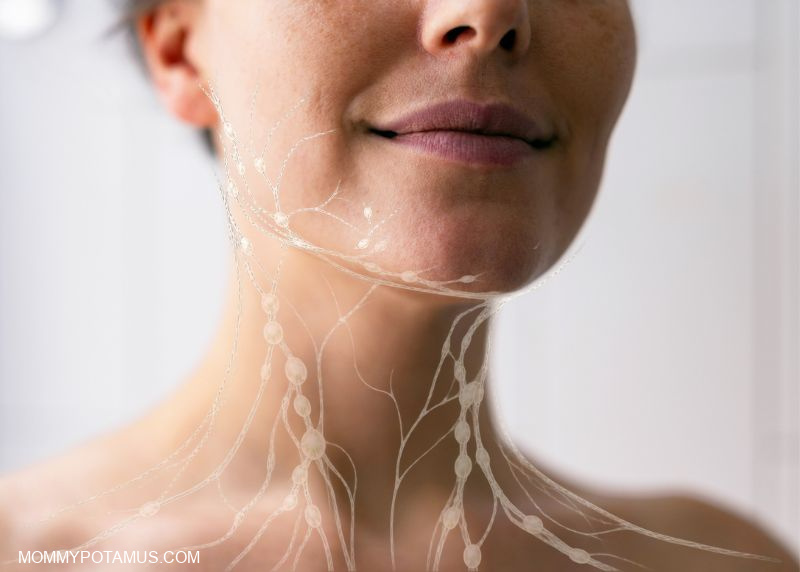
Hormones, Fluid Balance & Your Lymphatic System
Sometimes perimenopausal changes are obvious. Others are harder to put your finger on. You wake up looking puffier than usual. Clothes that fit comfortably one day feel snug the next. Sliding an Oura ring (or any ring) on and off your finger starts requiring a little more negotiation. Maybe you’ve even noticed that cellulite dimples look more noticeable.
Nothing dramatic happened – your body just seems to be handling fluid differently.
If this sounds familiar, there’s an overlooked part of perimenopause physiology worth talking about: how hormonal changes can influence your lymphatic system.
Estrogen and progesterone both influence how your body manages fluid, and it turns out that estrogen also directly interacts with the lymphatic system in some pretty interesting ways. (1) (2) Researchers are still working out exactly how all of those pieces come together during perimenopause, but we know enough to see that the systems are far more interconnected than previously understood.
Understanding that relationship can make some of these seemingly random changes feel a lot less random – and give us a clearer idea of how to support the body through them.
So let’s take a closer look at what your lymphatic system does, what we know about its relationship with perimenopause, and holistic ways to support healthy lymph flow through hormonal shifts.
As always, this is not medical advice and is not intended to diagnose or treat any condition. None of these statements have been evaluated by the FDA. Now let’s dive in.
Meet Your Other Circulatory System
When we think about circulation, blood usually gets most (if not all) the attention. But running alongside the cardiovascular system is another sprawling network with an equally important job: managing the fluid around your cells.
Your lymphatic system reaches throughout the body through a network of vessels, lymph nodes, tissues, and organs that include the thymus, spleen, and tonsils.
Here’s where the two circulatory systems meet. As blood travels through tiny capillaries, some fluid moves into the surrounding tissues, carrying oxygen, nutrients, hormones, and other substances to your cells. Much of that fluid eventually returns directly to the bloodstream – but not all of it.
The lymphatic system picks up what’s left behind, including excess fluid, proteins, and other material that need to be carried away from the tissues. (3)
Once that fluid enters a lymphatic vessel, it becomes lymph. From there, it travels through an extensive network of vessels and lymph nodes before eventually being returned to the bloodstream.
Even your brain has its own version of a rinse cycle that works closely with the lymphatic system. Called the glymphatic system, it uses cerebrospinal fluid to help carry metabolic waste and other byproducts away from the brain, especially during sleep.
So in a sense, the cardiovascular and lymphatic systems are partners: one delivers, while the other collects, recirculates, and helps keep the fluid environment around your cells in balance.
But fluid balance is only part of the lymphatic system’s job.
More Than a Drainage System
The lymphatic system is also an important part of your immune defenses. Lymph nodes act as gathering places where immune cells can encounter pathogens and other potential threats, helping the body decide when and how to respond.
As lymph moves through the body, it also carries proteins, cellular debris, and inflammatory signaling molecules away from tissues. (4) And in the digestive tract, specialized lymphatic vessels called lacteals absorb much of the dietary fat and fat-soluble nutrients we eat.
Also, although our two circulatory systems work together, they have some pretty unique differences. For example, your cardiovascular system has one central pump – the heart – but your lymphatic system doesn’t.
That doesn’t mean it just sits around waiting for us to move. Walking, muscle contractions, breathing, and changes in pressure throughout the body do all help move lymph along, but larger collecting lymphatic vessels contain smooth muscle of their own and rhythmically contract to help propel lymph forward.
So the lymphatic system is doing a lot more than draining excess fluid. It’s helping regulate the environment around your cells, supporting immune activity, transporting nutrients, and keeping lymph moving through the body.
And that brings us back to perimenopause. Because the lymphatic system is so involved in fluid regulation, changes in the hormones that influence both fluid balance and lymphatic biology may help explain why things can start to feel different during midlife.
What Do Hormones Have to Do With Lymph?
So what does all of this have to do with perimenopause – and why might our bodies suddenly seem to handle fluid differently?
There probably isn’t just one simple answer. Instead, research is uncovering several ways that reproductive hormones, fluid regulation, and lymphatic function connect.
- Estrogen and progesterone influence fluid regulation. Both hormones affect the systems that regulate water and sodium, although they don’t necessarily do so in the same way. Estradiol can change when the body signals thirst and releases vasopressin, while also influencing blood volume and how fluid is distributed between tissues. Progesterone modifies some of those responses as well. (1)
- Estrogen directly influences lymphatic biology. Experimental research shows that estrogen signaling – especially through ERα receptors – affects lymphatic endothelial cells (the cells that line lymphatic vessels), encourages new lymphatic vessel growth, helps maintain vessel stability, and supports repair after lymphatic injury. (5)
- Progesterone interacts with lymphatic cells, too. Human lymphatic endothelial cells can metabolize progesterone and contain receptors that allow them to respond to steroid hormones. We don’t yet know exactly how that plays out during perimenopause, but it’s another indication that the hormonal and lymphatic systems are interacting at a cellular level. (6)
- Lymphatic function appears to change with age and sex. In a study of 399 healthy adults, leg lymphatic pumping pressure declined with age, with a bigger drop seen in women of postmenopausal age. The study didn’t isolate the role of hormones, but the finding suggests that the menopause/aging transition may influence lymphatic function in women. (7)
There’s one more connection worth mentioning here: inflammation. Changing estrogen levels are associated with shifts toward more pro-inflammatory signaling during the menopausal transition. At the same time, the lymphatic system helps carry inflammatory signaling molecules, immune cells, and excess fluid away from tissues – an important part of resolving a local inflammatory response.
In other words, healthy lymphatic function becomes especially important during midlife – a time when the body may already be navigating a higher inflammatory load.
What This Means During Perimenopause
Taken together, the research suggests that perimenopausal fluid shifts are part of a bigger physiological picture. Our sex hormones influence systems far beyond reproduction, and fluid balance sits at an interesting intersection between fluctuating hormones and lymphatic function.
So while we can’t control every hormonal up and down in midlife, we can support the everyday processes that help the lymphatic system do its job.
Movement, muscle contractions, breathing, and other mechanical forces all help lymph move through the body, and there are other supportive approaches we can layer in as well.
From here, I’ll be sharing several ways to support healthy lymph flow, including herbs traditionally used for lymphatic support, a nourishing lymph-support tea, and simple everyday habits that help keep things moving.
✋ Before You Go, Grab This Free Midlife Guide
If you’ve ever found yourself thinking, “Why doesn’t my body respond the way it used to?” . . . this guide was written for you.
Midlife can change the rules for everything from sleep and energy to workouts, recovery, body composition, and more. Knowing what’s changing can help you let go of strategies that no longer fit – and start focusing on what supports your body now.
Inside, I’ll walk you through 10 things I wish I’d known sooner, so you can make more sense of what you’re experiencing and get clearer about where to go from here.
Enter your email below and I’ll send it right over. You’ll also receive my weekly newsletter with practical wellness tips, recipes, and new guides like this one.
Sources
- Stachenfeld, N. S. (2008). Sex Hormone Effects on Body Fluid Regulation. Exercise and Sport Sciences Reviews.
- Giersch, G. E. W., Charkoudian, N., Morrissey, M. C., Butler, C. R., Colburn, A. T., Caldwell, A. R., Kavouras, S. A., & Casa, D. J. (2021). Estrogen to Progesterone Ratio and Fluid Regulatory Responses to Varying Degrees and Methods of Dehydration. Frontiers in Sports and Active Living.
- Moore, J. E., Jr., & Bertram, C. D. (2018). Lymphatic System Flows. Annual Review of Fluid Mechanics.
- Schwager, S., & Detmar, M. (2019). Inflammation and Lymphatic Function. Frontiers in Immunology.
- Morfoisse, F., Tatin, F., Chaput, B., et al. (2018). Lymphatic Vasculature Requires Estrogen Receptor-α Signaling to Protect From Lymphedema. Arteriosclerosis, Thrombosis, and Vascular Biology.
- Klossner, R., Groessl, M., Schumacher, N., et al. (2021). Steroid Hormone Bioavailability Is Controlled by the Lymphatic System. Scientific Reports.
- Unno, N., Nishiyama, M., Suzuki, M., et al. (2012). A Novel Method of Measuring Human Lymphatic Pumping Using Indocyanine Green Fluorescence Lymphography. Journal of Vascular Surgery.