amber light bulbs

The Exact Lighting I Use at Home to Sleep Better (Amber Light Bulb Guide)

I spent years doing everything right for sleep. Taking magnesium, no screens, cool bedroom, and still waking at 3 am wondering what I was missing. It wasn’t until I started obsessing over my outdoor light exposure and the wavelengths coming out of my home lighting that things actually shifted. In fact, this is one of the most impactful changes I’ve ever made.

If you’re just looking for the products I mentioned in a video or podcast:

Why I Choose Amber Light Bulbs 

Light is the most powerful signal your body receives all day. Not just as light to see, but the information our cells are reading from the light. The spectrum of light entering your eyes tells your hypothalamus what time it is. This determines whether melatonin rises on schedule or gets suppressed for another 90 minutes while you lie in bed wondering why you can’t fall asleep.

The problem: standard LED lighting, including “warm white” bulbs, emits the same wavelengths of blue light as noon sunlight. Your overhead lights, your lamp, and your bathroom vanity are telling your cells it’s midday at 9 pm. Every night.

After years of testing (and a house that now glows like a very cozy campfire after 6 pm), here’s exactly what I use, why it works, and where to get it. And pro tip: I use timers in my house so the right lighting goes on in lamps at sunset and off around bedtime without any extra work. Those are all linked below.

In This Post

Why “Warm White” LEDs Still Aren’t Enough

This was the thing that surprised me most when I first started researching this properly. A 2700K “warm white” LED looks yellowish and feels softer than a daylight bulb. However, it still emits a measurable spike in the blue wavelength range (440–480nm) that suppresses melatonin. The warmth you see is partially filtered. The circadian-disrupting portion of the spectrum is still very much present.

What your body actually needs in the evening is light with no emissions below 530nm, in the amber/red spectrum with no blue and no green wavelengths. This is what’s called a true amber or low-blue spectrum, and it’s genuinely different from a warm white LED.

Your eyes contain specialized cells called melanopsin receptors. These cells have nothing to do with vision; they exist only to signal your master clock about what time it is. They’re exquisitely sensitive to short-wavelength blue light around 480nm. When they detect it, they signal the suprachiasmatic nucleus to suppress melatonin output.

Even dim light can interfere with a person’s circadian rhythm and melatonin secretion. A mere eight lux — about the level of most bedside lamps — has an effect. (Harvard Medical School)

A true amber bulb engineered to have zero emissions below 530nm can’t trigger those receptors. Your brain reads it as firelight. This triggers safe, post-sunset, begin repair mode.

The Exact Amber Bulbs and Lamps I Use

Evening Amber Light Bulbs (the Most Important Swap)

The body is used to and primed for bright overhead light during the day, so overhead lighting wasn’t my first priority in auditing my home light environment. I researched to find circadian-friendly bulbs for evening and put these in lamps so they’re always at eye level or below.

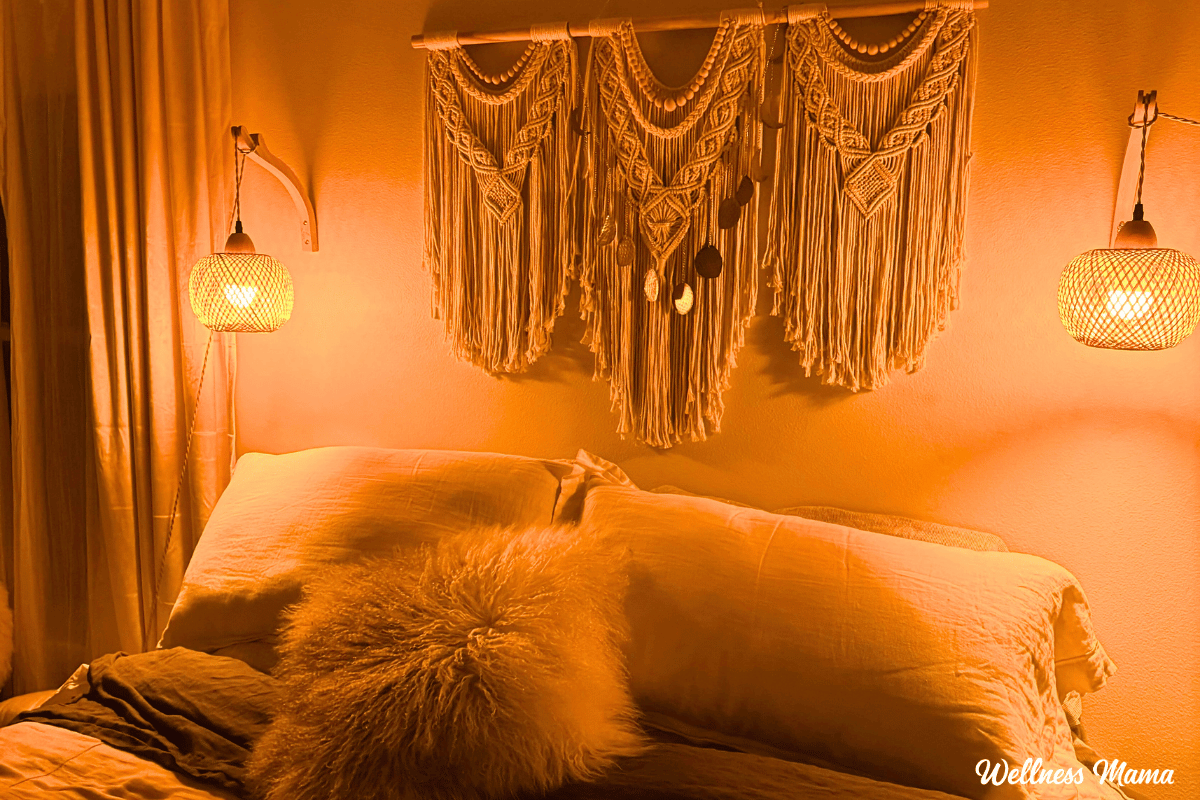
These go in every lamp in my main living spaces and any rooms we’re in after about 6 pm. Namely, the kitchen, living room, and dining room. This is where most circadian disruption happens, and it’s where the change makes the fastest difference. I also have these in our bedrooms.

You can get the lightbulbs I use from Healthy Home Lighting here (and use code wellnessmama to save 10%). 

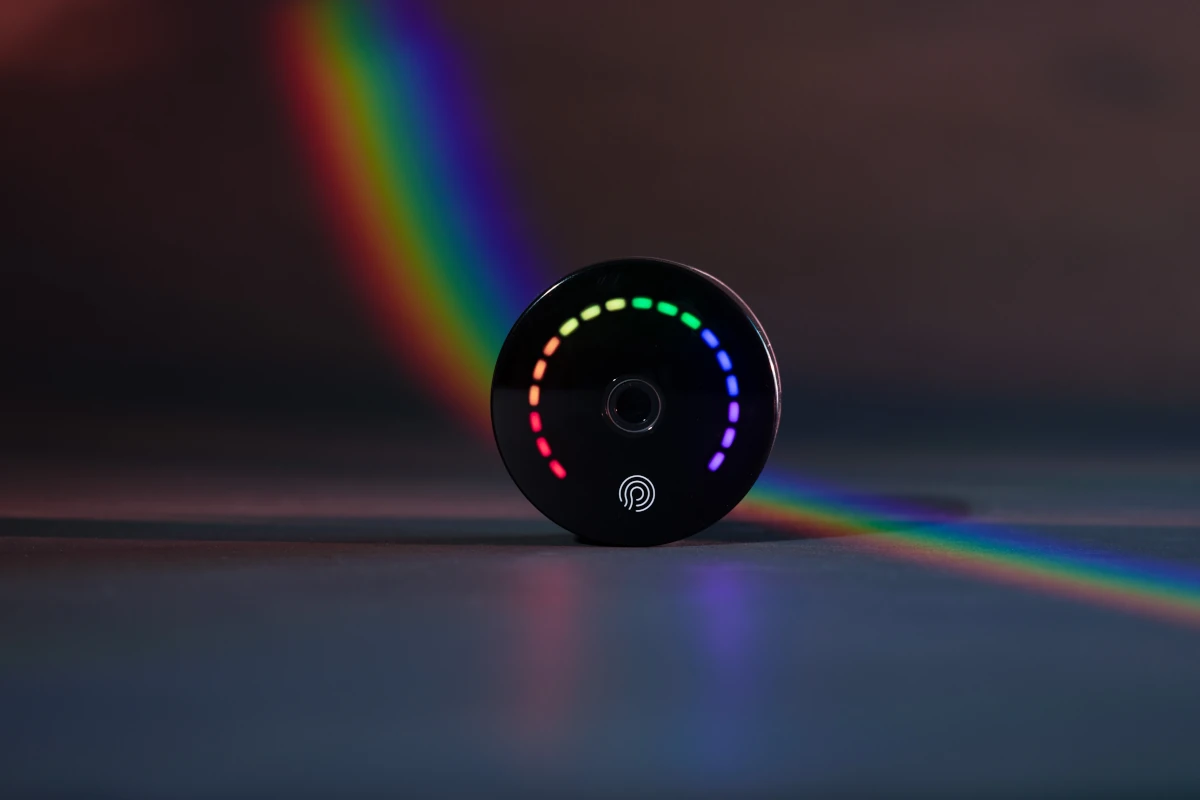
The bulbs I chose from Healthy Home are no-flicker, no-EMF, and have the right light wavelengths. They come with three modes: daylight, sunset, and campfire. I have our evening bulbs set to campfire mode automatically and they all come on at sunset. So we simply turn off any overhead light and switch to “night mode” in our home.

  • Zero blue light emissions — not just reduced, eliminated
  • Flicker-free and low EMF
  • Bright enough for everyday tasks, not just reading
  • Standard E26 base, which fits most lamps and fixtures

I also use digital timers, so these come on automatically. All the timers and lamps I use are linked here.

Red Bulbs For the Bedroom and Bathroom

In the bedroom and bathroom, I go further. I opt for true red light, which contains no blue or green wavelengths at all. Red light above 600nm has essentially zero effect on the circadian system. It’s what photographers use in darkrooms. I use these in bedside lamps and the bathroom vanity for the hour before sleep.

Find the flicker-free red light bulbs I use here. 

Note that these are different than red light therapy panels. While the light is still beneficial, those are their own category, and I actually don’t recommend using them at night or right before sleep.

The Three-Setting Bulb (Easiest Option to Start With)

If you want one bulb that does it all without swapping, a circadian lightbulb that cycles through daylight, amber, and deep red with your existing light switch is the simplest entry point. No app, no smart home setup, no Wifi or Bluetooth, you just flip the switch.

I don’t think the full red light bulbs are necessary unless you really want to go low light in the evening. The three settings of the Healthy Home Bulbs will work in most cases.

The Lamps Themselves

Bulbs are only half of the equation. Overhead lighting is actually the worst offender because it enters your eyes from above, the same angle as a high-noon sun. In our house, we turn off all overhead lights by around 6 or 7 pm and switch to floor and table lamps, positioning them below eye level. The angle matters as much as the spectrum.

My Daily Lighting Schedule

The goal is to treat light as a biological input throughout the day, not just something that helps you see. Here’s how our household actually runs this.

  • Morning (wake – 9 am): Outside within 30 minutes of waking, no sunglasses, glasses, contacts, or windows. If I can’t get outside, I open all the curtains and stand near an open window. Full-spectrum or bright indoor lights are fine for this part of the day.
  • Daytime (9 am – ~5 pm): Natural light is always preferred. Standard indoor lighting for workspaces is fine. Screens are no issue during daylight hours.
  • Early evening (~6 pm): Overhead lights off. Amber lamps on. If I’m using screens, I have a blue-light filter enabled.
  • Late evening (8 pm – bed): Red or deep amber only in the bedroom and bathroom. No overhead lighting. This is the window where melatonin should be rising and I protect it carefully.
  • Overnight: Complete darkness. Blackout curtains. A dim red nightlight only if needed for kids navigating to the bathroom.

You don’t have to do all of this at once. The single highest-leverage starting point is swapping the bedroom and living room lamps to amber light bulbs before your usual bedtime. That’s where I started. Most people notice a difference within a few nights.

What to Look for When Buying (So You Don’t Waste Money)

I’ve tested enough amber bulbs to know that not all of them do what they claim. Here’s what actually matters:

  • Zero emissions below 530nm. This is the actual threshold for melatonin-safe light. Look for this in the spectral data, not just in marketing copy. If a brand doesn’t publish its spectral chart, that’s a red flag.
  • Flicker-free certification. Cheap bulbs flicker at frequencies your eye can’t consciously detect, but that may contribute to headaches, eye strain, and nervous system load. Confirm the bulb is tested and confirmed flicker-free.
  • Low EMF. Smart color-changing bulbs that use WiFi or Bluetooth to shift their spectrum emit significantly higher EMF than standard bulbs. I avoid them in bedrooms specifically.
  • Color temperature alone isn’t enough. A 2700K rating means the light looks warm; it doesn’t mean it’s low-blue. Demand actual spectral data, not just a Kelvin number.
  • Avoid the “colored shell” trick. A standard LED inside an amber or red plastic bulb will filter some blue light, but it won’t eliminate it. You want a bulb engineered at the spectral level, not just painted.

The Science: Why Light Is a Cellular Input, Not Just a Convenience

I’ve written about blue light and circadian rhythm in detail before, but here’s the condensed version for anyone coming to this fresh:

Your circadian clock, housed in the suprachiasmatic nucleus of the hypothalamus, runs on a roughly 24-hour cycle, but it needs daily calibration from light to stay synchronized with the actual day. Morning light, especially the blue-wavelength spike at sunrise, resets the clock and triggers the cortisol pulse that wakes you up properly.

Everything downstream, including hormone production, immune function, overnight cellular repair, and metabolism, is organized around that signal.

In the evening, the same clock is meant to detect the absence of blue light as a sunset cue. Melatonin rises. Cortisol drops. Growth hormone prepares to pulse. Your brain’s glymphatic system begins clearing waste. Your body runs a very specific repair sequence overnight, and it depends entirely on melatonin starting on time.

When your home lighting keeps emitting blue wavelengths after sunset, melatonin is delayed, sometimes by 90 minutes or more. You’re not just staying up late. You’re postponing the entire repair cascade that should have started hours ago.

Switching your lights doesn’t solve everything. But it removes one of the most consistent nightly disruptors of the system that heals you while you sleep. For me personally, it was one of the highest-leverage changes I made, and one of the least expensive.

Frequently Asked Questions

Should I change every bulb in the house?

You don’t have to. I started with the rooms we’re in during the two to three hours before bed, like the living room, bedroom, and bathroom. The garage, laundry room, and spaces we use briefly don’t need to change. I wanted to get those three spaces right first.

Is amber light bright enough to actually see by?

Yes! Good-quality amber bulbs provide enough light for cooking, reading, and normal evening activities. Colors render slightly differently (reds and yellows look rich, blues and greens go flat), but it’s perfectly functional. If you need more brightness for detailed work, a dedicated desk lamp with a red-spectrum bulb placed close to your task works well too. I like this option better than increasing overhead lighting.

What about blue-light blocking glasses… can I just use those instead?

Glasses help, but they’re a partial solution since they only protect the eyes. Your skin also contains photoreceptors that communicate with the circadian system. Glasses alone don’t give the full benefit of changing the light source itself. I use both: amber glasses when I have to be on screens in the evening, and amber bulbs for the general environment.

Can I just use a dimmer with my existing bulbs?

Dimming reduces total light intensity, which helps, but it doesn’t change the wavelength composition. A dimmed standard LED still emits the same proportion of blue light, just less of it. It’s better than full brightness, but not the same as a true amber spectrum.

What about smart bulbs that change color temperature?

Color-tunable smart bulbs can help, but most still emit residual blue wavelengths even at their warmest setting. And they use WiFi or Bluetooth, which I prefer to minimize in bedrooms. The dedicated amber and red bulbs I use are simpler, have lower EMF, and, in my testing, work better.

Is this safe for kids?

Yes! Honestly, I think it’s especially important for kids, whose circadian systems are still developing and who are often more sensitive to the stimulating effects of blue light before bed. My kids have had amber bedroom lamps for years. The warm light genuinely seems to help them wind down, which tracks with what the science says.

How quickly will I notice a difference?

Most people notice changes in how easily they fall asleep within a few nights of consistent amber lighting in the two hours before bed. If you’re already doing the other sleep fundamentals (no food close to bedtime, a cool room, total darkness), this is often the missing piece that makes them all click into place.

Shop the Full List

Have you switched to amber lighting? What difference did you notice, and what products do you love? Leave a comment and let me know. I read every single one.

Tags: , , , , , , ,
The Psychology of Wellness Objects: Why a Bottle Can Change Your Routine

The Psychology of Wellness Objects: Why a Bottle Can Change Your Routine

Wellness routines rarely fail because people do not know what to do. They fail because the behavior does not fit the day. You can understand hydration, sleep hygiene, or step counts perfectly and still forget, postpone, or abandon the habit the moment your schedule gets busy. That gap between intention and action is where “wellness objects” come in.

A bottle on your desk, a pair of shoes by the door, or a journal on your pillow are not just tools. They are cues that shape decisions without requiring motivation on demand. That is why some people choose an energy water bottle as a physical anchor for hydration: not because a bottle magically creates discipline, but because objects can change what you notice, what you remember, and what feels easy to do next.

This article breaks down the psychology behind wellness objects and shows how to use a bottle as a practical behavior cue, without turning hydration into a complicated project.

Why objects can change behavior faster than goals

Goals live in your head. Objects live in your environment. And your environment has a quiet, constant influence on what you do.

Objects reduce the need for willpower

Willpower is finite, especially late in the day. When an object makes the healthy choice the easiest choice, you rely less on motivation. If the bottle is already filled and within reach, drinking water becomes a default action rather than a decision you have to “win” repeatedly.

Objects make habits visible

Many habits fail because they are invisible. You do not forget water because you do not care. You forget because nothing in your environment keeps it top-of-mind. A bottle in your line of sight is a reminder you do not have to think about.

Objects create friction in the right direction

Behavior change is often about adding friction to unwanted behaviors and removing friction from wanted ones. If your phone is within reach but your bottle is across the room, scrolling wins. If the bottle is closer, hydration wins more often.

The cue, routine, reward loop in real life

A habit is not just repetition. It’s usually a loop:

●      Cue: something triggers a behavior

●      Routine: the behavior itself

●      Reward: a payoff that reinforces repeating it

A bottle can function as a cue in multiple ways:

●      Visual cue: you see it and remember to sip

●      Tactile cue: you touch it and the action follows

●      Context cue: it “belongs” to your desk, gym bag, or car, so the behavior follows the setting

The reward does not have to be dramatic. It can be a small sense of completion, a clearer mouth feel, fewer headaches, or the satisfying checkmark of finishing a daily target.

Why a bottle becomes a “meaning object”

People often dismiss this as aesthetics, but meaning is one of the strongest forms of motivation.

Identity reinforcement

Objects can reinforce identity-based habits. When you think “I’m someone who takes care of my energy,” a bottle becomes a symbol of that identity. The behavior becomes self-consistent rather than forced.

Ritual and predictability

Rituals calm the nervous system because they reduce uncertainty. A simple ritual like filling the bottle after breakfast creates a predictable pattern that removes decision fatigue.

The power of personal attachment

If you like how an object looks and feels, you touch it more. You keep it nearby. You bring it with you. That increases exposure to the cue, which increases the habit.

This is not vanity. It is design psychology.

The hidden reason hydration is a perfect “object-based habit”

Hydration is a frequent, low-effort behavior. That makes it ideal for cue-based habit design.

●      It needs multiple repetitions per day

●      It can be triggered by simple cues

●      It has immediate feedback (dry mouth, energy dips, headaches, concentration)

●      It fits in nearly any routine without special equipment

In other words, if you can make hydration automatic, you practice the same habit mechanics that later make other routines easier (sleep routines, movement, meal planning).

How to set up your bottle so it actually changes your routine

The bottle itself is not the habit. The setup is the habit.

Choose a single “home base” location

Pick the one place where the bottle should live when you are home:

●      Desk

●      Kitchen counter near the coffee machine

●      Nightstand (if you wake thirsty)

●      By the front door next to keys

This reduces the “Where is it?” problem, which is a hidden source of habit failure.

Pair the bottle with existing routines

Habit stacking works because you piggyback on a behavior that already happens.

Simple pairings:

●      Fill the bottle right after brushing teeth in the morning

●      Take 5 sips before starting your first work block

●      Refill after lunch, every day

●      Drink before you leave the house

The pairing matters more than the timing details.

Make the bottle effortless to refill

A habit dies when it is annoying. If your refill process involves searching for a filter, washing a lid, or remembering where you left it, you will skip it on busy days.

Practical fixes:

●      Keep the bottle clean and ready

●      Create a refill station (sink, filtered pitcher, water dispenser)

●      Use a reminder cue like “refill after lunch”

Use “minimum viable hydration”

Instead of chasing a perfect ounce goal, define a minimum daily baseline that you can hit even on chaotic days.

Examples:

●      Finish one full bottle by lunch

●      Finish a second by late afternoon

●      Stop there if it becomes stressful

Consistency beats perfection.

Common mistakes that make wellness objects backfire

Treating the object like the solution

Buying a bottle does not change behavior. Placing it intentionally does. If the bottle lives in a cabinet, it’s not a cue. It’s storage.

Overcomplicating the system

Some people turn hydration into a spreadsheet with alarms every 20 minutes. That works briefly, then collapses. The goal is a routine that survives stress, not a routine that requires constant management.

Ignoring context changes

Your hydration routine might work at home and fail at work. That’s normal. The fix is to create separate contexts:

●      One bottle for the office

●      One bottle for the gym bag

●      One bottle for the car

Different environments need different cues.

How to tell if the bottle is working

Track outcomes that matter for 10 to 14 days:

●      How often you refill

●      Whether you finish your bottle by certain points in the day

●      Afternoon energy stability

●      Headaches or dry mouth frequency

●      Whether you crave stimulants more or less

You do not need perfect tracking. You need a signal: is this object improving consistency?

A grounded way to think about “energy” and hydration

Hydration is not a magic energy switch, but it influences common “low energy” experiences:

●      mental fatigue and concentration dips

●      headaches that reduce productivity

●      perceived effort during workouts

●      dry mouth and irritability that feel like stress

If you fix hydration and nothing changes, that’s also useful information. It tells you your energy issues may be driven more by sleep, stress, nutrition, iron status, or overall workload.

The bigger concept: nudges, not hacks

This approach sits inside a broader behavioral idea often described as nudging: small environmental changes that make desired behaviors easier and more likely.

Takeaway

A bottle can change your routine because objects shape behavior. They work as cues, reduce reliance on willpower, and make healthy actions easier to repeat. If you want a hydration habit that sticks, focus less on motivation and more on placement, pairing, and friction reduction. When the bottle is always visible, always ready, and attached to your day’s existing rhythms, hydration becomes automatic, and that automaticity is the real “wellness upgrade.”

Tags: , , , , ,
Herzindagi

Top 5 Glycolic Acid Serums To Include In Your Skincare Routine

Top Glycolic Acid Serums: Having brighter, even, beautiful skin is on everyone’s wishlist. Introducing a glycolic acid serum in your skincare routine will start giving you results for the skin you have always dreamed of having. This serum gently exfoliates your skin, getting rid of that dull layer and getting glowing skin with daily use. Let’s dive in to check out the best glycolic acid serums you need to try here!

5 Best Glycolic Acid Serums To Add In Your Skincare Routine

Are you looking for a new serum which will exfoliate your skin and make it more even and brighter? Check out our list for the best glycolic acid serums that you need to include in your skincare routine this year here!

L’Oreal Paris Glycolic Bright Skin Brightening Serum

Looking for a serum which will fade away your dark spots and get rid of your skin’s dullness? Try the L’Oreal Paris Glycolic Bright Skin Brightening serum. It has a super lightweight formula which absorbs quickly, making it a great pick for people who want to make their skin look more even and radiant without any uncomfortable stickiness.

Dr. Sheth’s Gulab & Glycolic Acid Serum

Dr. Seth’s brings us a serum with the goodness of roses and glycolic acid. It’s designed to exfoliate and clear out your pores while making sure your skin doesn’t get irritated. The formula has 6% glycolic acid with calming rose extracts.

ALSO READ- What Are Copper Peptides? The Skincare Ingredient Taking The Beauty Industry By Storm

La Roche-Posay Glycolic B5 10% Pure Glycolic Acid Serum

This targeted dark spot corrector features 10% pure Glycolic Acid (AHA) to exfoliate and brighten your skin. Formulated with Tranexamic Acid and Kojic Acid, it effectively reduces the appearance of discolorations and age spots from your face. The Vitamin B5 in this serum ensures that your skin stays soothed and hydrated, making it suitable for sensitive skin as well. 

Minimalist 10% AHA BHA Exfoliating Serum

This serum is a multi-level exfoliator which has a blend of Glycolic and Lactic Acids (AHAs) with Salicylic Acid (BHA). With these three power ingredients, the serum will go to the surface-level to refine your skin and deep-cleanse your pores. This serum also targets uneven texture and dullness without causing any dryness, all thanks to the added Hyaluronic Acid for hydration.

ALSO READ- 5 Step Skincare Routine For Dry Skin To Remain Hydrated This Winter

Lakme Illuminate Serum With 1% Glycolic Acid 

If this is your first time trying glycloic acid, you should try the Lakme Illuminate serum. This beginner-fruendly serum is formulated with a gentle 1% glycolic acid. It’s designed for daily use to give you a subtle, polished look. If you have sensitive skin or just want a tiny bit of exfoliation to help your makeup sit better, this Lakme glycolic acid serum will work best with your skin. 

Choose your favourite glycolic acid from our list and start using it in your skincare routine! Make sure to get the serum which will suit your skin and help fade any of your skin concerns. 

Image Credit: Freepik, Amazon, Nykaa

For more such stories, stay tuned to HerZindagi.

Tags: , , , , , ,
Best oLive
Privacy Overview

This website uses cookies so that we can provide you with the best user experience possible. Cookie information is stored in your browser and performs functions such as recognising you when you return to our website and helping our team to understand which sections of the website you find most interesting and useful.