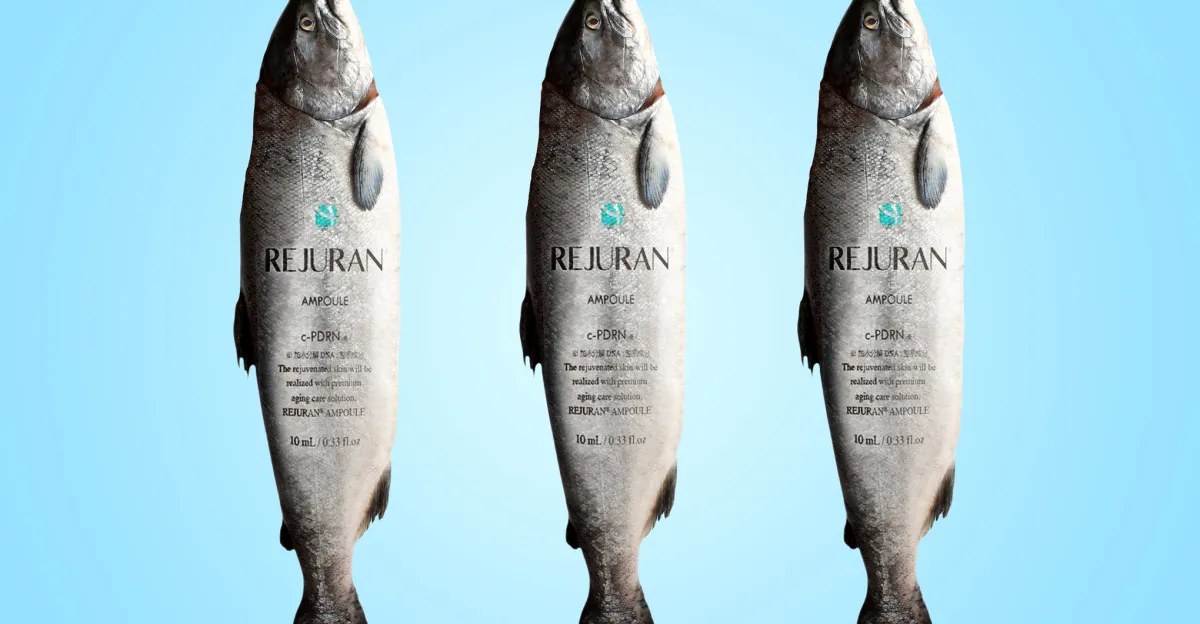
The wellness wild west’s latest skincare fad is salmon sperm 

The latest skincare fad is rubbing salmon sperm on your face

This is Optimizer, a weekly newsletter sent every Friday from Verge senior reviewer Victoria Song that dissects and discusses the latest gizmos and potions that swear they’re going to change your life. Opt in for Optimizer here.

While scrolling through my TikTok feed, I often find myself thinking of Elizabeth Báthory. Legend has it that Báthory, a powerful 16th-century Hungarian countess, would kill virgins and bathe in their blood to retain her youth. Historians have debated whether Báthory really was a serial killer, though most agree she probably didn’t actually bathe in blood. Still, she’s what I think of anytime I see how far vanity will take us: vampire facials, snail mucin, bird poop treatments, and now Rejuran — a Korean skincare serum with the hottest new ingredient, PDRN. In case you were unaware, PDRN comes from salmon sperm.

Usually, these ads show skinfluencers with bouncy, hydrated skin extracting a clear liquid from a silver bottle. This serum, they say, is a game changer. Rubbing it into your face will promote skin rejuvenation, elasticity, and collagen production. The result is enhanced healing, improved skin texture, and reduced wrinkles, and it’s all thanks to patented science. Rejuran’s PDRN molecule is 670 times smaller than your pores, meaning enhanced absorption.

You can be the most skeptical person on the planet, but it’s hard to argue with the human desire to be young and beautiful.

“PDRN stands for polydeoxyribonucleotide, which essentially is just a DNA fragment,” says Victoria Fu, a cosmetic chemist and one of the founders behind the Chemist Confessions skincare brand. “Super old-school PDRN treatments actually come from human placenta, but now salmon sperm PDRN has become the industry standard.”

According to Fu, beauty trends like injectables often stem from the medical field. Before it became a hot skincare ingredient, PDRN was studied as an injected therapeutic treatment for conditions like diabetic foot ulcers, and there are some promising studies for injectable PDRN that suggest it could be helpful for wound healing — though PDRN injectables haven’t been FDA-approved in the US. Generally speaking, injectables are considered more effective for rapid, dramatic, and structural changes, as they’re able to deliver ingredients deeper into the skin. Injectable hyaluronic acid, for instance, is more effective at restoring volume than topical hyaluronic acid.

Online, PDRN started gaining notoriety a few years ago as skinfluencers shuttled themselves to South Korea for salmon DNA facials. In the typical video, these beauty influencers would giggle. Come with me to get a salmon sperm facial! Usually, a doctor is shown injecting PDRN into the skin every few millimeters until the influencer’s face is riddled with tiny, swollen mounds. It hurts so much! Recovery takes so long! But just LOOK at this glow!!!

The painful treatment blew up once celebrities like Kim Kardashian and Jennifer Aniston admitted to incorporating salmon sperm facials into their routines. And then, about a year ago, Rejuran — the company behind the injections — announced a topical version. No scary needles, no need to fly to Korea, and a bottle costs about $52, whereas the facial could run anywhere from $500 to $700. Now, you can find PDRN in all kinds of skincare products ranging from eye creams to sunscreen.

Despite authoring this newsletter, I’m not immune to wellness fads. I covet glass skin like any other vain 30-something afraid of the harsh ravages of time. I’ve bought the stupid TikTok skincare wand that influencers said was “clinically proven” and that Hailey Bieber uses. I reviewed its clinical studies on electroporation — microcurrents that supposedly tear tiny holes in your skin to help products absorb better — and knew it was dubious (if relatively harmless).

Which is to say, I knew it was a red flag when I heard an influencer in a Rejuran ad say the product was “clinically proven,” but I bought a bottle anyway. I’ve used two bottles of Rejuran’s topical ampoule and other skincare products marketing hot new ingredients like volufiline, because that’s the power of science-adjacent wellness marketing. (Volufiline is a new plant-based compound that’s marketed as “topical filler” because it stimulates fat cell production.)

Still, if you truly could replicate injectable results in an easily accessible serum — that’s a compelling claim. So I asked Fu if any of the claims about topical PDRN being as effective as injected skincare treatments held water.

“There’s some early research supporting PDRN in medical and aesthetic procedures, but evidence for topical PDRN is still very limited,” says Fu. “A serum cannot be a non-invasive substitute for an injectable procedure.”

The reason is straightforward. Even if there’s evidence that PDRN itself could be an effective ingredient, the mode of delivery matters.

“Injectable treatments deliver material directly into skin tissue at concentrations and depths topical products simply won’t be able to achieve,” says Fu.

But silly things like facts aren’t enough to stop skincare brands from jumping on experimental fads so long as they’re not technically harmful.

Just the other day, I was served a video from megaviral beauty influencer Mikayla Nogueira announcing to her 17 million followers that she’s launching a salmon-derived PDRN face ampoule and eye serum for her own cosmetics line.

“A science-backed duo powered by PDRN that is going to lift, firm, plump your skin plus so much more. Not to mention these products are made in Korea, dermatologist tested, clinically tested, and proven to do exactly what they say they’re going to do,” Nogueira says in the ad. She goes on to say that she worked with Korean cosmetics chemists, and uses phrases like “low molecular weight” and “efficacious” levels.

I have no doubt Nogueira believes in PDRN products. But as I wrote in a recent Optimizer, “clinically tested” and “science-backed” are marketing phrases that don’t always mean what you think.

Meanwhile, other brands are advertising less icky versions of PDRN derived from plants. There are ginseng-derived PDRN products on the market, like the VT Cosmetics PDRN Essence 100, and the Medicube PDRN Pink Peptide Serum derived from roses. Supposedly, these brands would have you believe plant-based PDRN is just as effective and a vegan alternative.

“PDRN source, purity, molecular size, and stabilization all matter,” says Fu. “‘Plant-based PDRN’ is a bit of a marketing gray area. It may be DNA fragments, but it’s not automatically equivalent to the clinical material studied in medical literature. Two products can list PDRN and behave very differently. The good news is we are seeing more studies come out on these plant PDRNs, so hopefully we can better gauge these different sources soon.”

Fu says all things considered, PDRN is a “relatively vanilla” skincare active that’s unlikely to irritate your skin and is fine for curious skincare hobbyists to experiment with. But that also means it’s not a foundational part of any skincare routine. Things like sunscreen, moisturizers, and well-studied actives like retinoids are more likely to do the heavy lifting in any regimen. Like most things in the wellness space, the main harm that PDRN poses is to your wallet. Fu says that consistency and patience are the key to getting real, long-term results. (Unfortunately, these are also the two things most consumers would like to bypass.)

“Social media has made it possible for consumers to hear from industry insiders like ourselves,” Fu says, referring to herself and her partner, Gloria Lu. In addition to running their own cosmetics brand, the two chemists also write a skincare science education blog and host a podcast. “But the flip side is that consumers will also hear a LOT of noise and contradicting information from all sorts of directions.”

Fu says the smart thing to do is look at any testing a brand is willing to share and look for quantifiable grading metrics over consumer perception. As in, “34 percent improvement in elasticity” is a more meaningful claim than “90 percent of users agree they saw an improvement in skin hydration in two weeks.” Before and after pictures, she says, can also be misleading due to inconsistent lighting or face angles. If a claim sounds too good to be true, it likely is.

“We try to remind everyone to refrain from a ‘knee-jerk’ reaction and not to let the trends distract you from sticking to the fundamentals of your routine,” says Fu.

Having spent the past three months slathering a salmon sperm serum on my face, I honestly couldn’t tell you if it’s improved my skin. Maybe it’s a smidge glowier. I think it helped with one stubborn acne scar. I knew that I wouldn’t see dramatic results going in, just as I knew that the trendy volufiline serums that skinfluencers claim are “filler in a bottle” wouldn’t fix my undereyes. Is it egregious that I know better and still partook? Maybe. But to Fu’s point, I’m religious about the fundamentals — sunscreen, moisturizer, and as of recently, tretinoin, which I incorporated after consulting my dermatologist. The point is that I’ve done my homework and made an informed choice.

It just so happened that this time, I thought experimenting with salmon jizz serums was harmless fun.

Follow topics and authors from this story to see more like this in your personalized homepage feed and to receive email updates.

  • Close

    Victoria Song

    Senior Reviewer, Wearable Tech

    Posts from this author will be added to your daily email digest and your homepage feed.

    FollowFollow

    See All by Victoria Song

  • ColumnClose

    Column

    Posts from this topic will be added to your daily email digest and your homepage feed.

    FollowFollow

    See All Column

  • HealthClose

    Health

    Posts from this topic will be added to your daily email digest and your homepage feed.

    FollowFollow

    See All Health

  • OptimizerClose

    Optimizer

    Posts from this topic will be added to your daily email digest and your homepage feed.

    FollowFollow

    See All Optimizer

  • ScienceClose

    Science

    Posts from this topic will be added to your daily email digest and your homepage feed.

    FollowFollow

    See All Science

Tags: , , , , , ,
The wellness wild west’s latest skincare fad is salmon sperm 

The wellness wild west’s latest skincare fad is salmon sperm 

This is Optimizer, a weekly newsletter sent every Friday from Verge senior reviewer Victoria Song that dissects and discusses the latest gizmos and potions that swear they’re going to change your life. Opt in for Optimizer here.

While scrolling through my TikTok feed, I often find myself thinking of Elizabeth Báthory. Legend has it that Báthory, a powerful 16th-century Hungarian countess, would kill virgins and bathe in their blood to retain her youth. Historians have debated whether Báthory really was a serial killer, though most agree she probably didn’t actually bathe in blood. Still, she’s what I think of anytime I see how far vanity will take us: vampire facials, snail mucin, bird poop treatments, and now Rejuran — a Korean skincare serum with the hottest new ingredient, PDRN. In case you were unaware, PDRN comes from salmon sperm.

Usually, these ads show skinfluencers with bouncy, hydrated skin extracting a clear liquid from a silver bottle. This serum, they say, is a game changer. Rubbing it into your face will promote skin rejuvenation, elasticity, and collagen production. The result is enhanced healing, improved skin texture, and reduced wrinkles, and it’s all thanks to patented science. Rejuran’s PDRN molecule is 670 times smaller than your pores, meaning enhanced absorption.

You can be the most skeptical person on the planet, but it’s hard to argue with the human desire to be young and beautiful.

“PDRN stands for polydeoxyribonucleotide, which essentially is just a DNA fragment,” says Victoria Fu, a cosmetic chemist and one of the founders behind the Chemist Confessions skincare brand. “Super old-school PDRN treatments actually come from human placenta, but now salmon sperm PDRN has become the industry standard.”

According to Fu, beauty trends like injectables often stem from the medical field. Before it became a hot skincare ingredient, PDRN was studied as an injected therapeutic treatment for conditions like diabetic foot ulcers, and there are some promising studies for injectable PDRN that suggest it could be helpful for wound healing — though PDRN injectables haven’t been FDA-approved in the US. Generally speaking, injectables are considered more effective for rapid, dramatic, and structural changes, as they’re able to deliver ingredients deeper into the skin. Injectable hyaluronic acid, for instance, is more effective at restoring volume than topical hyaluronic acid.

Online, PDRN started gaining notoriety a few years ago as skinfluencers shuttled themselves to South Korea for salmon DNA facials. In the typical video, these beauty influencers would giggle. Come with me to get a salmon sperm facial! Usually, a doctor is shown injecting PDRN into the skin every few millimeters until the influencer’s face is riddled with tiny, swollen mounds. It hurts so much! Recovery takes so long! But just LOOK at this glow!!!

The painful treatment blew up once celebrities like Kim Kardashian and Jennifer Aniston admitted to incorporating salmon sperm facials into their routines. And then, about a year ago, Rejuran — the company behind the injections — announced a topical version. No scary needles, no need to fly to Korea, and a bottle costs about $52, whereas the facial could run anywhere from $500 to $700. Now, you can find PDRN in all kinds of skincare products ranging from eye creams to sunscreen.

Despite authoring this newsletter, I’m not immune to wellness fads. I covet glass skin like any other vain 30-something afraid of the harsh ravages of time. I’ve bought the stupid TikTok skincare wand that influencers said was “clinically proven” and that Hailey Bieber uses. I reviewed its clinical studies on electroporation — microcurrents that supposedly tear tiny holes in your skin to help products absorb better — and knew it was dubious (if relatively harmless).

Which is to say, I knew it was a red flag when I heard an influencer in a Rejuran ad say the product was “clinically proven,” but I bought a bottle anyway. I’ve used two bottles of Rejuran’s topical ampoule and other skincare products marketing hot new ingredients like volufiline, because that’s the power of science-adjacent wellness marketing. (Volufiline is a new plant-based compound that’s marketed as “topical filler” because it stimulates fat cell production.)

Still, if you truly could replicate injectable results in an easily accessible serum — that’s a compelling claim. So I asked Fu if any of the claims about topical PDRN being as effective as injected skincare treatments held water.

“There’s some early research supporting PDRN in medical and aesthetic procedures, but evidence for topical PDRN is still very limited,” says Fu. “A serum cannot be a non-invasive substitute for an injectable procedure.”

The reason is straightforward. Even if there’s evidence that PDRN itself could be an effective ingredient, the mode of delivery matters.

“Injectable treatments deliver material directly into skin tissue at concentrations and depths topical products simply won’t be able to achieve,” says Fu.

But silly things like facts aren’t enough to stop skincare brands from jumping on experimental fads so long as they’re not technically harmful.

Just the other day, I was served a video from megaviral beauty influencer Mikayla Nogueira announcing to her 17 million followers that she’s launching a salmon-derived PDRN face ampoule and eye serum for her own cosmetics line.

“A science-backed duo powered by PDRN that is going to lift, firm, plump your skin plus so much more. Not to mention these products are made in Korea, dermatologist tested, clinically tested, and proven to do exactly what they say they’re going to do,” Nogueira says in the ad. She goes on to say that she worked with Korean cosmetics chemists, and uses phrases like “low molecular weight” and “efficacious” levels.

I have no doubt Nogueira believes in PDRN products. But as I wrote in a recent Optimizer, “clinically tested” and “science-backed” are marketing phrases that don’t always mean what you think.

Meanwhile, other brands are advertising less icky versions of PDRN derived from plants. There are ginseng-derived PDRN products on the market, like the VT Cosmetics PDRN Essence 100, and the Medicube PDRN Pink Peptide Serum derived from roses. Supposedly, these brands would have you believe plant-based PDRN is just as effective and a vegan alternative.

“PDRN source, purity, molecular size, and stabilization all matter,” says Fu. “‘Plant-based PDRN’ is a bit of a marketing gray area. It may be DNA fragments, but it’s not automatically equivalent to the clinical material studied in medical literature. Two products can list PDRN and behave very differently. The good news is we are seeing more studies come out on these plant PDRNs, so hopefully we can better gauge these different sources soon.”

Fu says all things considered, PDRN is a “relatively vanilla” skincare active that’s unlikely to irritate your skin and is fine for curious skincare hobbyists to experiment with. But that also means it’s not a foundational part of any skincare routine. Things like sunscreen, moisturizers, and well-studied actives like retinoids are more likely to do the heavy lifting in any regimen. Like most things in the wellness space, the main harm that PDRN poses is to your wallet. Fu says that consistency and patience are the key to getting real, long-term results. (Unfortunately, these are also the two things most consumers would like to bypass.)

“Social media has made it possible for consumers to hear from industry insiders like ourselves,” Fu says, referring to herself and her partner, Gloria Lu. In addition to running their own cosmetics brand, the two chemists also write a skincare science education blog and host a podcast. “But the flip side is that consumers will also hear a LOT of noise and contradicting information from all sorts of directions.”

Fu says the smart thing to do is look at any testing a brand is willing to share and look for quantifiable grading metrics over consumer perception. As in, “34 percent improvement in elasticity” is a more meaningful claim than “90 percent of users agree they saw an improvement in skin hydration in two weeks.” Before and after pictures, she says, can also be misleading due to inconsistent lighting or face angles. If a claim sounds too good to be true, it likely is.

“We try to remind everyone to refrain from a ‘knee-jerk’ reaction and not to let the trends distract you from sticking to the fundamentals of your routine,” says Fu.

Having spent the past three months slathering a salmon sperm serum on my face, I honestly couldn’t tell you if it’s improved my skin. Maybe it’s a smidge glowier. I think it helped with one stubborn acne scar. I knew that I wouldn’t see dramatic results going in, just as I knew that the trendy volufiline serums that skinfluencers claim are “filler in a bottle” wouldn’t fix my undereyes. Is it egregious that I know better and still partook? Maybe. But to Fu’s point, I’m religious about the fundamentals — sunscreen, moisturizer, and as of recently, tretinoin, which I incorporated after consulting my dermatologist. The point is that I’ve done my homework and made an informed choice.

It just so happened that this time, I thought experimenting with salmon jizz serums was harmless fun.

Follow topics and authors from this story to see more like this in your personalized homepage feed and to receive email updates.

  • Close

    Victoria Song

    Senior Reviewer, Wearable Tech

    Posts from this author will be added to your daily email digest and your homepage feed.

    FollowFollow

    See All by Victoria Song

  • ColumnClose

    Column

    Posts from this topic will be added to your daily email digest and your homepage feed.

    FollowFollow

    See All Column

  • HealthClose

    Health

    Posts from this topic will be added to your daily email digest and your homepage feed.

    FollowFollow

    See All Health

  • OptimizerClose

    Optimizer

    Posts from this topic will be added to your daily email digest and your homepage feed.

    FollowFollow

    See All Optimizer

  • ScienceClose

    Science

    Posts from this topic will be added to your daily email digest and your homepage feed.

    FollowFollow

    See All Science

Tags: , , , , , , ,
Daily Mirror

Salmon sperm facials and mushroom powders – our favourite beauty treatments revealed

Young people are spending more than £6,500 a year on wellness and beauty treatments, a survey has shown(Image: Getty Images)

Youngsters are shelling out over £6,500 a year on outlandish wellness and beauty trends, a survey has claimed.

Previous advice has been limited to cleanse, tone and moisturise, drink enough water and move more. But this is not enough for the social media generation, it seems.

Salmon sperm facials, collagen supplements, weight loss injections and mushroom powders are now much more the order of the day. And., according to the study, British women now spend an average of £554 every month on feeling and looking their best.

Men aren’t too far behind, shelling out £431 on a range of wellness products – and this is despite 94% of Brits surveyed saying we needed to take a step back and go back to the basics with our health and wellness routines.

READ MORE: Hair snapping? Five expert ways to strengthen breakage-prone strands this JanuaryREAD MORE: Self-care beauty box worth £205 now under £40 and it includes luxe Rodial cleansing balm

Brits believe self-care was far simpler for previous generations(Image: Getty Images)

Nearly half of the 2,000 people surveyed said they had a regular self-care routine, with 37% using skin-boosting collagen and 31% taking multi-vitamin pills or even multi-vitamin injections. But more than half (52%) of those under 40 say they find it overwhelming trying to keep up with modern day wellness and beauty trends, while 25% admit they are spending more than they should on looking younger and feeling better.

Collagen supplements (49%) emerged as the product Brits have bought most in the last few years, followed by probiotic skincare (36%). Yet almost a quarter (23%) admit they have been duped into buying the latest wellness product, only to be completely underwhelmed by its supposed benefits.

Nearly two thirds (68%) insist they often look back at their parents and grandparents’ health routines which consisted of nothing more than eating healthily and getting some exercise. In fact, 79% said the idea of looking after yourself was a much simpler process 25 years ago in the survey by Pukka herbs.

Men spend £431 a month on skin care products, according to a survey(Image: Getty Images)

According to the respondents polled, older generations swore by basic health principles, such as getting a good night’s sleep (72%), drinking plenty of water (65%) and getting fresh air (52%). And in the spirit of keeping it simple, 92% of those polled said getting closer to nature is good for their physical and mental health, with 47% insisting they try to get an hour outside every day.

Eleonora Zoani, Senior Herbal Blending Manager at Pukka, which is launching a ‘Nothing Beats Nature’ campaign says, “From expensive “miracle” remedies to artificial products, we’re living in a time where our modern wellness routines have become a source of overwhelm and just another thing to fit into our busy everyday lives. There was once a time when things were simpler, and the blueprint for feeling well in body and mind was more accessible. Reconnecting with nature and embracing the daily consumption of herbal teas, allows us to harness the benefits that herbs have to offer.”

The top 15 products that young Brits are spending their cash on are:

1. Collagen supplements

2. Probiotic skincare

3. Hyaluronic Acid Skin boosting serums

4. Gut health supplements

5. Ice rolling/Cryo sticks

6. Vitamin supplements

7. Hair regrowth products

8. Muscle building BCAAs/creatine/protein powders

9. Sleep supplements

10. Chemical peels

11. Weight loss injections (Ozempic/Mounjaro)

12. Injectable fillers/botox

13. Profhillo

14. Mushroom extracts (Reishi/Chaga/Lion’s Mane)

15. Salmon sperm (PDRN) facial

Tags: , , , , , , , ,
Fish Sperm Skincare Trend Grows As Experts Call For Caution – The News Chronicle

Fish Sperm Skincare Trend Grows As Experts Call For Caution – The News Chronicle

A growing number of aesthetic clinics in Europe, the United Kingdom, and parts of Asia have begun offering skin-rejuvenation injections made from polynucleotides, DNA fragments purified from salmon or trout sperm. 


The treatment gained public attention after several celebrities including Charli XCX and Jennifer Aniston mentioned using it, leading to increased demand in late 2024 and 2025.


Polynucleotides are extracted from fish sperm through a controlled laboratory process. The DNA is then broken into small chains, sterilised, and prepared for medical use.


According to clinicians, these fragments may signal skin cells to repair damaged tissue, increase collagen and elastin production, and reduce inflammation. Clinics typically charge between £200 and £500 per session, and most patients complete a series of three treatments several weeks apart.


At a clinic in Manchester in November 2025, 29-year-old patient Abby received polynucleotide injections aimed at reducing acne-related scarring and redness. She told BBC that the earlier part of her treatment, which targeted the area under her eyes, reduced her dark circles.


The practitioner who treated her, nurse Helena Dunk, reported that many clients notice better hydration and improved skin texture, though results vary.


However, research into the treatment is still developing. Small studies from Europe and South Korea suggest improvements in skin elasticity, hydration, and scar appearance. However, dermatologists, including Dr John Pagliaro in Brisbane, Australia, state that larger, long-term studies are needed before confirming the full benefits and safety of the injections.


Safety concerns remain. The UK’s Medicine and Healthcare products Regulatory Agency (MHRA) registers polynucleotides as medical devices, but they are not regulated in the same way as medicines.


The U.S. Food and Drug Administration (FDA) has not approved polynucleotides for injection. Complications reported in the UK and the United States include infections, pigmentation changes, swelling, and allergic reactions, especially when products are poorly tested or administered incorrectly.


A case in New York involved 31-year-old Charlotte Bickley, who developed an infection and long-lasting dark rings under her eyes after treatment in 2024. She believes the injections were placed too deeply and is still receiving care to address the side effects.


Industry organisations, including Save Face in the UK, warn that unregulated products and untrained practitioners are entering the market as demand increases. They advise patients to ensure that treatments are carried out by qualified medical professionals using tested brands.


Despite the concerns, many clinicians continue to use polynucleotides, describing them as a useful option for people seeking gradual, natural-looking skin improvement. Experts have stated that results differ widely and that no single treatment is effective for everyone.

Tags: , , , , , , , , ,
Best oLive
Privacy Overview

This website uses cookies so that we can provide you with the best user experience possible. Cookie information is stored in your browser and performs functions such as recognising you when you return to our website and helping our team to understand which sections of the website you find most interesting and useful.
