
Global Skin Care Devices Market Size, Share, Trends and Forecast, 2026-2034

Global Skin Care Devices Market Size, Share, Trends and Forecast, 2026-2034

Company Logo

Non-invasive treatments, at-home adoption and energy-based innovation drive growth, while e-commerce expansion and clinic partnerships strengthen ROI

Dublin, Oct. 21, 2026 (GLOBE NEWSWIRE) — “Skin Care Devices Market Size, Market Share, Application Analysis, Regional Outlook, Growth Trends, Key Players, Competitive Strategies and Forecasts, 2026 To 2034” has been added to ResearchAndMarkets.com’s offering.

The skin care devices market is expected to expand at a CAGR of 12.5% during 2026-2034, supported by rising demand for non-invasive aesthetic treatments, increased adoption of at-home skin care solutions, and continued innovation in energy-based technologies. Devices used for anti-aging, acne treatment, pigmentation reduction, skin tightening, hair removal, and skin rejuvenation are gaining traction across professional and home-use settings.

Higher spending on personal care, growing awareness of appearance-related wellness, and social media influence are strengthening global demand. Improvements in device safety, portability, treatment comfort, and performance are also increasing consumer confidence and supporting adoption across multiple age groups.

Market Growth Drivers and Challenges

Demand for procedures that provide visible results with limited downtime remains a major market driver. At-home devices are benefiting from convenience, privacy, wider online availability, and lower long-term costs compared with repeated in-clinic treatments. Aging populations and interest in wrinkle reduction, collagen stimulation, and skin tightening are supporting demand for radiofrequency (RF), microcurrent, and ultrasound devices. Acne, pigmentation, and uneven skin tone concerns are increasing the use of light/LED therapy and intense pulsed light (IPL) technologies.

Market expansion may be constrained by the high cost of premium consumer devices and professional clinical systems. Safety concerns involving burns, irritation, misuse, and inconsistent results can affect trust, particularly within the at-home laser and IPL categories. Country-specific regulatory and certification requirements may extend approval timelines and increase manufacturers’ costs. Professional systems also require maintenance, training, and consumables, while topical skincare products and in-clinic injectables create competitive pressure.

Technology and Price Range Analysis

The skin care devices market is segmented by technology into light/LED therapy, radiofrequency (RF), ultrasound, microcurrent, laser, and intense pulsed light (IPL). Light/LED therapy maintains a strong position due to its use in acne treatment, inflammation reduction, and skin rejuvenation. RF devices are widely adopted for skin tightening and anti-aging procedures, while ultrasound technology is gaining momentum in firming and deeper tissue applications. Microcurrent devices remain popular for at-home facial toning and lifting. Laser and IPL systems continue to support pigmentation treatment, skin resurfacing, and hair removal applications.

By price range, low-cost products include mass-market home devices, entry-level cleansing tools, and basic LED products. The medium-price category benefits from demand for trusted brands, enhanced performance, and improved safety features. High-price products include professional systems and premium at-home devices offering advanced energy controls, durability, and stronger efficacy claims.

Product, End Use, and Distribution Segmentation

Product categories covered in the report include anti-aging devices, acne treatment devices, hair removal devices, skin rejuvenation systems, skin cleansing devices, and oxygen/steamer devices. Applications include acne and psoriasis treatment, tattoo and hair removal, cellulite reduction, skin tightening, body contouring, pigmentation and spot reduction, wrinkle reduction, skin resurfacing, skin hydration, oxygen therapy, and skin brightening.

End-use segments comprise at-home consumers, beauty salons and spas, dermatology clinics, and other professional settings. Consumer groups include men, women, and unisex users. Distribution channels include e-commerce platforms, company websites, supermarkets/hypermarkets, specialty beauty stores, dermatology clinics, and aesthetic centres.

Regional Market Outlook

North America represents a major skin care devices market due to high aesthetic spending, established dermatology and medspa networks, and early adoption of premium home-use technologies. Europe is supported by sustained demand for non-invasive cosmetic procedures, strong safety requirements, and expanding professional skincare clinics.

Asia Pacific is expected to record strong growth as disposable income, beauty consciousness, e-commerce activity, and aesthetic clinic networks expand. Latin America is benefiting from increased beauty and wellness expenditure and the development of private aesthetic clinics. The Middle East and Africa offer selective opportunities, particularly in major cities with strong demand for premium aesthetic services and advanced clinical systems.

Competitive Landscape

Competition centers on clinical validation, safety controls, treatment effectiveness, comfort, durability, and user-friendly design. Manufacturers are expanding professional and home-use portfolios, strengthening e-commerce and clinical distribution, and investing in training for safe operation. Partnerships with dermatology clinics, medspas, retailers, and online platforms remain important, while premium brands continue developing advanced energy delivery and multi-functional systems.

Key companies include Alma Lasers GmbH, BTL Aesthetics, Candela Medical, Canfield Scientific, Inc., Conair Corporation, Cutera, Inc., Cynosure, Inc., Fotona d.o.o., Lumenis Ltd., Nu Skin Enterprises, Inc., Panasonic Corporation, Philips Healthcare, Silkn, Solta Medical, Inc., Syneron Medical Ltd., and TRIA Beauty, Inc.

Research Scope and Methodology

The report analyzes market segments from 2023 to 2033, using 2024 as the base year and estimating CAGR for 2025 to 2033. It provides quantitative regional and micro-market estimates alongside competitive intelligence, market trends, segment analysis, Porter’s Five Forces analysis, investment opportunities, emerging technologies, case studies, and strategic recommendations.

The research methodology combines secondary research, primary research, and expert panel review. Market estimates consider company revenues, research and development expenditure, government spending, end-user volumes, pricing, consumption, geographical revenue, and micro and macro environmental factors. Proprietary forecasting software, data triangulation, and top-down and bottom-up validation support consistency across the market projections.

Key Topics Covered

1. Preface
1.1. Report Description
1.1.1. Purpose of the Report
1.1.2. Target Audience
1.1.3. Key Offerings
1.2. Market Segmentation
1.3. Research Methodology
1.3.1. Phase I – Secondary Research
1.3.2. Phase II – Primary Research
1.3.3. Phase III – Expert Panel Review
1.3.4. Assumptions
1.3.5. Approach Adopted

2. Executive Summary
2.1. Market Snapshot: Global Skin Care Devices Market
2.2. Global Skin Care Devices Market, By Product Type, 2025 (US$ Million)
2.3. Global Skin Care Devices Market, By Technology, 2025 (US$ Million)
2.4. Global Skin Care Devices Market, By Price Range, 2025 (US$ Million)
2.5. Global Skin Care Devices Market, By End Use, 2025 (US$ Million)
2.6. Global Skin Care Devices Market, By Consumer Group, 2025 (US$ Million)
2.7. Global Skin Care Devices Market, By Application, 2025 (US$ Million)
2.8. Global Skin Care Devices Market, By Distribution Channel, 2025 (US$ Million)
2.9. Global Skin Care Devices Market, By Geography, 2025 (US$ Million)
2.10. Attractive Investment Proposition by Geography, 2025

3. Skin Care Devices Market: Competitive Analysis
3.1. Market Positioning of Key Skin Care Devices Market Vendors
3.2. Strategies Adopted by Skin Care Devices Market Vendors

4. Skin Care Devices Market: Macro Analysis & Market Dynamics
4.1. Introduction
4.2. Global Skin Care Devices Market Value, 2024-2034, (US$ Million)
4.3. Market Dynamics
4.3.1. Market Drivers
4.3.2. Market Restraints
4.3.3. Key Challenges
4.3.4. Key Opportunities
4.4. Impact Analysis of Drivers and Restraints
4.5. Porter’s Five Force Model
4.5.1. Supplier Power
4.5.2. Buyer Power
4.5.3. Threat Of Substitutes
4.5.4. Threat Of New Entrants
4.5.5. Competitive Rivalry
4.6. PESTEL Analysis
4.6.1. Political Landscape
4.6.2. Economic Landscape
4.6.3. Social Landscape
4.6.4. Technology Landscape
4.6.5. Environmental Landscape
4.6.6. Legal Landscape

5. Skin Care Devices Market: By Product Type, 2024-2034, USD (Million)
5.1. Market Overview
5.2. Growth & Revenue Analysis: 2025 Versus 2034
5.3. Market Segmentation
5.3.1. Anti-aging devices
5.3.1.1. Laser devices
5.3.1.2. Ultrasound devices
5.3.1.3. Microcurrent devices
5.3.1.4. Others (derma pens, etc.)
5.3.2. Acne treatment devices
5.3.2.1. Laser spot treatment devices
5.3.2.2. Thermal spot treatment devices
5.3.2.3. RF devices
5.3.3. Hair removal devices
5.3.3.1. IPL devices
5.3.3.2. Epilators
5.3.3.3. Threading devices
5.3.4. Skin rejuvenation
5.3.4.1. Microdermabrasion devices
5.3.4.2. Oxygen infusion devices
5.3.5. Skin Cleansing devices
5.3.5.1. Silicone Cleansing Devices
5.3.5.2. Exfoliating devices
5.3.5.3. Others (ultrasonic excavators, etc.)
5.3.6. Oxygen/steamer devices
5.3.6.1. Oxygen devices
5.3.6.2. Steamer devices
5.3.6.3. Facial steamer devices
5.3.6.4. Nano mist devices

6. Skin Care Devices Market: By Technology, 2024-2034, USD (Million)
6.1. Market Overview
6.2. Growth & Revenue Analysis: 2025 Versus 2034
6.3. Market Segmentation
6.3.1. Light/LED therapy
6.3.2. Radiofrequency (RF)
6.3.3. Ultrasound
6.3.4. Microcurrent
6.3.5. Laser
6.3.6. Intense pulsed light (IPL)

7. Skin Care Devices Market: By Price Range, 2024-2034, USD (Million)
7.1. Market Overview
7.2. Growth & Revenue Analysis: 2025 Versus 2034
7.3. Market Segmentation
7.3.1. Low
7.3.2. Medium
7.3.3. High

8. Skin Care Devices Market: By End Use, 2024-2034, USD (Million)
8.1. Market Overview
8.2. Growth & Revenue Analysis: 2025 Versus 2034
8.3. Market Segmentation
8.3.1. At-home
8.3.2. Beauty salon & spa
8.3.3. Dermatology clinics
8.3.4. Others

9. Skin Care Devices Market: By Consumer Group, 2024-2034, USD (Million)
9.1. Market Overview
9.2. Growth & Revenue Analysis: 2025 Versus 2034
9.3. Market Segmentation
9.3.1. Men
9.3.2. Women
9.3.3. Unisex

10. Skin Care Devices Market: By Application, 2024-2034, USD (Million)
10.1. Market Overview
10.2. Growth & Revenue Analysis: 2025 Versus 2034
10.3. Market Segmentation
10.3.1. Acne treatment
10.3.2. Psoriasis treatment
10.3.3. Tattoo removal
10.3.4. Hair removal
10.3.5. Cellulite reduction
10.3.6. Skin tightening
10.3.7. Body contouring
10.3.8. Pigmentation & spot reduction
10.3.9. Wrinkle reduction
10.3.10. Skin resurfacing
10.3.11. Skin hydration & oxygen therapy
10.3.12. Skin brightening
10.3.13. Others (rosacea treatment, vascular lesion treatment, etc.)

11. Skin Care Devices Market: By Distribution Channel, 2024-2034, USD (Million)
11.1. Market Overview
11.2. Growth & Revenue Analysis: 2025 Versus 2034
11.3. Market Segmentation
11.3.1. Online
11.3.1.1. E-commerce
11.3.1.2. Company websites
11.3.2. Offline
11.3.2.1. Supermarkets/hypermarkets
11.3.2.2. Specialty beauty stores
11.3.2.3. Dermatology clinics
11.3.2.4. Others (aesthetic centres, etc.)

12. North America Skin Care Devices Market, 2024-2034, USD (Million)
12.1. Market Overview
12.2. Market Analysis By Product Type, Technology, Price Range, End Use, Consumer Group, Application, and Distribution Channel
12.3. Country Analysis
12.3.1. U.S.
12.3.2. Canada
12.3.3. Rest of North America

13. UK and European Union Skin Care Devices Market, 2024-2034, USD (Million)
13.1. Market Overview
13.2. Market Analysis By Product Type, Technology, Price Range, End Use, Consumer Group, Application, and Distribution Channel
13.3. Country Analysis
13.3.1. UK
13.3.2. Germany
13.3.3. Spain
13.3.4. Italy
13.3.5. France
13.3.6. Rest of Europe

14. Asia Pacific Skin Care Devices Market, 2024-2034, USD (Million)
14.1. Market Overview
14.2. Market Analysis By Product Type, Technology, Price Range, End Use, Consumer Group, Application, and Distribution Channel
14.3. Country Analysis
14.3.1. China
14.3.2. Japan
14.3.3. India
14.3.4. Australia
14.3.5. South Korea
14.3.6. Rest of Asia Pacific

15. Latin America Skin Care Devices Market, 2024-2034, USD (Million)
15.1. Market Overview
15.2. Market Analysis By Product Type, Technology, Price Range, End Use, Consumer Group, Application, and Distribution Channel
15.3. Country Analysis
15.3.1. Brazil
15.3.2. Mexico
15.3.3. Rest of Latin America

16. Middle East and Africa Skin Care Devices Market, 2024-2034, USD (Million)
16.1. Market Overview
16.2. Market Analysis By Product Type, Technology, Price Range, End Use, Consumer Group, Application, and Distribution Channel
16.3. Regional Analysis
16.3.1. GCC
16.3.2. Africa
16.3.3. Rest of Middle East and Africa

17. Company Profiles
17.1. Profile Framework
Company Overview, Financial Performance, Product Portfolio, Strategic Initiatives
17.2. Alma Lasers GmbH
17.3. BTL Aesthetics
17.4. Candela Medical
17.5. Canfield Scientific, Inc.
17.6. Conair Corporation
17.7. Cutera, Inc.
17.8. Cynosure, Inc.
17.9. Fotona d.o.o.
17.10. Lumenis Ltd.
17.11. Nu Skin Enterprises, Inc.
17.12. Panasonic Corporation
17.13. Philips Healthcare
17.14. Silkn
17.15. Solta Medical, Inc.
17.16. Syneron Medical Ltd.
17.17. Other Notable Players

For more information about this report visit https://www.researchandmarkets.com/r/5bu1gg

About ResearchAndMarkets.com
ResearchAndMarkets.com is the world’s leading source for international market research reports and market data. We provide you with the latest data on international and regional markets, key industries, the top companies, new products and the latest trends.

Tags: , , , , , , , ,
Global K-Beauty Products Market Size, Share, Trends, Competitive Analysis, and Forecast, 2026-2034

Global K-Beauty Products Market Size, Share, Trends, Competitive Analysis, and Forecast, 2026-2034

Company Logo

ROI opportunities center on cross-border e-commerce, influencer-led discovery, premium functional skincare, fast product refreshes, and localized retail partnerships

Dublin, Oct. 16, 2026 (GLOBE NEWSWIRE) — “K-Beauty Products Market Size, Market Share, Application Analysis, Regional Outlook, Growth Trends, Key Players, Competitive Strategies and Forecasts, 2026 To 2034” has been added to ResearchAndMarkets.com’s offering.

The global K-beauty products market is expected to expand at a CAGR of 6.5% during 2026-2034, supported by sustained demand for Korean skincare routines, ingredient-focused formulations and rapidly evolving beauty trends. Social media, influencer-led product discovery and cross-border e-commerce are increasing the visibility and availability of K-beauty products across North America, Europe, Asia Pacific, Latin America and the Middle East and Africa.

Consumer preference for skin-first products continues to strengthen demand for solutions addressing hydration, brightening, barrier repair, acne, sun protection and visible signs of aging. Premiumization in dermacosmetics, functional skincare and sunscreen is contributing to market value growth, while innovation in textures, packaging and multi-step regimens differentiates K-beauty from traditional cosmetic offerings.

Market Growth Drivers

Global awareness of Korean skincare routines and trust in ingredient-led products are major K-beauty market growth drivers. Formulations featuring niacinamide, ceramides, peptides, hyaluronic acid, snail mucin, centella asiatica and fermented extracts continue to attract consumers seeking targeted performance. Demand is particularly strong for sensitive-skin products, acne solutions, barrier-focused skincare and high-performance sun protection.

Social media platforms and beauty influencers accelerate product discovery, adoption and online conversion. Cross-border e-commerce also enables established companies and indie K-beauty brands to reach consumers in the U.S., Southeast Asia and Europe. Korean ODM/OEM capabilities further support rapid formulation, product development and commercialization, allowing brands to respond to seasonal trends and changing consumer preferences.

Market Challenges

Intense competition and short trend cycles can increase inventory exposure, promotional spending and customer acquisition costs. Counterfeit products and unauthorized online sellers may affect brand credibility and consumer confidence. Regulatory differences involving product claims, SPF testing, labeling and ingredient restrictions can delay international market entry and raise compliance expenses.

Export-focused companies also face currency fluctuations, cross-border shipping costs and margin pressure. In price-sensitive markets, widening price gaps may encourage consumers to choose locally produced K-beauty inspired alternatives.

Product and Consumer Segmentation

The market includes skincare, makeup, bodycare, haircare and other categories. Skincare holds the largest share, driven by demand for cleansers, toners, essences, serums, moisturizers, masks and sunscreens. Makeup remains significant, supported by cushion foundations, lip tints and lightweight complexion products associated with the glass skin trend.

Bodycare is benefiting from growing interest in gentle exfoliation, brightening and fragrance-led formats. Haircare is expanding through scalp treatments, hair essences and premium treatment masks. Other categories include beauty tools, devices and specialty products supported by Korean innovation and distinctive packaging.

Female consumers account for the dominant share due to higher spending across skincare and makeup categories. The male segment is growing steadily as demand increases for simple routines, acne care, sun protection and grooming products. Gender-neutral positioning is also widening the addressable market for functional and unisex skincare.

Online channels play a central role in product discovery and international distribution, while offline channels remain important for product testing, professional guidance and brand visibility through specialty stores, pharmacies, department stores and mass retailers.

Regional Market Insights

Asia Pacific represents the largest regional market, with South Korea serving as the principal innovation and manufacturing hub. China, Japan, India, Australia and Southeast Asia contribute to regional demand through online marketplaces and specialty retail networks.

North America is positioned as a high-growth market due to strong brand penetration, influencer marketing and consumer interest in sensitive-skin and dermacosmetic products. Europe is recording steady expansion, supported by clean-label preferences, pharmacy distribution and demand for barrier-focused skincare and advanced sunscreens.

Latin America is developing through youth-driven beauty trends and wider online access. The Middle East and Africa offer selective growth opportunities supported by premium beauty retail, brightening products, skincare demand and increasing cross-border purchases.

Competitive Landscape

Competition centers on formulation efficacy, hero-ingredient positioning, texture innovation, packaging and rapid product refresh cycles. Clinical-style claims, consumer reviews and social proof are increasingly important for trust and conversion. Companies are strengthening their market presence through global retail partnerships, localized launches and broader cross-border distribution.

Prominent participants include Able C&C Co., Ltd., Amorepacific Corporation, LG Household & Health Care, APR Corp (Medicube), COSRX, Dr. Jart+ (Estee Lauder), Clio Cosmetics, Beauty of Joseon, Innisfree, Tony Moly, Nature Republic, Neogen Corporation, Banila Co, Missha (Able C&C) and Kolmar Korea (ODM/OEM).

Report Scope and Research Methodology

The report provides quantitative market estimates by segment and geography alongside analysis of market trends, competitive intelligence, emerging technologies, investment opportunities, strategic developments and industry conditions. It evaluates end use, distribution channel and regional performance across North America, the UK and European Union, Asia Pacific, Latin America, and the Middle East and Africa.

The research incorporates secondary research, primary research and expert panel review. Key inputs include manufacturer research and development budgets, government spending, company revenues, consumption volume, pricing, market value, end-user activity and country-level revenue. Market estimates are validated through data triangulation and top-down and bottom-up approaches. The report also assesses segment growth, regional opportunities, competitive strategies and the micro and macro environmental factors influencing the K-beauty products market.

Key Topics Covered

1. Preface
1.1. Report Description
1.1.1. Purpose of the Report
1.1.2. Target Audience
1.1.3. Key Offerings
1.2. Market Segmentation
1.3. Research Methodology
1.3.1. Phase I – Secondary Research
1.3.2. Phase II – Primary Research
1.3.3. Phase III – Expert Panel Review
1.3.4. Assumptions
1.3.5. Approach Adopted

2. Executive Summary
2.1. Market Snapshot: Global K-Beauty Products Market
2.2. Global K-Beauty Products Market, By End Use, 2025 (US$ Million)
2.3. Global K-Beauty Products Market, By Distribution Channel, 2025 (US$ Million)
2.4. Global K-Beauty Products Market, By Geography, 2025 (US$ Million)
2.5. Attractive Investment Proposition by Geography, 2025

3. K-Beauty Products Market: Competitive Analysis
3.1. Market Positioning of Key K-Beauty Products Market Vendors
3.2. Strategies Adopted by K-Beauty Products Market Vendors

4. K-Beauty Products Market: Macro Analysis & Market Dynamics
4.1. Introduction
4.2. Global K-Beauty Products Market Value, 2024 – 2034, (US$ Million)
4.3. Market Dynamics
4.3.1. Market Drivers
4.3.2. Market Restraints
4.3.3. Key Challenges
4.3.4. Key Opportunities
4.4. Impact Analysis of Drivers and Restraints
4.5. Porter’s Five Force Model
4.5.1. Supplier Power
4.5.2. Buyer Power
4.5.3. Threat Of Substitutes
4.5.4. Threat Of New Entrants
4.5.5. Competitive Rivalry
4.6. PESTEL Analysis
4.6.1. Political Landscape
4.6.2. Economic Landscape
4.6.3. Social Landscape
4.6.4. Technology Landscape
4.6.5. Environmental Landscape
4.6.6. Legal Landscape

5. K-Beauty Products Market: By End Use, 2024-2034, USD (Million)
5.1. Market Overview
5.2. Growth & Revenue Analysis: 2025 Versus 2034
5.3. Market Segmentation
5.3.1. Male
5.3.2. Female

6. K-Beauty Products Market: By Distribution Channel, 2024-2034, USD (Million)
6.1. Market Overview
6.2. Growth & Revenue Analysis: 2025 Versus 2034
6.3. Market Segmentation
6.3.1. Online channels
6.3.2. Offline channels

All regional and country-level market analyses cover end use and distribution channel for 2024-2034, USD (Million).

7. North America K-Beauty Products Market, 2024-2034, USD (Million)
7.1. Market Overview
7.2. Regional Analysis
7.2.1. U.S.
7.2.2. Canada
7.2.3. Rest of North America

8. UK and European Union K-Beauty Products Market, 2024-2034, USD (Million)
8.1. Market Overview
8.2. Regional Analysis
8.2.1. UK
8.2.2. Germany
8.2.3. Spain
8.2.4. Italy
8.2.5. France
8.2.6. Rest of Europe

9. Asia Pacific K-Beauty Products Market, 2024-2034, USD (Million)
9.1. Market Overview
9.2. Regional Analysis
9.2.1. China
9.2.2. Japan
9.2.3. India
9.2.4. Australia
9.2.5. South Korea
9.2.6. Rest of Asia Pacific

10. Latin America K-Beauty Products Market, 2024-2034, USD (Million)
10.1. Market Overview
10.2. Regional Analysis
10.2.1. Brazil
10.2.2. Mexico
10.2.3. Rest of Latin America

11. Middle East and Africa K-Beauty Products Market, 2024-2034, USD (Million)
11.1. Market Overview
11.2. Regional Analysis
11.2.1. GCC
11.2.2. Africa
11.2.3. Rest of Middle East and Africa

12. Company Profiles
Company profiles include company overview, financial performance, product portfolio and strategic initiatives.
12.1. Able C&C Co.Ltd.
12.2. Amorepacific Corporation
12.3. LG Household & Health Care
12.4. COSRX
12.5. Clio Cosmetics
12.6. Beauty of Joseon
12.7. Innisfree
12.8. Tony Moly
12.9. Nature Republic
12.10. Neogen Corporation
12.11. Banila Co
12.12. Other Notable Players

For more information about this report visit https://www.researchandmarkets.com/r/3vqqdr

About ResearchAndMarkets.com
ResearchAndMarkets.com is the world’s leading source for international market research reports and market data. We provide you with the latest data on international and regional markets, key industries, the top companies, new products and the latest trends.

Tags: , , , , , , , , ,
Chocolate_Covered_Raspberries

Bite Size Chocolate Covered Raspberry Bites

Valentine’s Day is a day where many of us take the opportunity to tell our loved ones how much we appreciate them. Whether that’s a significant other, the ladies in your Galentine’s group, or your kids, these chocolate covered raspberry bites are a great way to do that. 

They’re a healthy treat that are delicious anytime of the year!

Chocolate Covered Raspberries Get an Upgrade

Chocolate covered fruit is a favorite in our house. I’ll make this dark chocolate fondue on certain occasions to dip fruit and homemade marshmallows in. While chocolate covered fruit can be a healthy treat, it can be tricky to get it to work sometimes. 

If you’ve ever made your own chocolate covered raspberries or other fruit you might have experienced this. Gloppy chocolate that falls off and looks anything but appetizing. These chocolate covered raspberry bites have the same flavor, but even better.

Chocolate Covered Raspberry Bites

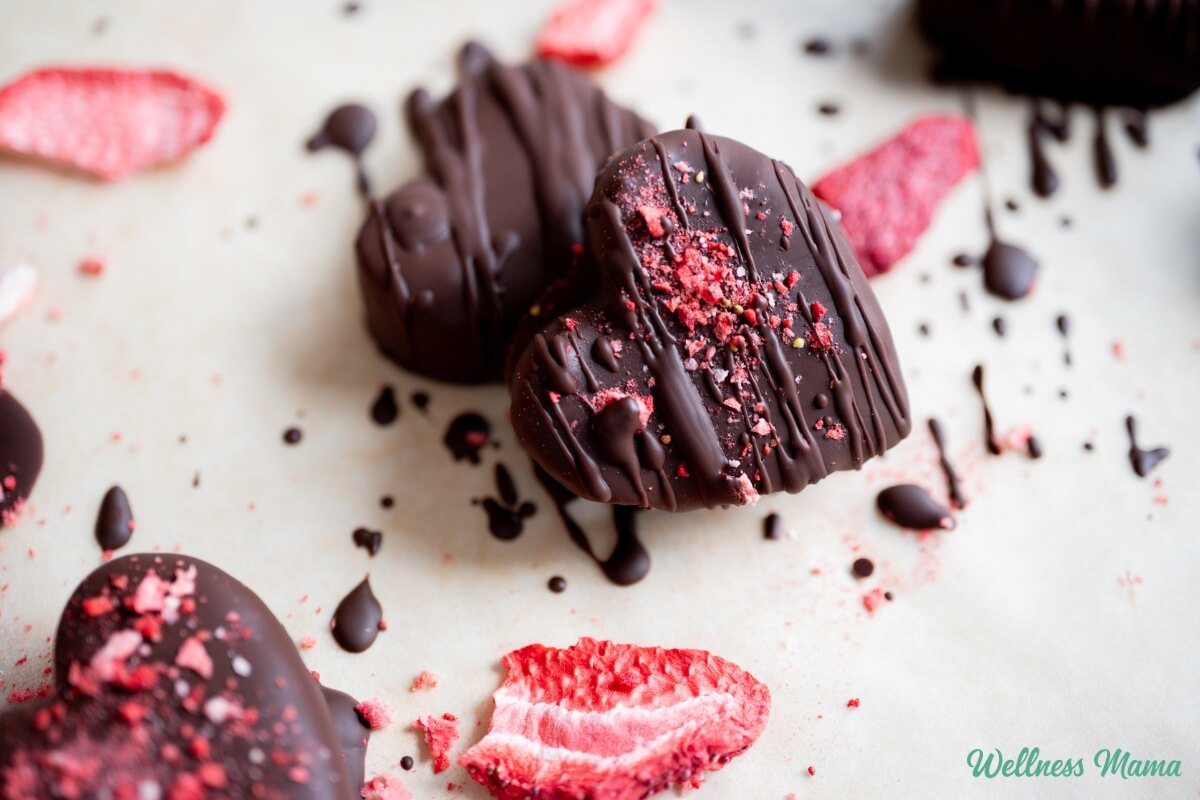
I make these in some cute heart molds that are perfect for Valentine’s Day. You can really use any silicone molds you want though that make chunky shapes. And instead of simply dipping raspberries in chocolate, we’re making a raspberry filling first. It’s naturally sweetened with maple syrup and thickened with chia seeds. 

Research shows that maple syrup isn’t just sugar, but a unique array of minerals, antioxidants, and anti-inflammatory compounds. Chia seeds are a great source of fiber, but they have a whole lot of other benefits. These include supporting healthy blood pressure and digestion, reducing inflammation, and even helping improve anxiety and depression symptoms by nurturing the gut. 

Then there are the juicy raspberries with their vitamin C, fiber, and antioxidants. These chocolate covered raspberry bites are naturally colorful, fun to decorate, and great for any little helpers in the kitchen. My younger kids had no problem helping make these. Plus, they were gone by that afternoon!

 Tips and Tricks

You can use a different mold, but I chose a heart mold for these. If you don’t have a good silicone mold on hand, then you can also make them without one. Simply spoon small jam mounds onto parchment, freeze, and then dip in chocolate to make rustic bites. 

Start with a smaller amount of maple syrup, taste, and adjust to your preference. I prefer mine to be more on the tart side. These store well in the fridge for up to a week. You can also keep them in an airtight container in the freezer for up to 1 month. Fair warning: if you want any leftover for the freezer you may need to double the batch!

Here’s how to make delicious, festive, and nutritious chocolate covered raspberry bites.

Chocolate Covered Raspberry Bites

They taste like chocolate-covered raspberry jam… but better.

Optional Topping

  • 2 TBSP freeze-dried strawberries or raspberries (crushed)
  • In a bowl, mash raspberries with maple syrup, chia seeds, and vanilla until thick and jam-like. Let rest 5–10 minutes so the chia thickens.

  • Spoon the mixture evenly into 10 large 2-inch silicone heart cavities, filling nearly to the top and smoothing the surface.

  • Freeze at least 4 hours or overnight until fully firm.

  • Melt dark chocolate and coconut oil gently until smooth.

  • Remove frozen hearts from molds and dip into chocolate until fully coated.

  • Sprinkle with crushed freeze-dried berries if desired.

  • Place on a parchment paper lined baking sheet and freeze for 10–15 minutes until hardened.

  • Serve straight from the freezer or allow to soften slightly before eating.

Nutrition Facts

Chocolate Covered Raspberry Bites

Amount Per Serving (1 heart)

Calories 135
Calories from Fat 72

% Daily Value*

Fat 8g12%

Saturated Fat 4g25%

Trans Fat 0.01g

Polyunsaturated Fat 1g

Monounsaturated Fat 2g

Cholesterol 0.4mg0%

Sodium 4mg0%

Potassium 180mg5%

Carbohydrates 15g5%

Fiber 4g17%

Sugar 8g9%

Protein 2g4%

Vitamin A 12IU0%

Vitamin C 41mg50%

Calcium 34mg3%

Iron 3mg17%

* Percent Daily Values are based on a 2000 calorie diet.

If the molds you use are bigger or smaller than mine, then the nutrition data will be a little different per serving. 

More Chocolatey Treats

Looking for more ways to treat yourself and family? Here are some of our favorite scrumptious desserts!

What are some of your favorite fruity desserts to make? Leave a comment and let us know!

Tags: , , , , ,
Best oLive
Privacy Overview

This website uses cookies so that we can provide you with the best user experience possible. Cookie information is stored in your browser and performs functions such as recognising you when you return to our website and helping our team to understand which sections of the website you find most interesting and useful.
