Your skincare routine is missing this cacao scrub

Your skincare routine is missing this cacao scrub

Follow this guide

What’s the story

African cacao husk face scrub is taking the skincare world by storm, thanks to its natural exfoliating properties.
Derived from the outer shell of cacao beans, this scrub is rich in antioxidants and nutrients that can help you achieve smoother skin.
The natural ingredient is gaining popularity for being a gentle, yet effective, alternative to chemical exfoliants.
Here is everything you need to know about this skincare wonder.

Natural exfoliation benefits

African cacao husk acts as a natural exfoliant, removing dead skin cells without irritating the skin.
Unlike synthetic scrubs, which can be harsh on sensitive skin, cacao husk provides a gentle polishing effect.
This helps in unclogging pores and reducing the appearance of blemishes, giving you a clearer complexion over time.

Rich in antioxidants

Cacao husk is also packed with antioxidants that fight free radicals and protect your skin from environmental damage.
These antioxidants help in reducing signs of aging, such as fine lines and wrinkles.
Regular use of a cacao husk scrub can improve your skin’s elasticity and firmness, giving you a youthful glow.

Nutrient-dense composition

Beyond exfoliation, African cacao husk is loaded with essential nutrients like magnesium and zinc.
These minerals are crucial for healthy skin functioning, as they promote cell regeneration and repair.
Using this natural scrub can improve your overall skin texture by nourishing it deeply.

Eco-friendly skincare choice

Opting for African cacao husk face scrub also means making an eco-friendly choice in your skincare routine.
The ingredient is sustainably sourced from the byproduct of chocolate production, minimizing waste while providing effective skincare benefits.
This aligns with the growing demand for sustainable beauty products that are kind to both the environment and your skin.

Tags: , , , ,
article-image

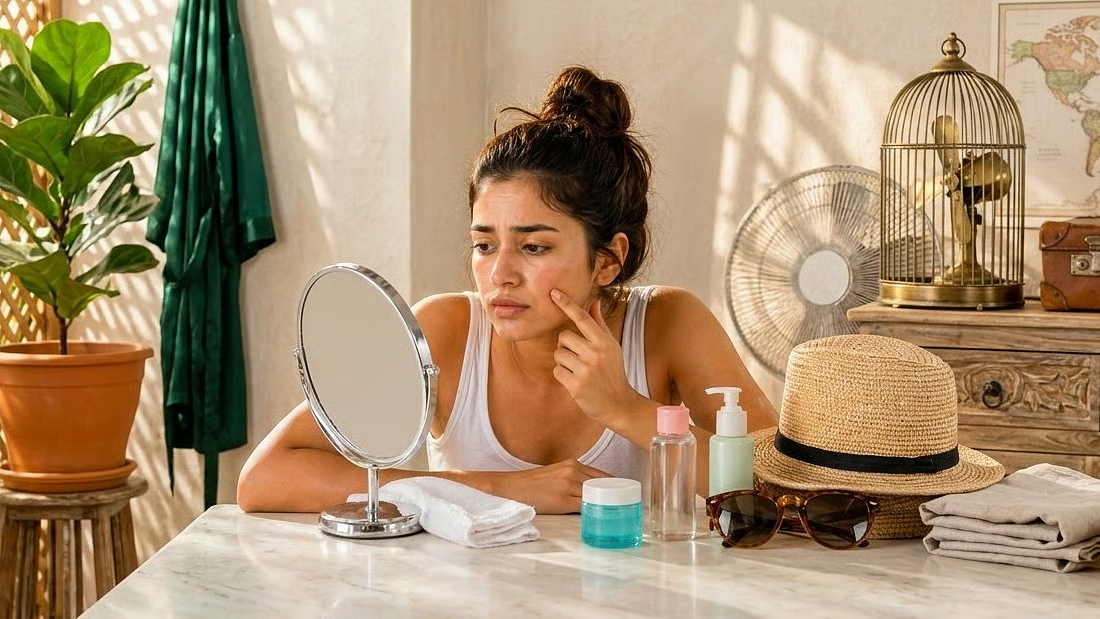
Think You’re Beating The Heat? Oily, Sticky, Breaking Out? Your Summer Routine Might Be The Problem

Summer skincare can get a bit confusing. The moment the weather changes, skin starts behaving differently – more oil, more sweat, the occasional breakout – and most of us instinctively try to “fix” it. We wash our face more often, switch to stronger products, or stop using moisturiser altogether because everything already feels greasy.

But what’s often missing is that these quick fixes can quietly weaken the skin over time.

A lot of this comes down to the skin barrier. It’s the outer layer of your skin that holds everything together, keeps moisture in, protects from environmental stress, and helps maintain balance. And in summer, this barrier is already working overtime.

Especially now, when summers are harsher and nights don’t cool down as much, the skin doesn’t really get a break. Add to that the constant back-and-forth between outdoor heat, pollution, and indoor air-conditioning, and it’s not surprising that skin starts feeling off, sometimes oily, sometimes dry, sometimes just more sensitive than usual.

In this kind of environment, a few everyday habits can do more damage than we realise:

Over-cleansing

Washing the face multiple times a day can feel refreshing, especially in humid weather. But frequent cleansing – particularly with strong or foaming face washes – can strip away the skin’s natural lipids. These lipids are essential for maintaining the barrier. Once disrupted, the skin often responds by producing even more oil, creating a cycle that’s hard to manage. A gentler approach, using mild cleansers with ingredients like aloe, neem, or tulsi, can help remove impurities without disturbing the skin’s balance.

Skipping moisturiser

One of the most common misconceptions is that oily skin doesn’t need moisturiser in summer. In reality, oil and hydration are not the same. Heat, sun exposure, and air-conditioning can all reduce the skin’s water content, even if it appears greasy. Skipping moisturiser can weaken the barrier over time, making the skin more prone to irritation. Lightweight, water-based hydration, such as gels or formulations with cucumber or fruit extracts, can help replenish moisture without feeling heavy.

Over-exfoliating

There’s also this urge in summer to constantly “clean” the skin – get rid of tan, dullness, clogged pores. Exfoliation helps, but only to a point.

When it becomes too frequent or too harsh, it can thin out the skin barrier and make your skin more reactive, especially in the sun. That’s when you start noticing redness or that slight stinging feeling.

Gentler exfoliation works better in the long run. Even traditional formats like ubtan, when used mildly, tend to be less disruptive and still effective.

Environmental stress

Summer isn’t just heat. It’s heat, UV exposure, dust, pollution, and then suddenly cold, dry air indoors. Your skin is constantly adjusting.

This kind of back-and-forth can be tiring for the skin barrier. Sometimes what helps is not doing more, but just adding a bit of calm back into the routine – ingredients that cool, soothe, and don’t overwork the skin.

Using unsuitable products

Products that work well in cooler months may not be ideal for summer. Heavy creams can feel occlusive in humid weather, while overly drying formulations can strip the skin further. Summer calls for lighter, breathable textures that allow the skin to function comfortably. There’s also a growing preference for fresher, more thoughtfully processed formulations that retain ingredient efficacy while being gentle enough for frequent use.

The larger shift

A common thread across these habits is the tendency to overcorrect. Summer skincare is often approached with the goal of controlling oil, removing tan, or managing sweat. But healthy skin doesn’t come from constant stripping or aggressive treatments. It comes from balance.

When the skin barrier is intact, the skin is better equipped to regulate itself—whether that’s oil production, hydration, or sensitivity. This is where skincare routines are gradually evolving. There’s a shift towards approaches that are simpler, more consistent, and better aligned with both the climate and the skin’s natural functioning.

In many ways, summer skincare is less about doing more and more about doing it right. Small changes like choosing gentler cleansers, not skipping hydration, or being mindful of over-exfoliation can go a long way in protecting the skin barrier. Because once that barrier is strong, everything else tends to fall into place.

(Swagatika Das is the CEO & Co-Founder, Nat Habit)

Tags: , , , , , , , ,
Skincare Routine in Your 30s: What Actually Matters

Skincare Routine in Your 30s: What Actually Matters

Looking back, I cringe thinking about how much I neglected my skin throughout my 20s and 30s. Honestly, I don’t think I owned so much as a drugstore moisturizer, let alone a multi-step routine or a bottle of facial sunscreen. It simply wasn’t something I gave any thought to.

My come-to-Jesus moment happened in a brewery bathroom on a summer afternoon. I’d stopped to wash my hands and caught a glimpse of myself in the mirror. Something above my lip — dirt from my bike handlebars, I assumed. I scrubbed at it with wet fingers, grateful I’d noticed before heading back out into the sunshine. But it wouldn’t budge. Swipe, swipe, swipe. Still there. Oh my god. How had I not noticed before? Years of benign neglect had finally shown up as melasma, shaped like a dirt mustache that was suddenly the only feature of my face I could think about.

Fast forward to now, at 44. I have an arsenal of well-curated products, sunscreen in every form (lotion, spray, powder) in every bag I own, and a quarterly facial appointment I look forward to more than almost anything else on my calendar.

That said, I’m also a woman on the internet, which means my algorithm fires a constant stream of products and treatments at me. Slugging. Tallow balm. Skin cycling. LED masks. Retinol before 30, never before 30, only on alternating Tuesdays. The line between actually caring for your skin and quietly harming it is thinner than the before-and-after creators want you to believe.

If you’re in your 20s or 30s, I want to save you the particular horror of a brewery bathroom mirror moment. And I don’t want you wasting time, money, or energy on things that don’t matter. So I talked with Kristyn Smith, esthetician and founder of Practise NYC, who has spent over two decades working at the intersection of clinical aesthetics and holistic skin health. She gave me the clearest framework I’ve heard for cutting through the noise.

What should your skincare routine in your 30s actually include?

The first thing Smith wants you to know is that the 10-step routines and viral skin-cycling schedules are largely a distraction. “Your skin is an organ, not a project,” she says. “If a product doesn’t serve a specific function for your unique barrier, it’s just noise.”

What does serving your barrier actually look like? For someone in their 20s with no existing routine, Smith’s list is almost aggressively short. A gentle cleanser that doesn’t strip your natural lipids, a quality moisturizer to prevent water loss, and SPF. “Everything else is an ‘extra’ until you have this foundation,” she says.

It’s a deflating answer if you’ve already built a shelf full of actives, but Smith’s reasoning holds. The most common mistake she sees in clients in their 30s is an obsession with aggressive correction — too much retinol, harsh acids, overcrowded routines — at the direct expense of their skin barrier. “The skin is resilient, so it seems fine now,” she explains. “But you are essentially borrowing from your skin’s future health.”

What actually ages your skin

Here’s the part nobody making money off your skincare routine wants you to hear. Products account for maybe 20% of how your skin ages. The rest comes down to sleep, stress management, diet, and hormones.

“You cannot ‘product’ your way out of a high-stress lifestyle or a lack of sleep,” Smith says. “I see the skin as a mirror of what is happening internally. If you are depleted, your skin will look depleted.”

This lands differently when you’re a mom in your 30s navigating real hormonal flux — postpartum, sleep-deprived, or bumping up against early perimenopause sooner than you expected. Smith says this is exactly the moment to shift your routine toward soothing and stabilizing rather than correcting. Hormonal changes make skin more reactive and more prone to melasma (yep, that’s the one). “This isn’t the time for aggressive peels,” she says. “It’s the time for hydration, Vitamin C, and gentle botanicals.”

For busy moms who want to actually build these habits, Smith recommends habit stacking. Apply your serum while the kids are in the bath. Treat a five-minute LED mask session as your reset. “It’s about making self-care feel like a necessity, not a luxury,” she says.

The SPF conversation is simpler than the internet makes it

There is perhaps no skincare topic more polluted with conflicting information right now than sunscreen. Mineral vs. chemical. Oxybenzone concerns. The wellness-adjacent crowd suggesting you actually want more sun exposure for collagen and vitamin D. I asked Smith to just tell me what she tells her clients.

“Whether you choose mineral or chemical, the best sunscreen is the one you will actually wear every single day,” she says. If you have sensitive skin or you’re pregnant, mineral is often the better bet, more soothing with fewer variables. But the priority, full stop, is protection — from UV rays, DNA damage, and the cumulative sun exposure that adds up over decades.

And what exactly are you protecting beyond that? Your collagen, mostly. “Once it’s gone, it is very hard to rebuild,” Smith says. SPF is part of it, but so is a nutrient-dense diet and avoiding what she calls pro-inflammatory habits like smoking and excessive sugar. This is where the unsexy long-game stuff lives.

On retinol, tallow, and everything your algorithm is pushing

Retinoids are treated as a near-universal recommendation for anyone over 25, but Smith’s take is more nuanced than most. “Not every skin type can handle Vitamin A,” she says, particularly people with rosacea or a compromised barrier. In those cases, she’ll often look at alternatives like bakuchiol or lower-dose retinaldehydes to get the benefits without the chronic inflammation.

Beef tallow, the ancestral skincare trend that has taken over a certain corner of the wellness internet, gets a similarly grounded response. Smith understands the appeal, but from a clinical standpoint, tallow can be comedogenic (read: pore-clogging) for a lot of people. “We have evolved to create incredibly sophisticated, bio-available formulations that mimic the skin’s natural oils without the risk of breakouts or stability issues,” she says. The appeal-to-nature argument, in other words, doesn’t automatically make something better for your face.

More broadly, when a client comes in having gone deep on a TikTok protocol, Smith redirects rather than dismisses. “A creator’s ‘holy grail’ ingredient might be a disaster for your specific skin type,” she says. The goal is to understand your own skin’s cues, not follow someone else’s digital script.

The #1 skincare habit an esthetician wants you to build now

I asked Smith what she’d want a Motherly reader to do differently after reading this. I expected SPF. I expected a product recommendation.

What I got was this: “Stop looking at your skin in a magnifying mirror. When we over-analyze every pore, we tend to over-treat. Step back, be gentle, and trust that a healthy barrier is the most beautiful thing you can wear.”

Honestly? I’ve been staring in magnifying mirrors since the brewery bathroom. I’m going to think about that one for a while.

Tags: , , ,
sodium for cellular health

Why Getting Enough Salt is Critical For Health

Sodium used to be something I barely thought about. Like many women trying to “do all the right things,” I ate whole foods, drank plenty of water, and avoided “bad” foods. On paper, it looked like a perfect routine. However, I was still having symptoms like low energy and sluggish digestion. 

It wasn’t until I started digging into the science of minerals, especially sodium, that things began to click. For years we’ve been told that sodium is bad and something to be restricted. However, what I’ve learned (and experienced) over the years flips that advice on its head. 

Sodium is one of the most foundational elements in how our bodies generate energy, communicate internally, and even feel safe at a nervous system level. For many of us, the real problem is that we’re not getting enough sodium.

Sodium: and Why Our Cells Crave it

When we hear the word “electrolytes,” it’s easy to think of sports drinks or hydration powders. But at a cellular level, electrolytes are something much more profound. They are what allows electricity to flow throughout the body. 

Sodium, in particular, is one of the primary electrolytes. In simple terms, it carries a positive charge when dissolved in water. This charge is what allows it to conduct electricity. That’s incredibly important because the human body is, at its core, an electrical system.

Every thought, heartbeat, and movement depends on electrical signaling. Without adequate sodium, that signaling becomes less efficient. Research even shows that sodium and potassium ions are constantly moving across cellular and organelle membranes. This highlights just how deeply embedded these minerals are in cellular function.

From my own experience, this was one of the biggest mindset shifts. I stopped thinking about sodium as just something to sprinkle on food and started thinking of it as a conductor. It’s something that allows the body to function smoothly at every level.

Sodium For Cell Power

To understand why sodium matters so much, it helps to zoom in to the level of individual cells.

Every cell in the body maintains a delicate balance of sodium and potassium across its membrane. This balance, aka the sodium-potassium gradient, is what allows cells to generate electrical impulses. These impulses are essential for nearly every function in the body.

One of the most fascinating aspects of this is the sodium-potassium pump. This tiny but powerful mechanism uses energy (in the form of ATP) to push sodium out of the cell and pull potassium in. It’s estimated that this process alone uses a significant amount of the body’s energy, and up to half of our brain’s energy. 

Not Getting Enough

That’s not a small detail. It means that maintaining proper sodium levels isn’t just helpful, it’s energetically prioritized by the body. And when our body is stressed and not getting the energy it needs, it deprioritizes other functions, like digestion and clear thinking. 

When we don’t get enough sodium, several things start to break down, including: 

  • Electrical signaling becomes less efficient
  • Cells struggle to regulate fluid balance
  • Energy production may feel sluggish
  • Brain function can feel “off” or foggy
  • Digestion can feel slow
  • Drier skin and hair from lack of true hydration

I noticed this personally. On days when I wasn’t getting enough sodium, especially if I’d been sweating or drinking more water than usual, I felt noticeably more fatigued and mentally slower. I noticed quite a difference when I started prioritizing getting more sodium. 

Why “More Water” Isn’t Always Better

We’ve all heard the advice to “drink more water.” And while hydration is important, there’s a piece of the puzzle that often gets missed. Hydration isn’t just about water, it’s about balancing fluid and mineral levels. 

Sodium plays a key role in regulating the body’s fluid levels, especially in the space outside our cells. When sodium levels drop too low relative to water intake, cells can begin to swell. This is especially significant in the brain, where even small changes in fluid balance can affect how we feel.

This can show up as:

  • Headaches
  • Brain fog
  • Nausea or fatigue
  • A general sense of feeling “off”

In some cases, what feels like dehydration may actually be the opposite, too much water without enough minerals. This was another area where my own habits needed adjusting. I’d been drinking a lot of plain water, thinking I was helping myself out. However, once I started adding minerals, especially sodium, I found I actually needed less water to feel hydrated. 

Sodium and the Nervous System: A Hidden Safety Signal

One of the most interesting ideas I came across is that sodium can act as a “safety signal” for the body.

Good sodium levels support healthy blood volume and circulation. This helps the brain know that the body is in a stable, well-resourced state. When sodium is too low, the body may interpret this as a form of stress, even if we don’t feel stressed ourselves. 

This can trigger symptoms that feel a lot like anxiety:

  • Racing heart or palpitations
  • Dizziness when standing
  • Restlessness or unease
  • Feeling tired but wired (fatigue paired with difficulty relaxing)

I noticed these symptoms, especially when I was doing all the “healthy” things (eating clean and exercising), but still felt off. In some cases, simply increasing sodium intake made a noticeable difference in how calm and stable I felt.

It’s a powerful reminder that the nervous system doesn’t just respond to thoughts or emotions. It also responds to physical inputs, like minerals.

Rethinking Sodium and Blood Pressure

For decades, sodium has been closely tied with high blood pressure. But when you look more closely at the research, the story becomes much more nuanced. It’s true that high sodium from processed foods, especially in the context of low potassium and low activity levels, can contribute to hypertension in some people. However, that’s not the full picture.

Some research suggests a J-shaped curve, where both very high and very low sodium intakes may be linked with increased health risks. In other words, too little sodium may be just as problematic as too much for certain people. Even more interesting, some experts estimate that about 75% of us may actually see stable or better blood pressure with higher sodium intake. Especially when this sodium comes from whole-food and is balanced with other minerals.

In my own family and clients I’ve worked with, I’ve seen this play out in real life. Focusing on a nutrient-dense diet, adequate mineral intake, consistent movement, and specifically increasing sodium didn’t raise blood pressure. Instead, there was real life data showing it had the opposite effect and improved blood pressure. 

Of course, if you have any health condition it’s worth consulting with a natural healthcare professional you trust for targeted advice. 

Why Modern Lifestyles May Deplete Sodium

One of the biggest disconnects in the sodium conversation is that our lifestyles have changed. An active person who lives in a hot climate or exercises or saunas can lose more minerals in five years than a person who doesn’t do these things will in their whole lifetime. And for anyone who prioritizes whole foods, we’ve eliminated the main source of sodium in modern diets: ultraprocessed foods (which is still a good thing!).

Many healthy habits can actually increase sodium loss:

  • Regular exercise
  • Sauna use
  • Living in hot climates
  • Pregnancy and breastfeeding
  • Low-carb or ketogenic diets
  • Chronic or underlying stress

Sweating alone leads to significant mineral loss. Add in stress, which can increase sodium excretion through the kidneys, and it’s easy to see how someone could become depleted.

This was definitely something I noticed. Between exercise, sauna use, and multiple pregnancies, I likely needed more minerals and sodium than most. And yet, like many women, I’d been conditioned to limit salt rather than consider whether I might need more. Interesting side note: my last pregnancy was by far my easiest, and this was after I started prioritizing sodium intake.

Choosing the Right Sources of Sodium

Not all sodium sources are created equal, and this is an important distinction.

Most of the sodium in the standard American diet comes from highly processed foods. These foods often combine sodium with refined ingredients, unhealthy fats, and additives. This also makes it difficult to isolate sodium as the sole issue. In contrast, using high-quality salt with whole foods creates a very different context.

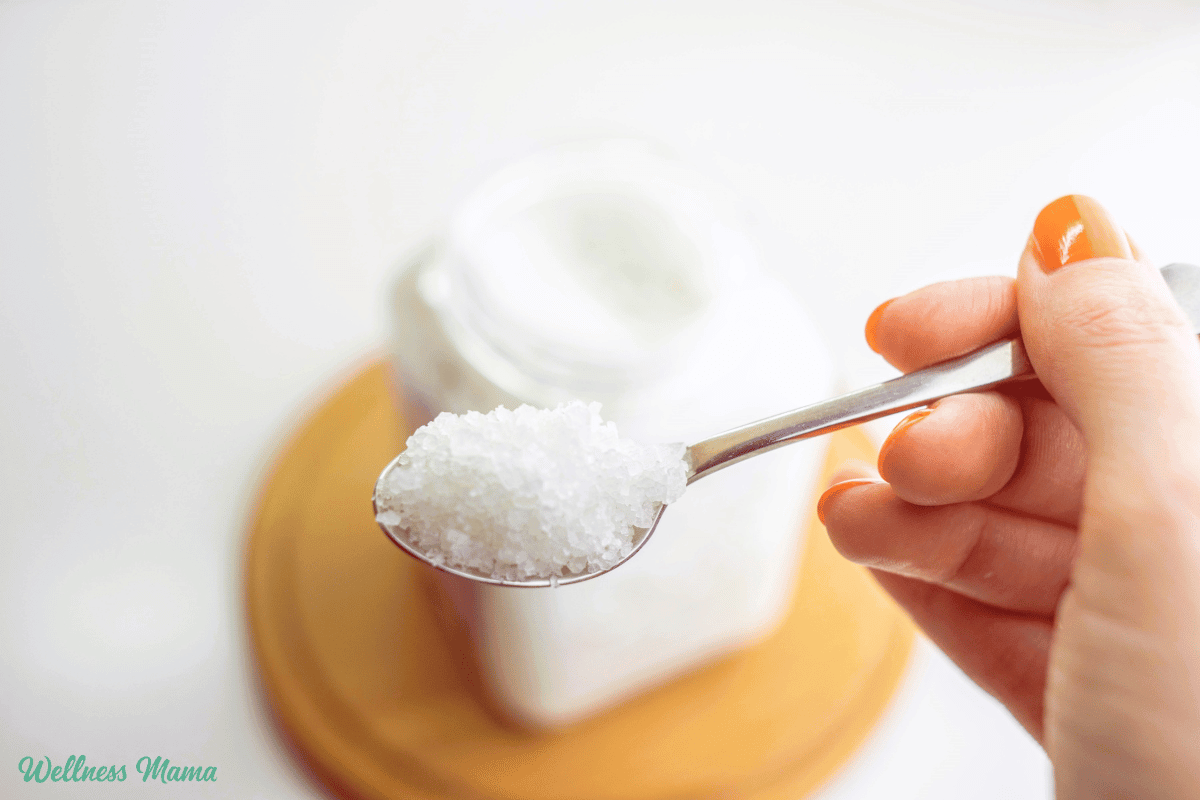
Natural salts, like Himalayan or mined mineral salts, often contain trace minerals and are less processed than conventional table salt. However, even here, quality matters. Some sea salts have microplastics, while certain mined salts can have some levels of heavy metals, including lead. It’s worth doing your research and using what you’re comfortable with. 

This is what I’ve been using lately:

How Much Sodium and Where to Get it

The US sodium guidelines suggest an upper limit of 2.3 grams per day, or about one teaspoon. However, the average person gets about 3.4 grams per day, mostly from ultraprocessed foods. But what is that sweet spot for optimal health? 

It varies by person, but I try to get at least 5 grams a day, sometimes more. Podcast guest and research biochemist Robb Wolf gives a good explanation for why here. 

Personally, I use well-sourced mineral salts and pair them with nutrient-dense foods. I also include naturally salty foods like fermented vegetables and broths, which provide sodium alongside other beneficial compounds. Here’s what else I do:

  • Use healthy salt on seasonal, local foods to taste
  • Mineralized water – I felt a big hydration difference when I started using the Mayu Swirl with minerals (code wellnessmama gives a discount)
  • Using electrolytes and minerals like LMNT or trace minerals
  • Drinking salted broth
  • Eat naturally salty foods like olives, fermented veggies, and pickles, etc.
  • Sip fermented pickled juice
  • Salt tablets (I take these every day in addition to adding salt to food and drinks)
  • Drink sole water first thing in the morning most days

Practical Ways to Support Healthy Sodium Levels

Rather than focusing on strict numbers, I’ve found it helpful to think in terms of context and feedback. Some simple approaches that have worked for me include:

  • Paying attention to how I feel: Energy, clarity, and hydration cues
  • Adjusting intake based on activity level, climate, and stress

One of the most helpful tools has simply been awareness. Noticing patterns, like feeling better with added electrolytes or worse after excessive plain water, can offer valuable clues.

Final Thoughts and A More Nuanced View of Sodium

Sodium is far more than a number on a nutrition label. It’s a foundational component of how the body functions, electrically, neurologically, and even emotionally. It’s responsible for powering cell communication, supporting fluid balance, nervous system stability, and so much more. 

For many of us, especially those focused on whole foods and active lifestyles, the conversation needs to shift from restriction to optimization. The question shouldn’t be, how little sodium we can get away with? A better question is, how can we support our bodies with the right balance of minerals in the context of how we actually live?

Like so many aspects of health, the answer isn’t one-size-fits-all. But in my experience, and even more in the research, sodium deserves a second look. 

Do you try to get more salt or avoid it? Leave a comment and let us know!

Tags: , ,
Best oLive
Privacy Overview

This website uses cookies so that we can provide you with the best user experience possible. Cookie information is stored in your browser and performs functions such as recognising you when you return to our website and helping our team to understand which sections of the website you find most interesting and useful.