Global Shea Butter Market Set to Reach USD 8.57 Billion by 2034 as Clean Beauty, Sustainable Sourcing and Food-Grade Applications Strengthen, says Maximize Market Research

Global Shea Butter Market Set to Reach USD 8.57 Billion by 2034 as Clean Beauty, Sustainable Sourcing and Food-Grade Applications Strengthen, says Maximize Market Research

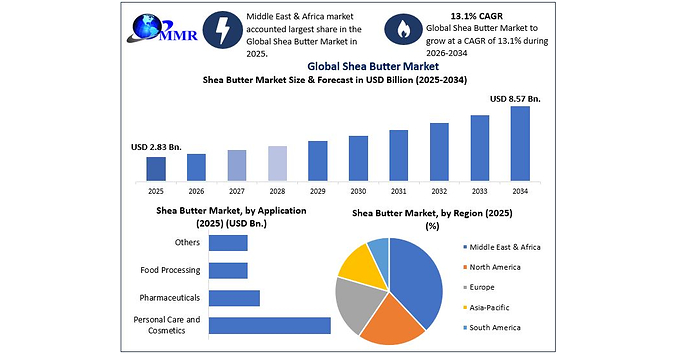
PUNE, India, Oct. 6, 2026 /PRNewswire/ — The Global Shea Butter Market was valued at USD 2.83 Billion in 2025 and is projected to grow at a CAGR of 13.1% from 2026 to 2034, reaching USD 8.57 Billion by 2034, according to a new analysis by Maximize Market Research.

Explore 125 market data tables and 60 figures across 324 pages, along with a detailed Table of Contents covering the Global Shea Butter Market.

Global Shea Butter Market Size

Global Shea Butter Market Size & Forecast
Market Size (Base Year 2025): USD 2.83 Billion
Forecast Market Size (2034): USD 8.57 Billion
CAGR (2026–2034): 13.1%
Base Year: 2025
Forecast Period: 2026–2034
Historical Period: 2020–2025

Global Shea Butter Market Overview

The Global Shea Butter Market continues to expand as demand rises for natural ingredients, plant-based raw materials, clean-label products, sustainable personal care ingredients, and functional food fats. Shea butter is widely used across cosmetics and personal care, food processing, pharmaceuticals, bakery products, confectionery, skincare, haircare, medicinal ointments, and cocoa butter equivalent applications. The Shea Butter Market growth is supported by increasing consumer preference for raw and unrefined shea butter, refined shea butter, organic shea butter, cosmetic-grade shea butter, food-grade shea butter, and ethically sourced shea products. Growing demand for moisturizing ingredients, natural antioxidants, essential fatty acids, and plant-derived emollients is strengthening the Global Shea Butter Market size, market share, market demand, and long-term Shea Butter Market forecast.

The market is also being shaped by organic certification, fair-trade sourcing, sustainable shea butter production, transparent supply chains, digital traceability, women-led cooperatives, regenerative sourcing practices, and increasing investment in West African processing infrastructure. The rising use of shea butter in clean beauty, natural skincare, premium haircare, pharmaceutical formulations, chocolate, bakery, and cocoa butter equivalent products is creating strong Shea Butter Market opportunities. The Middle East and Africa remain the leading regional market due to the concentration of shea cultivation, harvesting, and processing across the West African Shea Belt, while demand from North America, Europe, and Asia Pacific continues to strengthen the global Shea Butter Industry outlook. Companies are increasingly focusing on supply reliability, quality consistency, organic and fair-trade certification, product innovation, refined and ultra-refined grades, and value-added shea butter solutions to improve their competitive position in the Shea Butter Market.

Get Full PDF Sample Copy of Report: (Including Full TOC, List of Tables & Figures, Chart) @https://www.maximizemarketresearch.com/request-sample/23770/

The Global Shea Butter Market is evolving as cosmetics, food, pharmaceutical, and confectionery companies increase their use of natural, sustainable, traceable, and plant-based ingredients. Organic shea butter, fair-trade shea butter, cosmetic-grade shea butter, food-grade shea butter, cocoa butter equivalents, clean beauty formulations, sustainable sourcing, and supply-chain modernization are creating stronger market opportunities. Companies that combine product quality, ethical sourcing, traceability, consistent supply, advanced processing, organic certification, and application-focused innovation are likely to shape the Shea Butter Market through 2034.

Shea Butter Market Growth Drivers, Opportunities & Key Highlights

The Global Shea Butter Market is expanding as demand rises for natural ingredients, clean-label cosmetics, plant-based emollients, sustainable raw materials, and cocoa butter equivalents. Raw and unrefined shea butter remains a key category due to its strong use in skincare, haircare, balms, soaps, and body butter, while refined shea butter supports food processing, confectionery, pharmaceuticals, and large-scale cosmetic production.

New market opportunities are emerging through organic certification, fair-trade sourcing, digital traceability, women-led cooperatives, and supply-chain modernization. AAK introduced new liquid shea butter solutions in 2025, while Bunge Loders Croklaan strengthened localized processing in West Africa through its partnership with Mali Shi.

Key Market Highlights

  • USD 2.83 Billion: Market size in 2025
  • USD 8.57 Billion: Projected market size by 2034
  • 13.1% CAGR: Growth during 2026–2034
  • 16 million+ women: Engaged in shea collection and processing across West Africa
  • 26,000+ women collectors: Supported through the Mali Shi partnership
  • 250,000–350,000 tons: Annual dry kernel production in the leading MEA region
  • Middle East & Africa: Leading regional market
  • Raw and Unrefined Shea Butter: Leading type segment

Germany Shea Butter Market Strengthens with Sustainable Sourcing Partnership

In Germany, the Shea Butter Market gained momentum in 2026 as Beiersdorf and AAK extended their partnership to strengthen sustainable shea sourcing in West Africa. The initiative has already supported more than 10,500 women in Ghana and Burkina Faso through training, savings programs, improved processing support, and sustainable production practices. The next phase focuses on sustainable land management, water infrastructure restoration, and new processing equipment. These developments reflect rising demand for traceable, ethically sourced, fair-trade, and sustainable shea butter for skincare, body care, and lip-care applications, while reinforcing Germany’s role in clean-beauty innovation and responsible shea supply chains.

The Global Shea Butter Market is segmented by Type, Nature, Application, Distribution Channel, and Region.

By Type, Raw and Unrefined Shea Butter holds the leading position in 2025 due to higher nutrient retention, natural aroma, and strong demand from clean-beauty and organic personal care brands. It is widely used in skincare, haircare, balms, soaps, and artisanal formulations because of its vitamins, antioxidants, and bioactive compounds. Refined Shea Butter also maintains strong demand across food processing, confectionery, pharmaceuticals, and large-scale cosmetic manufacturing where consistent color, odor, texture, purity, and stability are important.

By Nature, Conventional Shea Butter accounts for a major share because of its broad availability, cost-effectiveness, and wide use in food processing, bakery, confectionery, commercial cosmetics, and cocoa butter equivalent applications. Organic Shea Butter is the fastest-growing category, supported by rising demand for clean, traceable, chemical-free, fair-trade, and sustainably sourced ingredients in premium skincare, haircare, and therapeutic products.

Get Insightful Data on Regions, Market Segments, Customer Landscape, and Top Companies (Charts, Tables, Figures and More) https://www.maximizemarketresearch.com/request-sample/23770/ 

Middle East & Africa Leads the Shea Butter Market as West African Production and Sustainable Sourcing Strengthen

Middle East & Africa remains the leading region in the Global Shea Butter Market, supported by the concentration of shea cultivation, harvesting, and primary processing across the West African Shea Belt. Ghana, Burkina Faso, Nigeria, Mali, Benin, and Togo remain major production and export centers, while annual dry kernel production of more than 250,000–350,000 tons supports the region’s dominant market share. Rising demand for raw and unrefined shea butter, organic shea butter, cosmetic-grade shea butter, and food-grade shea butter is strengthening regional exports to cosmetics, pharmaceuticals, food processing, bakery, confectionery, and cocoa butter equivalent applications.

North America and Europe remain important demand markets, supported by strong adoption of natural skincare, clean-label cosmetics, premium personal care, sustainable ingredients, and cocoa butter equivalents. Asia Pacific is also expanding as beauty, haircare, food processing, and pharmaceutical industries increase their use of plant-based and natural ingredients. South America continues to develop through growing demand for natural personal-care products, specialty ingredients, and sustainable raw materials, supporting wider global Shea Butter Market opportunities.

Global Shea Butter Market Competitive Landscape

The Global Shea Butter Market is highly competitive, with major companies focusing on sustainable sourcing, product purity, processing quality, supply reliability, organic certification, fair-trade practices, and application-specific shea butter solutions. Competition is increasingly centered on raw and unrefined shea butter, refined and ultra-refined shea butter, cosmetic-grade shea butter, food-grade shea butter, traceable supply chains, and clean-label ingredients across cosmetics, food, pharmaceuticals, bakery, and confectionery applications.

Major players include AAK, Bunge Loders Croklaan, Fuji Oil, BASF, Croda, Clariant, OLVEA, and Ghana Nuts Company. Recent developments show that competition is shifting toward product innovation, localized processing, ethical sourcing, and stronger West African supply networks. In 2025, AAK introduced LIPEX 205, LIPEX SheaLiquid TR, and LIPEX SheaClear, expanding liquid shea butter options for personal-care formulations, while Bunge Loders Croklaan strengthened its partnership with Mali Shi, supporting local processing, more than 100 direct jobs, and over 26,000 women collectors. Across the market, companies are strengthening their positions through sustainable sourcing programs, advanced refining, traceability, community partnerships, and value-added shea butter products.

Global Shea Butter Market Recent Development

In October 2025, AAK AB introduced its new Liquid Shea Butter Solutions portfolio, including LIPEX 205, LIPEX SheaLiquid TR, and LIPEX SheaClear, marking one of the most notable recent developments in the Global Shea Butter Market. The new solutions are designed to deliver the moisturizing and barrier-supporting benefits of traditional shea butter in a pumpable, non-crystallizing liquid format that simplifies processing, improves formulation stability, and supports lighter and transparent personal-care products. The development strengthens AAK’s position in cosmetic-grade shea butter and reflects the market’s growing focus on innovation, clean-label formulations, traceable sourcing, and value-added shea ingredients for premium skincare and personal-care applications.

Immediate Delivery Available | Buy this Research Report (Insights, Charts, Tables, Figures and More) https://www.maximizemarketresearch.com/checkout/23770/ 

Global Shea Butter Market – Key Players

  1. AAK AB
  2. BASF SE
  3. Bunge Limited
  4. Cargill, Incorporated
  5. Croda International Plc
  6. Fuji Oil Holdings Inc.
  7. Ghana Nuts Company Limited
  8. IOI Loders Croklaan Group BV
  9. Clariant AG
  10. OLVEA Group
  11. SOPHIM S.A.
  12. Olam International
  13. Manorama Industries Limited
  14. The Savannah Fruits Company
  15. Baraka Impact
  16. SheaMoisture (Unilever)
  17. L’Occitane en Provence
  18. The Body Shop
  19. Agrobotanicals, LLC
  20. Suru Chemicals and Pharmaceuticals Pvt. Ltd.
  21. Medaure Limited
  22. All Organic Treasures GmbH
  23. Sekaf Ghana Ltd.
  24. Shea Radiance LLC
  25. Pameri Organic US
  26. 3F Industries Limited
  27. Wilmar Africa Limited
  28. International Oils & Fats Limited
  29. Akoma International Ltd.
  30. Better Butter Company
  31. Shebu Industries
  32. Makers Ingredients Limited
  33. Purenso Select
  34. NOW Foods
  35. Bulk Apothecary
  36. Green Leaf Naturals
  37. Zoic Cosmetics
  38. Gombella Integrated Services
  39. Natural Sourcing, LLC
  40. Right Shea
  41. Hallstar (Biochemica)
  42. Synthite Industries Pvt. Ltd.
  43. Cornelius Group PLC
  44. Enkay Indo-Nigerian Industries Ltd.
  45. Mary Tylor Naturals LLC
  46. Medikonda Nutrients
  47. VedaOils
  48. A.G. Organica Private Limited
  49. Alaffia
  50. Naasakle International LLC

Access Full Summary: https://www.maximizemarketresearch.com/market-report/global-shea-butter-market/23770/ 

Analyst Perspective

Analyst highlights that the Global Shea Butter Market is gaining importance as demand for natural ingredients, clean-label cosmetics, sustainable raw materials, plant-based emollients, food-grade fats, and cocoa butter equivalents continues to support market growth. Product innovation in organic shea butter, fair-trade sourcing, traceable supply chains, refined and ultra-refined grades, and liquid shea solutions is strengthening the market, while Middle East & Africa remains the leading region due to the strong West African production base. Companies that improve product quality, strengthen sustainable sourcing, expand processing capacity, invest in traceability, and develop value-added shea butter solutions are likely to shape the market through 2034.

Related Reports:

Moisturizing Cream Market by Product Type, Distribution Channel, Consumer Group, and Region – Global Forecast to 2034.

Cosmetic Ingredients Market by Type, Ingredient Type, Application, and Region – Global Forecast to 2034.

Natural Skin Care Products Market by Type, Product, End-User, and Region – Global Forecast to 2034.

Cosmetic Skin Care Market is segmented by Product, Gender, Distribution Channel, Application, and Region – Global Forecast to 2034.

Vegan Cosmetics Market by Product, Price Point, End User, Distribution Channel, and Region – Global Forecast to 2034.

Lip Care Products Market is segmented by Product Type, Distribution Channel, Application, End-User, and Region – Global Forecast to 2034.

Lip Balm Market by Product, Type, Usage, Application, and Region – Global Forecast to 2034.

Baby Care Products Market by Product, Age Group, Distribution Channel, and Region – Global Forecast to 2034.

Aloe Vera Products Market by Product Type, Category, Distribution Channel, End-User, and Region – Global Forecast to 2034.

Facial Care Market by Age, Product, Gender, Distribution Channel, and Region – Global Forecast to 2034.

About Maximize Market Research – Global Shea Butter Market

Maximize Market Research is a global market research and business consulting firm providing data-driven insights across consumer goods & services, beauty & personal care, food processing, pharmaceuticals, and natural ingredients. Its Global Shea Butter Market research covers raw and refined shea butter, organic and conventional products, cosmetics, food, pharmaceuticals, distribution channels, regional demand, sustainable sourcing, fair-trade practices, cocoa butter equivalents, competitive strategies, and recent industry developments. The report helps businesses understand market trends, product innovation, ethical sourcing, supply-chain developments, and long-term opportunities through 2034.

Global Seismic Services Market 2025–2032: Expanding Oil & Gas Exploration, Advanced 3D/4D Seismic Imaging, Renewable Energy Surveys, and AI-Driven Reservoir Analytics – MMR Statistics

MMR Statistics is a part of Maximize Market Research, developed to provide quick access to market size, industry data, forecasts, trends, and statistical insights across a wide range of sectors. It presents research data in multiple formats, making it easier for businesses, analysts, and decision-makers to use market intelligence for presentations, strategy, benchmarking, and business planning.

Global Eyeglasses Market (2026–2032) Market Size, Trends & Key Players – Stellar Market Research

Stellar Market Research is a strategic partner of Maximize Market Research, providing global and region-wise market research reports across multiple industries. Its research focuses on market trends, competitive developments, regional opportunities, industry dynamics, and growth outlooks, complementing Maximize Market Research with broader market coverage and region-specific business intelligence.

Contact:
Lumawant Godage
MAXIMIZE MARKET RESEARCH PVT. LTD.
+91 96073 65656
Email: [email protected]
Visit Our Web Site: https://www.maximizemarketresearch.com/

SOURCE Maximize Market Research Pvt. Ltd.

Tags: , , , , , , , , , , , , , , , ,
Schneider Electric to buy US software firm PTC in $22.6 billion deal

Schneider Electric to buy US software firm PTC in $22.6 billion deal

France’s Schneider Electric struck its biggest deal ever on Monday, agreeing to buy US software company PTC for around $22.6 billion as it builds up its data centre business amid booming demand.

However, the French engineering company’s shares fell nearly 10% in early Paris trading as investors weighed the size of the acquisition, the big premium offered for the shares and the outlook for software companies’ valuations amid AI-related market uncertainty.

Up to Friday’s close, Schneider’s shares were up 29%​ year-to-date, before Monday’s losses wiped off close to €15 billion ($17 billion) from its market capitalisation.

“AI disruption fears are still weighing on software valuations, which allows acquiring PTC at a decade low valuation but could still weigh on Schneider post deal,” Jefferies said in a note to investors.

Berenberg analyst Nay Soe Naing told Reuters the deal presented a healthy valuation amid a compressed valuation environment and challenging investor sentiment across the software space.

PTC shares jumped 34.4% in US premarket trading.

BACKBONE OF DATA CENTRE BUILD-UP

Schneider, once known primarily for industrial components like fuses and circuit breakers, now builds the backbone of data centres, supplying everything from cooling units and server racks to critical power distribution equipment.

The PTC acquisition would expand its industrial software and AI business by adding the Boston-based company’s product-design and lifecycle-management software to its offering.

Schneider CEO Olivier Blum told investors that PTC’s engineering and design data would strengthen Schneider’s ability to deploy AI across customers’ industrial operations.

“Data is becoming a very critical layer” for extracting value from AI, as the technology requires closer links between data and the software used to contextualise it, Blum said in the conference call.

The combination would lift Schneider’s software-as-a-service revenue to about 24% of group total, accelerating its push beyond electrical equipment and automation into higher-growth, recurring-revenue software, he added.

Booming demand for data centres, particularly from the US, is driving Schneider’s earnings, offering a growing source of revenue that is helping it offset weakness in some traditional electrical-equipment markets.

PTC, which provides software solutions for designing, manufacturing and servicing products across multiple sectors, has also benefited from growing demand for its AI-powered tools.

Monday’s deal follows Schneider’s June agreement to buy Cognite Holding, a privately held provider of AI software and industrial data.

DEAL DETAILS

The transaction would be Schneider’s largest-ever acquisition and one of the biggest in Europe this year, according to LSEG data.

It would be financed through an issuance of new shares worth €5 billion to €6 billion under an existing shareholder authorisation, and new debt of €16 billion to €17 billion.

The $205-per-share offer implies an enterprise value of $23.7 billion for PTC and represents a 42.3% premium to its last closing price.

France’s third-highest-valued listed company expects the deal to generate €250 million in annual run-rate cost savings by the third year after closing, alongside about €800 million in revenue synergies.

The acquisition is expected to close by the third quarter of 2027, subject to approvals from PTC shareholders and regulators.

Tags: , , , , , , ,
Global Cosmetics Market to Reach USD 704.17 Billion by 2032, Reveals New Maximize Market Research Analysis

Global Cosmetics Market to Reach USD 704.17 Billion by 2032, Reveals New Maximize Market Research Analysis

Maximize Market Research’s Cosmetics Market Global Outlook (2025–2032) has been updated with the latest developments from the first nine months of 2025.

“Maximize Market Research reveals AI skincare, clean beauty, and K-beauty trends are reshaping global cosmetics growth.”

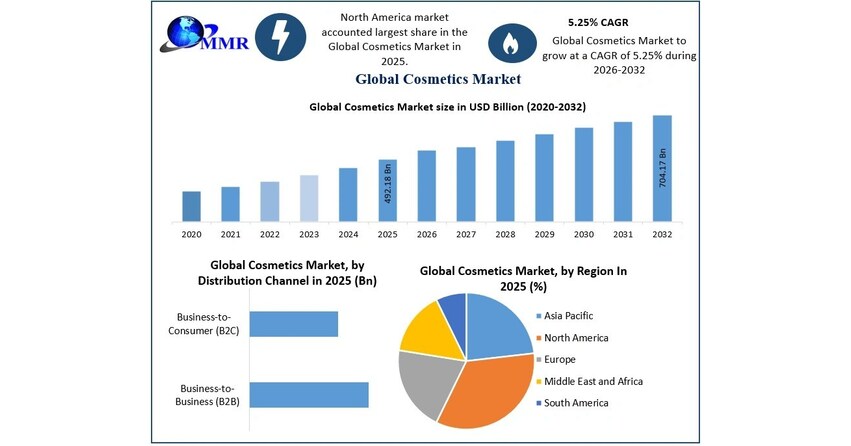
PUNE, India, Feb. 27, 2026 /PRNewswire/ — Global Cosmetics Market was valued at USD 492.18 billion in 2025 and is expected to grow at a CAGR of 5.25% from 2025 to 2032, reaching nearly USD 704.17 billion by 2032. This growth is fueled by rising beauty consciousness, expanding demand for premium skincare, organic and natural cosmetics, inclusive beauty products, and the ongoing digital transformation in the beauty and personal care industry.

Get Full PDF Sample Copy of Report: (Including Full TOC, List of Tables & Figures, Chart) @ https://www.maximizemarketresearch.com/request-sample/72541/ 

Global Cosmetics Market

Key Market Trends & Insights from the Cosmetics Market Report

Skincare Segment Dominates Global Cosmetics Revenues

The skincare product segment accounted for the largest share of 48% in 2025, driven by rising consumer preference for dermatologist-recommended products, anti-aging solutions, and clean beauty formulations. High adoption of serums, moisturizers, sunscreens, and acne-care products underscores the growing trend of science-backed skincare. Consumers are increasingly searching for “microbiome-friendly cosmetics for sensitive skin” and “organic anti-aging skincare solutions”, highlighting the influence of long-tail search intent in shaping product strategies.

Rise of AI-Powered Personalized Beauty Solutions

AI-powered beauty solutions and virtual try-on technologies are transforming consumer engagement. Companies like L’Oréal, AmorePacific, and Perfect Corp are integrating AI skin diagnostics and personalized product recommendations to enhance customer loyalty and drive premium adoption. Long-tail searches like “AI-powered skincare routine for combination skin” and “virtual makeup try-on apps” are gaining traction globally, reflecting heightened consumer demand for precision beauty solutions.

Sustainable and Eco-Friendly Beauty Drives Market Growth

Demand for sustainable cosmetics, refillable packaging, and plant-based skincare formulations continues to grow. Consumers are actively searching for “cruelty-free beauty brands”, “eco-friendly cosmetic packaging solutions”, and “vegan organic skincare products”. This trend is particularly pronounced in Europe, North America, and APAC, where regulatory frameworks encourage ethical sourcing and transparency in beauty product ingredients.

Digital Transformation and Influencer-Driven Beauty Trends

The digital commerce revolution and social media influencer marketing are accelerating the adoption of innovative cosmetic products. Micro-influencers and beauty content creators are introducing hybrid skincare-cosmetic solutions, such as tinted SPF moisturizers and serum foundations, driving searches like “best hybrid beauty products for anti-aging” and “top eco-friendly makeup brands”.

Inclusive Beauty Products and Male Grooming Expansion

Consumers increasingly demand inclusive beauty products catering to all skin tones and genders. The male grooming segment is expanding rapidly, with rising adoption of skincare and anti-aging products for men. Searches such as “best natural cosmetics for dark skin tones” and “men’s cruelty-free skincare products” highlight opportunities for niche innovation and long-tail keyword optimization.

Cosmetics Market Composition by Product & Innovation:

  • Color Cosmetics: Focus on long-lasting, skin-friendly formulations and multifunctional makeup.
  • Skincare: Includes anti-aging creams, serums, and microbiome-friendly solutions.
  • Perfumes / Body Mists: Premium fragrances leveraging natural, sustainable ingredients.
  • Advanced Cosmetics: Cosmeceuticals blending bioengineered ingredients and antioxidant-rich formulations.
  • Beauty Devices: At-home aesthetic treatments, including hair-removal devices and AI-powered skin analyzers.

Notable Innovations:

Bioengineered ingredients: Plant-based peptides and probiotics for sensitive skin.

Personalization apps: AI-based solutions recommending custom foundations and skincare regimens.

Sustainable packaging solutions: Refillable containers, compostable packaging, and zero-waste initiatives.

Global Cosmetics Market Segmentation: Skincare, AI-Powered Serums & Clean Beauty Trends Driving Consumer Engagement

Global Cosmetics Market is evolving with skincare face care products leading in daily consumption, from hydrating moisturizers to microbiome-friendly serums. Color cosmetics, body care, and perfumes follow, yet AI-powered personalized skincare and clean beauty solutions are redefining trends. With online retail and B2C channels driving rapid adoption, consumers are exploring anti-aging creams, organic face oils, and inclusive beauty formulations, creating unprecedented opportunities for innovation and engagement.

Get Insightful Data on Regions, Market Segments, Customer Landscape, and Top Companies (Charts, Tables, Figures and More) – https://www.maximizemarketresearch.com/request-sample/72541/ 

By Product    

Skincare

Face Care

Moisturizers & Creams

      Serums & Essence

      Face Wash & Cleansers

      Face Mask

      Face Oil

      Under-eye Creams

      Others

Body Care

 Lotions & Creams

     Body Oil

     Hand Creams

     Foot Creams

      Others

Bath Products

Shower Gel

     Bath Soap

     Others

Intimate Care

  Intimate Washes

    Wipes

    Whitening Products

    Others

Others

Color Cosmetics

Eye Products

 Eye Shadow

       Eye Liner

       Kohl Pencil

        Others

Facial Products

 Primer

       Foundation

       Concealer

Face Powder

       Others

Lip Products

Lipstick

       Lip Glosses

       Lip Liners

       Lip Mask

       Others

Others

Perfumes/Deodorants/Body Mists

By End User   

Men

Women

By Distribution Channel      

Business-to-Business (B2B)

Business-to-Consumer (B2C)

Online Retail Stores

  Hypermarket/Supermarket

  Brand Stores

  Multi-brand Stores

  Departmental Stores

  Other Retail Stores

Competitive Analysis: Global Beauty Leaders

  • L’Oreal: Advanced AI cloud diagnostics, virtual try-ons, and sustainable ingredient sourcing.
  • AmorePacific: Generative AI beauty assistants for custom makeup recommendations.
  • Shiseido: Non-invasive Skin Visualizer AI tools for real-time skin health assessment.
  • Estee Lauder: Partnership with research centers for longevity and anti-aging beauty solutions.

Leading brands are investing heavily in AI-powered personalization, microbiome-friendly cosmeceuticals, sustainable formulations, and inclusive product lines, creating competitive differentiation.

Cosmetics Market Breakthroughs 2025–2026: AR Virtual Try-Ons, 3D-Printed Makeup & Science-Driven Skincare Innovations

In January 2025, L’Oréal’s BOLD venture fund invested in Timeline, a longevity-focused skincare platform, accelerating next-generation anti-aging and wellness cosmetics.

In December 2024, Estée Lauder partnered with Stanford’s Aesthetics & Culture Program to fund longevity and consumer behavior research, enhancing its science-driven skincare pipeline.

2025–2026: Rise of AR-powered virtual try-ons and custom 3D-printed makeup formulations, supporting bespoke beauty product launches globally.

Immediate Delivery Available | Buy this Research Report (Insights, Charts, Tables, Figures and More) –

Global Cosmetics Market Regional Insights: AI Skincare, K-Beauty Trends & Clean Beauty Driving Growth

North America leads the global Cosmetics Market, driven by AI-powered personalized skincare, anti-aging serums, and microbiome-friendly creams. Rapid adoption of online B2C channels, clean beauty products, and AR virtual try-ons fuels growth. Meanwhile, Europe and Asia-Pacific showcase innovation in sustainable formulations, K-beauty trends, and inclusive cosmetics, creating a competitive landscape that keeps beauty enthusiasts globally engaged.

Asia-Pacific ranks as the second-largest cosmetics market, fueled by K-beauty innovations, Japan’s science-driven skincare, and China’s influencer-led e-commerce. Rising demand for anti-aging creams, microbiome-friendly serums, and herbal skincare in India and Australia drives rapid growth. Digital-first beauty trends, clean and inclusive formulations, and premiumization are reshaping consumer engagement, making the region a global hotspot for innovative cosmetic solutions.

Cosmetics Market, Key Players:

  1. Proctor and Gamble Company
  2. Revlon, Inc
  3. The Estee Lauder Company Inc
  4. Amway Corp
  5. L’Oréal International
  6. Proctor and Gamble Company
  7. Bayer AG
  8. Henkel AG
  9. Clarins
  10. Beiersdorf AG
  11. Kiko Milano
  12. kao corporation
  13. Shiseido Company Limited
  14. Nykaa E-Offline Pvt. Ltd
  15. Sugar Cosmetics
  16. Chicmax
  17. Proya Cosmetics
  18. Shenzhen Beauty Star Company
  19. C’Bon Cosmetics
  20. Paramount Cosmetics
  21. Huda Beauty
  22. The Foschini Group
  23. Gulf Pharmaceutical Industries
  24. Givaudan
  25. Galderma Group
  26. ULTA Beauty
  27. Puig Brfands

Read Full Cosmetics Market Research Report – https://www.maximizemarketresearch.com/market-report/global-cosmetics-market/72541/ 

FAQs:

  1. Why is the skincare segment dominating the global cosmetics market?

    Ans: Skincare leads with 48% share, driven by demand for anti-aging creams, serums, and microbiome-friendly skincare. Rising adoption of AI-powered personalized routines and clean, organic formulations fuels daily usage, making face care the most lucrative segment globally.

  2. How are AI and AR technologies reshaping the cosmetics industry?

    Ans: AI and AR enable personalized skincare, virtual try-ons, and 3D-printed makeup, enhancing consumer engagement. Brands like L’Oréal and Shiseido leverage these tools for bespoke anti-aging solutions and inclusive products, bridging digital and in-store experiences.

  3. Which regions are leading growth in the global cosmetics market and why?

    Ans: North America dominates due to AI skincare, clean beauty, and B2C adoption, while Asia-Pacific excels with K-beauty trends, science-driven skincare, and influencer-led e-commerce. Both benefit from premium skincare demand, inclusive formulations, and digital-first beauty trends.

Analyst Perspective:

From an analyst perspective, the global cosmetics sector is rapidly evolving with AI-powered personalized skincare, microbiome-friendly formulations, and clean beauty innovations driving growth. Leading players like L’Oréal, AmorePacific, and Estée Lauder are investing in AR try-ons, longevity-focused platforms, and sustainable solutions, while North America and Asia-Pacific adoption accelerates. Strategic innovation, digital engagement, and inclusive products position the industry for long-term competitive differentiation and expansion.

Related Reports:

Anti-Ageing Cosmetics Market: https://www.maximizemarketresearch.com/market-report/anti-ageing-cosmetics-market/200288/

Functional Cosmetics Market: https://www.maximizemarketresearch.com/market-report/functional-cosmetics-market/126140/

Global Anti-acne Cosmetics Market: https://www.maximizemarketresearch.com/market-report/global-anti-acne-cosmetics-market/119557/

Global Cosmetics and Perfumery Glass Bottles Market: https://www.maximizemarketresearch.com/market-report/cosmetics-and-perfumery-glass-bottles-market/105115/

Premium Cosmetics Market: https://www.maximizemarketresearch.com/market-report/global-premium-cosmetics-market/90273/

global halal cosmetics market: https://www.maximizemarketresearch.com/market-report/global-halal-cosmetics-market/69023/

Vegan Cosmetics Market: https://www.maximizemarketresearch.com/market-report/global-vegan-cosmetics-market/20003/

About Maximize Market Research: Cosmetics Market (Consumer Goods & Services)

Maximize Market Research is a leading market research and consulting firm specializing in the Consumer Goods & Services domain, with a strong focus on the cosmetics and beauty industry. Our insights and analytics support global clients in understanding trends, innovations, and consumer behavior in skincare, color cosmetics, perfumes, and personal care segments.

We partner with major players in the global cosmetics market, delivering growth-driven research, competitive benchmarking, and strategic guidance. By analyzing AI-powered skincare, clean beauty, microbiome-friendly formulations, and digital adoption trends, we help brands navigate evolving consumer demands, regional dynamics, and investment opportunities to strengthen market positioning and drive sustainable business growth.

Contact:

Lumawant Godage

MAXIMIZE MARKET RESEARCH PVT. LTD.

+91 96073 65656

Email: sales@maximizemarketresearch.com    

Content Source: https://www.maximizemarketresearch.com/market-report/global-cosmetics-market/72541/ 

Visit Our Web Site: https://www.maximizemarketresearch.com/    

LinkedIn.com: https://www.linkedin.com/company/maxmize-market-research-pvt-ltd/

Instagram: https://www.instagram.com/maximizemarketresearch/

Facebook: https://www.facebook.com/maximizemarketresearch/    

X (Twitter): https://x.com/MMRAnalytics

Photo – https://mma.prnewswire.com/media/2922149/Maximize_Market_Research_Photo.jpg

Tags: , , , , , , , , ,
A $78.34 Billion Market by 2030, Fueled by Advancements in Clean Beauty, Preventive Skincare, and Targeted Product Innovation

A $78.34 Billion Market by 2030, Fueled by Advancements in Clean Beauty, Preventive Skincare, and Targeted Product Innovation

Company Logo

The global anti-aging products market is forecast to grow at a CAGR of 6.96% from 2024 to 2030. Growth is driven by technological advancements, clean beauty trends, and personalization demand. The market additionally benefits from rising men’s grooming, an aging population, early preventive skincare, and digital engagement. Key collaborations, such as Beiersdorf with Rubedo Life Sciences and Estee Lauder with Serpin Pharma, aim to accelerate innovation. North America holds the largest market share at over 34%. Key players include Beiersdorf, Estée Lauder, and Procter & Gamble. The men’s segment is the fastest-growing at 7.88% CAGR.

Global Anti-Aging Products Market

Global Anti-Aging Products Market

Dublin, Nov. 24, 2025 (GLOBE NEWSWIRE) — The “Anti-Aging Products Market Research Report 2025-2030” report has been added to ResearchAndMarkets.com’s offering.

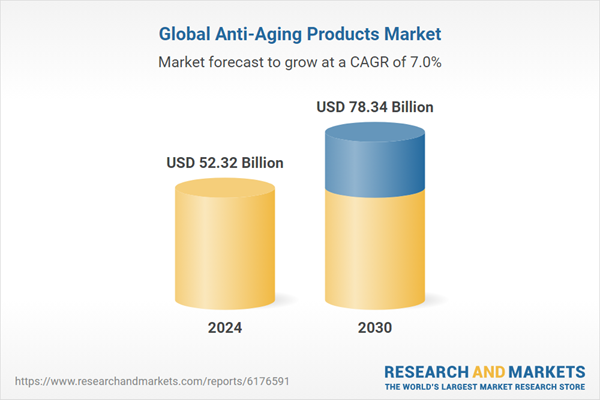
The global anti-aging products market is expected to reach a value of $78.34 billion by 2030 from $52.32 billion in 2024, growing at a CAGR of 6.96%

The market is growing significantly, driven by several factors including technological advancements and product innovation, clean beauty trends, and the rising demand for personalization. In addition, the increasing demand for men’s grooming, an aging population, the preventive skincare from a younger age, digital engagement, and growing interest in skin health are further contributing to the market’s growth.

The global anti-aging products market report consists of exclusive data on 25 vendors. The market is highly competitive and fragmented, comprising a mix of established global players, small companies, and niche brands. Larger players are heavily investing in the development of new products to attract a wider consumer base and maintain competitiveness. In contrast, niche companies focus on offering highly affordable, single-ingredient serums, leveraging their agility to introduce innovative products by engaging directly with consumers and delivering authentic solutions.

Companies are also investing significantly in R&D to deliver new solutions and secure patents. In addition, larger firms are actively acquiring successful brands to fill portfolio gaps. Competition among players remains intense, as rapid advancements in technology and formulations raise consumer expectations for continual innovation and upgrades in anti-aging products.

ANTI-AGING PRODUCTS MARKET GEOGRAPHICAL ANALYSIS

North America leads the global anti-aging products market with the largest share of over 34%. The market is driven by several factors, including high consumer awareness, the longevity economy and aging population, innovations and technological advancements, stringent regulations, personalization trends, and the “beauty from within” movement.

The US dominates the regional market due to advancements in technology and innovation, a strong focus on longevity, and heightened skin health awareness. Meanwhile, Canada is emerging as one of the fastest-growing countries in the North American anti-aging products market.

Well-informed consumers are seeking solutions that support skin longevity, integrity, and a youthful appearance. This demand is further fueled by health-centric messaging, social media, and influencer marketing. The “beauty from within” trend is encouraging consumers to purchase high-quality, natural ingredient-based anti-aging products. As a result, companies are increasingly adopting natural ingredients in product formulations and targeting consumers who prioritize natural skincare, which is expected to drive market growth during the forecast period.

繼續閱讀

ANTI-AGING PRODUCTS MARKET TRENDS

Advancement & Product Innovation

The advancement & product innovation is a trend in the global anti-aging products market. It is driven by several factors, including the rise of prejuvenation, rising demand for proven efficacy, integration of new formulations into daily routines, desire for customization & personalization, and influence of clean beauty.

Product innovation is showing promising growth in the global anti-aging products market due to several factors, including targeted functionalities, ethical sourcing, and accessibility. Manufacturers are continuously investing in R&D activities to create new and innovative anti-aging products, as consumers’ demand for effective and natural skin health solutions has increased significantly.

Clean Beauty Trends

The clean beauty trend in the global market is fueling the growth of anti-aging products. It is driven by several factors, such as an increased demand for recognizable & natural ingredients, increased environmental & ethical consciousness, concerns about artificial additives, shift from anti-aging to healthy longevity, and premiumization in the market.

The consumers, especially Millennials and Gen Z, are actively seeking information about the products on online platforms that demand clean beauty. They are actively seeking ingredient labels that increase transparency in the market. The demand for clean beauty is creating stronger competition among the market players. Thus, the brand has differentiated itself with manufacturing processes, ethical practices, and ingredient sourcing.

ANTI-AGING PRODUCTS MARKET DRIVERS

Aging Population

An aging population is a crucial and major factor driving the growth of the anti-aging products market across the globe. Several factors drive it: increased disposable income, increased focus on health & well-being, and an active lifestyle. The older population is more proactive as compared to previous generations about health & wellness. They want to slow down the aging signs and look for healthy longevity. This generation is more engaged in life and has a more active lifestyle. It drives the demand for products that align with a healthy lifestyle and are more effective.

Preventive Skincare from a Younger Age

Preventive skincare from a younger age is a significant driver in the global anti-aging products market. It is driven by several factors: the rise of prejuvenation, increased skincare awareness & education, concern beyond wrinkles, social media influence, and the clean beauty movement. The rise of prejuvenation is most prevalent among Millennials and Gen Z, who are adopting anti-aging products in their early 20s. The focus has shifted from reactive to a healthy longevity of a proactive mindset. They are investing heavily in a future youthful appearance.

INDUSTRY RESTRAINTS

High Cost

The high cost is impacting the anti-aging products market in various ways, including slow growth, limited accessibility, price sensitivity, and competition. It may restrict the price-sensitive people from buying such products. The high cost of anti-aging products is a direct reflection of the various investments that are required for bringing them to the market.

It includes high-potency ingredients, premium packaging & marketing, rigorous regulations & efficacy testing, and extensive research & development. Sourcing clinically proven ingredients like advanced peptides, hyaluronic acid, and vitamin C derivatives can be more expensive. The use of sustainably sourced or rare plant-based ingredients can also add to the cost. It increases the overall cost of the anti-aging product.

KEY QUESTIONS ANSWERED:

  • How big is the global anti-aging products market?

  • What is the growth rate of the global anti-aging products market?

  • Who are the major players in the global anti-aging products market?

  • What are the key drivers of the global anti-aging products market?

KEY TAKEAWAYS

  • By Product: The creams, lotions & moisturizers segment accounted for the largest market share of over 45%.

  • By Application: The anti-wrinkle segment dominates and holds the largest market share.

  • By Gender: The men segment shows the highest growth of 7.88% during the forecast period.

  • By Distribution Channel: The offline segment holds the largest global anti-aging products market share.

  • By Geography: North America leads the global anti-aging products market with the largest share of over 34%.

  • Growth Factor: The global anti-aging products market is set to grow due to an aging population and increasing preventive skincare from a younger age.

Key Attributes:

Report Attribute

Details

No. of Pages

138

Forecast Period

2024 – 2030

Estimated Market Value (USD) in 2024

$52.32 Billion

Forecasted Market Value (USD) by 2030

$78.34 Billion

Compound Annual Growth Rate

6.9%

Regions Covered

Global

ANTI-AGING PRODUCTS MARKET VENDOR LANDSCAPE

Key Vendors

Other Prominent Vendors

SEGMENTATION & FORECASTS

By Product

By Application

  • Anti-Wrinkle

  • Anti-Pigmentation

  • Others

By Gender

By Distribution Channel

By Geography

  • North America

  • US

  • Canada

  • Europe

  • Germany

  • France

  • UK

  • Italy

  • Spain

  • APAC

  • China

  • Japan

  • South Korea

  • India

  • Latin America

  • Brazil

  • Mexico

  • Middle East & Africa

  • South Africa

  • Turkey

  • Saudi Arabia

For more information about this report visit https://www.researchandmarkets.com/r/eay61s

About ResearchAndMarkets.com
ResearchAndMarkets.com is the world’s leading source for international market research reports and market data. We provide you with the latest data on international and regional markets, key industries, the top companies, new products and the latest trends.

Attachment

CONTACT: CONTACT: ResearchAndMarkets.com Laura Wood,Senior Press Manager press@researchandmarkets.com For E.S.T Office Hours Call 1-917-300-0470 For U.S./ CAN Toll Free Call 1-800-526-8630 For GMT Office Hours Call +353-1-416-8900

Tags: , , , , , , , , , ,
New Global Wellness Institute Report Shows UAE Wellness Economy Now Worth $40.8 Billion

New Global Wellness Institute Report Shows UAE Wellness Economy Now Worth $40.8 Billion

Classified in: Health, Business
Subjects: NPT, SVY, LIC

In partnership with Aldar, the report shows the UAE wellness economy grew 14.3% between 2019 and 2024?the fastest growth in the Middle East

MIAMI, Nov. 19, 2025 /PRNewswire/ — The non-profit Global Wellness Institute (GWI), the leading research organization for the global wellness industry, today released a new report on the wellness economy of the United Arab Emirates (UAE)?revealing it is the fastest-growing in the Middle East/North Africa (MENA) region and is now valued at $40.8 billion.

The 2025 report is available on GWI’s Geography of Wellness platform thanks to a new partnership with leading real estate developer Aldar, and shows the UAE ranks #1 in the region in several wellness sectors, including Wellness Real Estate ($1.4 billion in 2024), Personal Care & Beauty ($14.8 billion in 2024) and Spa Revenue ($2.9 billion in 2024), and is growing fastest among all MENA countries in the sectors of Public Health, Prevention & Personalized Medicine; Physical Activity; and Workplace Wellness.

“The UAE’s National Strategy for Wellbeing 2031 aims to position the country as a global leader in quality of life, so it’s not surprising that its wellness economy is the fastest growing in the Middle East and North Africa,” said Susie Ellis, GWI chair and CEO. “Blending innovation with heritage, the UAE is redefining itself as a wellness destination for visitors and residents alike. We’re especially grateful to Aldar?who are creating some of the most innovative wellness real estate projects in the world?for partnering with us to bring these country-specific insights to light.”

In recent years, the UAE’s wellness real estate sector has surged, growing an impressive 22.8% from 2019 to 2024. And with new properties like SHA Emirates and Aldar’s Fahid Island?Abu Dhabi’s first coastal wellness destination?on the horizon, the wellness real estate market is poised to grow even further.

The UAE’s wellness tourism sector has also grown at an impressive 23.5% CAGR and is now worth $11.3 billion. This has been fueled in part by the UAE Tourism Strategy 2031, which emphasizes medical and wellness tourism as a growth area and aims to diversify tourism offerings, expand wellness travel and position wellbeing as both a lifestyle priority and a driver of economic growth and global competitiveness.

Jonathan Emery, Chief Executive Officer at Aldar Development, said: “The UAE is leading a global transformation in how communities are designed to actively shape better, healthier lives. When wellness is intentionally embedded from the earliest planning stages, through walkable layouts, community-focused designs, and amenities that promote social connection, it creates environments where healthy choices become intuitive. Our collaboration with the Global Wellness Institute is an important part of this ambition as it enables us to inform our design process with data and insights that will help to make wellbeing an everyday standard.”

LIVING WELL IN THE UNITED ARAB EMIRATES

The UAE is carving out a distinctive identity as a world-class wellness destination?a place where tradition meets innovation and luxury blends with authenticity. The country’s deep wellness heritage draws from ancient healing practices and Bedouin wisdom, from herbal remedies and hammam rituals to a traditional diet rich in antioxidant ingredients and fresh catch from the sea.

Today, visitors and residents alike can enjoy modern skincare and aromatherapy treatments infused with traditional botanicals like frankincense and myrrh. An extensive array of urban wellness retreats, spas, fitness centers and health food offerings in the UAE are augmented by options to use biometric skin analysis, biofeedback systems and AI diagnostics to deliver personalized treatments, fitness plans, stress management programs and nutrition guidance.

The UAE is heavily investing in AI-driven healthcare to improve efficiency, accessibility and quality of care. Mindful of its delicate ecosystem, the Emirates has set out an ambitious plan to reduce its ecological footprint through renewable energy, water conservation and carbon reduction. Wellbeing has been a national priority in the UAE since 2019, when the government launched its National Strategy for Wellbeing 2031, with the objective of enhancing the quality of life, building up capabilities and promoting the culture of wellbeing across the nation.

KEY WELLNESS EXPERIENCES IN THE UNITED ARAB EMIRATES

The Emirates’ varied geography?from vast desert expanses to rugged mountains and tranquil coastlines?offers a serene backdrop for mental rejuvenation, cultural immersion and outdoor adventures such as falconry, camel trekking, horseback riding and desert meditation.

Guests who want to leverage technology for wellness can access advanced platforms to track sleep cycles, heart rate variability and stress markers to generate personalized wellness plans. Eco-friendly spas and resorts in the UAE are adopting solar-powered facilities, organic skincare products and zero-waste wellness programs. As the UAE continues to evolve its wellness landscape, it remains steadfast in its commitment to delivering transformative experiences where visitors can unwind in tranquil deserts, reconnect with nature in serene oases and embrace futuristic wellness solutions that empower mind, body and spirit.

To learn more about the UAE’s wellness economy, visit its dedicated Geography of Wellness page on the GWI website.

About the Global Wellness Institute
The Global Wellness Institute (GWI), a nonprofit 501(c)(3), is considered the leading global research and educational resource for the global wellness industry and is known for introducing major industry initiatives and regional events that bring together leaders to chart the future. GWI positively impacts global health and wellness by educating public institutions, businesses and individuals on how they can work to prevent disease, reduce stress and enhance overall quality of life. Its mission is to empower wellness worldwide.

About Aldar
Aldar is the leading real estate developer, manager, and investor in Abu Dhabi, with a growing presence across the United Arab Emirates, the Middle East, North Africa, and Europe. The company has two core business segments, Aldar Development and Aldar Investment.
Aldar Development is a master developer of a 62 million sqm strategic landbank, creating integrated and thriving communities across Abu Dhabi, Dubai, and Ras Al Khaimah’s most desirable destinations. The delivery of Aldar’s developments is managed by Aldar Projects, which is also a key partner of the Abu Dhabi government in delivering housing and infrastructure projects across the UAE’s capital. Internationally, Aldar Development wholly owns UK real estate developer London Square, as well as a majority stake in leading Egyptian real estate development company, SODIC. Aldar Investment houses a core asset management business comprising a portfolio of more than AED 47 billion worth of investment grade and income-generating real estate assets diversified across retail, residential, commercial, logistics, and hospitality segments. It manages four core platforms: Aldar Investment Properties, Aldar Hospitality, Aldar Education, and Aldar Estates. For more information on Aldar please visit www.aldar.com.

SOURCE GLOBAL WELLNESS INSTITUTE

These press releases may also interest you

News published on 19 november 2025 at 23:30 and distributed by:

Tags: , , , , , , , ,
Microneedling Market is Projected to Reach USD 1.1 billion by 2030, Driven by Growing Demand for Skin Treatments

Microneedling Market is Projected to Reach USD 1.1 billion by 2030, Driven by Growing Demand for Skin Treatments

Mordor Intelligence has published a new report on the Microneedling Market, offering a comprehensive analysis of trends, growth drivers, and future projections.

— Introduction: Understanding the Microneedling Market 

The microneedling devices market size stood at USD 0.65 billion in 2025 and is forecast to reach USD 1.1 billion by 2030, advancing at a 10.9% CAGR. The microneedling market is experiencing robust growth, with increasing demand for non-invasive skin treatments and aesthetic procedures. The rise in skincare awareness, coupled with the preference for minimally invasive options, has resulted in an expansion of the microneedling industry. This technique, also known as collagen induction therapy, has gained widespread popularity for its effectiveness in treating a range of skin issues, including acne scars, fine lines, and wrinkles. The market’s growth is further driven by advancements in technology, along with increasing consumer interest in achieving youthful, glowing skin without the need for invasive surgeries. 

Key Trends Driving the Microneedling Market 

Several key trends are influencing the growth trajectory of the microneedling market. These include: 

  • Rising Demand for Non-Invasive Aesthetic Procedures: Microneedling’s ability to rejuvenate skin and treat various skin issues without the need for surgery has positioned it as a go-to treatment for people looking for non-invasive solutions. Its popularity is particularly strong among individuals seeking to minimize the appearance of scars, fine lines, and stretch marks. 
  • Increased Awareness of Skin Health: Growing awareness about skincare and skin health has led consumers to opt for treatments that promote long-term benefits. Microneedling, known for boosting collagen production, is seen as a safe and effective way to rejuvenate skin and improve overall texture, further fueling its demand. 
  • Technological Advancements in Devices: The development of advanced microneedling devices with enhanced precision, adjustable needle depths, and added safety features has made treatments more comfortable and effective. These innovations are attracting both professionals and individuals seeking at-home solutions for skincare. 
  • Expanding Aesthetic Clinics and Home Treatment Kits: A significant shift toward at-home skincare devices and the growing number of aesthetic clinics offering microneedling treatments are expanding the market’s reach. Consumers now have more access to professional services and devices that allow them to perform treatments in the comfort of their homes. 

Market Segmentation 

By Product Type 

  •  Manual Dermarollers  
  • Automated Microneedling Pens  
  • RF Microneedling Systems  
  • Hydro / Infusion Microneedling Devices  
  • Dissolving Microneedle Patches  

By Application  

  • Skin Rejuvenation & Anti-aging  
  • Acne & Surgical Scar Revision  
  • Hyperpigmentation & Melasma  
  • Alopecia / Hair Restoration  
  • Stretch Marks & Cellulite  
  • Transdermal Drug / Vaccine Delivery 

 By End User  

  • Dermatology & Plastic Surgery Clinics  
  • Aesthetic MedSpas 
  •  Hospitals  
  • Home-use Consumers 

By Geography 

  •  North America 
  • South America 
  • Europe 
  • Asia pacific 
  • Middle east&Africa 

Explore Our Full Library of microneedling market Industry Reports – https://www.mordorintelligence.com/industry-reports/microneedling-market?utm_source=marketersmedia 

Key Players in the Microneedling Market 

  • DermapenWorld 
  • Crown Aesthetics (SkinPen) 
  • Cynosure 
  • Cutera 
  • Candela Medical 

Conclusion: The Future of the Microneedling Market 

The microneedling market is poised for significant growth, driven by increasing demand for non-invasive aesthetic procedures, technological advancements in devices, and greater awareness of skincare benefits. As more consumers seek effective treatments for a range of skin concerns, microneedling will continue to be at the forefront of the aesthetic industry. The growing popularity of at-home devices and the expansion of aesthetic clinics worldwide will further fuel market expansion. 

In the coming years, the industry is expected to witness further innovation in microneedling devices, enhancing both safety and results. With the rising focus on anti-aging and skin health, the microneedling market will continue to evolve, catering to a broad consumer base across various demographics. 

As the market grows, companies that focus on technological improvements, safety standards, and accessibility will likely maintain a strong foothold, offering consumers a wide range of options to suit their skincare needs. 

About Mordor Intelligence: 

Mordor Intelligence is a trusted partner for businesses seeking comprehensive and actionable market intelligence. Our global reach, expert team, and tailored solutions empower organizations and individuals to make informed decisions, navigate complex markets, and achieve their strategic goals. 

With a team of over 550 domain experts and on-ground specialists spanning 150+ countries, Mordor Intelligence possesses a unique understanding of the global business landscape. This expertise translates into comprehensive syndicated and custom research reports covering a wide spectrum of industries, including aerospace & defense, agriculture, animal nutrition and wellness, automation, automotive, chemicals & materials, consumer goods & services, electronics, energy & power, financial services, food & beverages, healthcare, hospitality & tourism, information & communications technology, investment opportunities, and logistics. 

For any inquiries or to access the full report, please contact: 

media@mordorintelligence.com  

https://www.mordorintelligence.com/  

About the company: Mordor Intelligence is a trusted partner for businesses seeking comprehensive and actionable market intelligence. Our global reach, expert team, and tailored solutions empower organizations and individuals to make informed decisions, navigate complex markets, and achieve their strategic goals.

With a team of over 550 domain experts and on-ground specialists spanning 150+ countries, Mordor Intelligence possesses a unique understanding of the global business landscape. This expertise translates into comprehensive syndicated and custom research reports covering a wide spectrum of industries, including aerospace & defense, agriculture, animal nutrition and wellness, automation, automotive, chemicals & materials, consumer goods & services, electronics, energy & power, financial services, food & beverages, healthcare, hospitality & tourism, information & communications technology, investment opportunities, and logistics.

For any inquiries or to access the full report, please contact:

media@mordorintelligence.com

https://www.mordorintelligence.com/

Contact Info:
Name: Jignesh Thakkar
Email: Send Email
Organization: Mordor Intelligence
Address: Hyderabad
Phone: +1617-765-2493
Website: https://www.mordorintelligence.com/

Release ID: 89176102

In the event of encountering any errors, concerns, or inconsistencies within the content shared in this press release, we kindly request that you immediately contact us at error@releasecontact.com (it is important to note that this email is the authorized channel for such matters, sending multiple emails to multiple addresses does not necessarily help expedite your request). Our dedicated team will be readily accessible to address your feedback within 8 hours and take appropriate measures to rectify any identified issues or facilitate press release takedowns. Ensuring accuracy and reliability are central to our commitment.

Source : Microneedling Market is Projected to Reach USD 1.1 billion by 2030, Driven by Growing Demand for Skin Treatments

The information provided in this article was created by MarketersMEDIA Newswire, our news partner. The author’s opinions and the content shared on this page are their own and may not necessarily represent the perspectives of Thailand Business News.

Tags: , , , , , , , , , ,
Best oLive
Privacy Overview

This website uses cookies so that we can provide you with the best user experience possible. Cookie information is stored in your browser and performs functions such as recognising you when you return to our website and helping our team to understand which sections of the website you find most interesting and useful.