A Balanced Guide to Organic Self-Tanners
When it comes to dressing up, I am generally of the opinion that we should choose clothing that complements our skin tone.
The key word though is complement, not match.
Which brings me to graduation season.
This spring, my daughter is graduating not once but twice – first with her associate’s degree, then from high school – and that’s how I learned that graduation dresses are almost always white.
My legs are also pasty white, as are the legs of Miss High School Valedictorian, Class of 1.
The Usual Advice (And Why I Question It)
In most reviews, this is the part where someone says that we all need to avoid UV rays for our health, and the best way to achieve a healthy, sun-kissed glow is to use self-tanner.
However, there’s a growing body of research that suggests there’s a “sweet spot” for sun exposure. Too much can be harmful – but according to respected researchers including Dutch dermatologist Han J. van der Rhee – so can too little. (1)
That’s why, especially in the summer, my family makes it a goal to get sunshine every day. Now, don’t come for me – we do use sunscreen and other strategies like covering up and/or finding shade to avoid overexposure. This article is not about that, though – this one is, if you’re interested.
Now back to the special occasion situation. My daughter found a white dress that’s perfect for senior photos and graduation, and she wanted a safe sunless tanning option, so I decided now is the time to dive deep into the research on what’s available.
What I Found
Over the past couple of years, I’ve seen a lot of ads for organic self-tanners and wondered if they’re truly non-toxic and as good as reviewers say.
The short answer is that there are versions with truly non-toxic ingredients, but the actual biological impact varies depending on when (and possibly how) they’re applied.
The long answer starts with something you’ll see on almost every sunless tanner label – dihydroxyacetone.
Meet DHA, The Active Ingredient
If you’ve looked into self-tanners at all, you’ve probably come across DHA (dihydroxyacetone). It’s the most common active ingredient used to achieve a bronze glow.
DHA is a sugar molecule that reacts with amino acids on your skin’s surface to produce melanoidins, which are brown-pigmented molecules that mimic the look of a natural tan. (2) This surface-level bronzing effect essentially “stains” the top layer of skin.
Some DHA is synthetic, but the form found in organic and natural products is derived from non-GMO sugar beets or sugarcane. It’s generally considered safe for topical use, and has been approved by the U.S. Food and Drug Administration for use in self-tanning lotions.
However, there are a few nuances that don’t get talked about very often.
#1: Sunless Tanning May Reduce Vitamin D Production
Melanoidins might sound similar to melanin, but they’re functionally different.
Melanin formation happens when skin absorbs UV light – it’s a responsive biological process.
Melanoidin is formed when sugars and amino acids combine through the Maillard reaction – the same process that creates a browning effect on toast and roasted potatoes. According to one pilot study, when DHA creates a layer of melanoidins on the skin, it acts as a mild natural sunscreen that can reduce UVB penetration enough to decrease vitamin D production by an average of 24%. (3) (4)
Now, this was a small study, so we need more research to confirm and clarify the details.
However, since more than half of the U.S. adult population already has insufficient levels of vitamin D, I would personally keep an eye on my levels if I was using sunless tanning products on a consistent basis. (5)
For special occasions, when the effect will wear off after about a week, I’m 0% worried about vitamin D. However, I will be following an unofficial 24 hour rule, which leads me to an important caveat:
#2: Sunless Tanning & Sunlight Exposure
If you’re planning to apply sunless tanner before heading to the beach, you might want to do it a couple of days in advance.
Here’s why: Some studies have found that DHA-treated skin may temporarily produce more free radicals when exposed to UV light. (6) The window is estimated to be about 24 hours. (7)
Now, maybe you’re wondering whether erythrulose – a DHA alternative derived from fermented raspberries – has the same impact. The answer is . . probably. We don’t have any research on it specifically, but it works the same way that DHA does – via melanoidins and the Maillard reaction. It’s reasonable to presume that it also temporarily reduces UV tolerance, at least until we have more data.
So what does this mean in practical terms? Many experts recommend applying sunless tanner at night, allowing it to set, and using sunscreen the next day.
This is when thoughtful formulation matters – not just the active ingredient. Many brands now intentionally add antioxidant-rich ingredients to their products to help reduce and/or neutralize free radicals. (8)
#3: A Note On Spray Tans
While lotions and creams are applied topically, spray tans can introduce DHA into areas it wasn’t designed for, like the lungs or mucous membranes.
The FDA has specifically noted that DHA is not approved for inhalation, which is why protective measures (like nose plugs and eye protection) are often recommended during spray applications. I personally think this is more of a concern with commercial spray tans – which use an aerosolized mist with very fine droplets – not at home spray products in pump bottles that release larger droplets.
I personally wouldn’t take a deep breath while spraying my face, though. 🙂
What “Organic” Means (and Doesn’t Mean) in Self-Tanners
Now that we’ve talked about active ingredient, DHA, let’s talk about what else is in the bottle.
For a product to be “certified organic,” it usually needs to contain a very high percentage of organic ingredients.
Some self-tanners meet that standard. Others combine organic ingredients with naturally derived, plant-based components that aren’t certified but improve the formula (like vanilla fruit extract for scent).
Either way, the goal is the same: to create nourishing, skin-friendly blends that don’t include problematic ingredients like:
Parabens
These artificial preservatives can mimic estrogen in the body and have been linked to hormone imbalances, reproductive problems, developmental problems, and other health issues. They also cause significant ecological disruption by acting as endocrine disruptors in wildlife, especially aquatic life, where they cause reproductive and/or developmental problems. (9)
Fragrance (a.k.a. parfum)
Thanks to a loophole in U.S. labeling rules, companies can hide undisclosed chemicals under the catch-all term “fragrance.”
Formaldehyde-Releasing Preservatives
In personal care products, formaldehyde can be added to products to extend their shelf life. But if you’re like me, you’d immediately put back any product that listed formaldehyde on the label. Companies know that, which is why they use formaldehyde-releasing preservatives.
Yep, ingredients like sodium hydroxymethylglycinate don’t contain formaldehyde outright – but they slowly release small amounts over time as they break down. There’s no formaldehyde on the label, but exposure is still happening, and according to the Campaign for Safe Cosmetics even low levels – around 250 parts per million (ppm) or even 200 ppm in sensitized individuals – are cause for concern. (10)
Artificial Dyes
Many self-tanners use added colorants to create an instant “bronzed” look before the active ingredient develops.
These dyes are often petroleum-derived and can trigger redness, itching, or sensitivity.
Common examples include:
- FD&C Red 40
- FD&C Yellow 5
- FD&C Blue 1
- Coal tar–derived colorants
What I’d Want My Daughter to Know
That was a lot . . . probably more than you were looking for!
Here’s why: when my mom, sister, or daughter asks me for a recommendation, I want them to have the important details before deciding what works best for them. I want the same for you, too.
With all of that in mind, here’s what I’d say to my daughter about sunless tanners (actually, it’s what I did say):
- They’re great for special occasions.
- Apply them at night, then avoid heavy sun exposure the next day. Use sunscreen if you’re going to be outside.
- Pay attention to the overall formulation, not just the active ingredient. I’d look for products that intentionally include antioxidants.
- If you start using self-tanner often, it may be worth keeping an eye on your vitamin D levels.
My Top 3 Picks for Organic Self-Tanners
Navigating the “natural” beauty landscape can be overwhelming. Many brands greenwash, and there are so many to sift through it can be difficult to even know where to start.
To narrow down my list, I looked for:
- High Percentage of Organic/Natural Ingredients: Obviously. Antioxidant-rich formulas were also a high priority.
- Absence of “Red Flag” Ingredients: No parabens, phthalates, synthetic fragrances, etc.
- Performance: The goal is sun-kissed, not orange.
- Streak-Free Application: Nobody wants zebra stripes.
- Positive Reviews: Does it consistently perform well for real users?
I ended up ruling out several popular “clean” self-tanners that rely on frequent reapplication or ingredient bases I wasn’t comfortable with. The ones below are the few that met my criteria for both formulation and real-world performance.
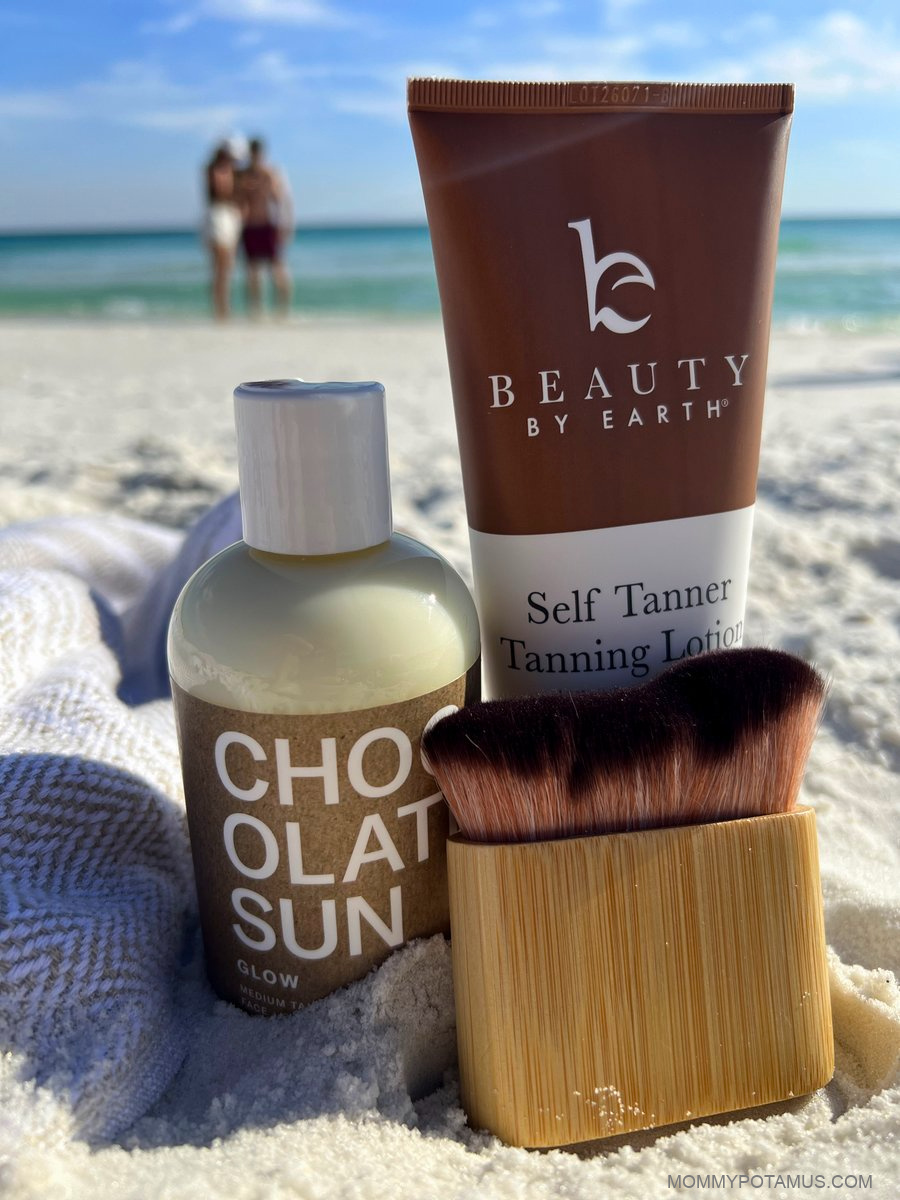
🥇 Beauty by Earth Self Tanner Body Lotion
Best overall balance of pure ingredients + performance
This body lotion is a crowd favorite for good reason. It gives skin a natural-looking glow without veering orange, and is versatile enough to be used on the face as well as the body. Beauty By Earth does make a separate face lotion for sensitive, dry, or breakout-prone skin, but to keep things simple I just used the body lotion and it worked well for me.
The organic aloe and shea butter base leaves skin feeling soft and supple – not dry – and the formula also includes antioxidants like green tea extract, pomegranate extract, and witch hazel extract.
It’s user-friendly, making it a great option for people (like me) who don’t use it enough to have expert-level applications skills. The scent is subtle and pleasant.
Why it stands out:
- Simple ingredients
- Good color (not orange-heavy)
- Consistently strong user feedback
- Pregnancy safe
Key Ingredients
- Organic Aloe Vera: Hydrates and soothes.
- Organic Shea Butter: Deeply moisturizes and improves skin elasticity.
- Organic Coconut Oil: Nourishes and provides a lovely scent.
- DHA from sugar beets: The bronzing ingredient.
- Antioxidants: Green tea extract, pomegranate extract, and witch hazel extract.
🥈 Chocolate Sun Tanning Cream (Face & Body)
Chocolate Sun uses a moisturizing base of organic aloe, coconut oil, jojoba oil, and other skin-conditioning botanicals to support hydration while the color develops.
What I like most about it is that it doesn’t rely on repeated applications to work. You’ll typically start to see color within a few hours, with a deeper, natural-looking tan developing over time – making it a great option for occasional use rather than something you have to maintain throughout the week.
The texture is easy to work with, which makes application very forgiving (especially if you’re not using self-tanner regularly).
Why it stands out:
- 89% Organic Ingredients
- Designed to work well with a single application
- Simple, botanical-focused formula
- Good color
- Hydrating base that supports skin during development
Key Ingredients
- Aloe Vera: Hydrates and supports skin barrier
- Coconut Oil: Nourishes and helps with even application
- Jojoba Oil: Mimics skin’s natural oils for a balanced feel.
- Sweet Almond & Sunflower Oil: Lighter oils for absorption
- DHA (naturally derived): Active tanning ingredient
- Antioxidant: Green Tea Leaf Extract
🥉Eco Tan Invisible Tan Cream
Best certified organic option
This brand is certified organic in Australia, where it was founded along the Gold Coast by Sonya Driver. I haven’t personally tried their highly rated Invisible Tan cream because it’s currently out of stock in many places.
However, it’s consistently one of the highest-rated options in the natural beauty space, and reviewers say it’s rich, glides on smoothly, and develops into a beautiful, natural-looking bronze overnight.
From a formulation standpoint, it checks a lot of boxes: certified organic ingredients, a nourishing base (including aloe and plant oils), and a focus on antioxidants.
They do offer other products as well, like Hempitan, but reviews are more mixed. I’m waiting for the Invisible Tan Cream to come back in stock, then I will test it out and report back.
Why it stands out:
- Certified organic (In Australia)
- Good mid-tone color
Key Ingredients
- Organic Aloe Vera: Soothes and hydrates the skin.
- Macadamia Seed Oil: High in fatty acids that are highly moisturising, and work to regenerate and soften the skin.
- Organic Avocado Oil: Rich in vitamin E, deeply moisturizing.
- Antioxidants: Elderberry extract, geranium oil, chamomile extract
- DHA (Dihydroxyacetone) derived from natural sugar beet: The active bronzing agent.
How to Get the Best Results (Without Overcomplicating Things)
You don’t need a 15-step routine to get a good result, but a few small things make a big difference.
Start with smooth skin
Exfoliating ahead of time helps the color go on evenly and fade more naturally. A natural-fiber mitt (made with loofah, hemp or sisal) works well for this.
Moisturize dry areas first
Elbows, knees, ankles, and hands tend to grab more color. A light layer of moisturizer in those spots helps keep things even.
Apply like you would a body lotion
Work in sections and blend well. You don’t need perfect technique – just take your time and don’t rush it.
About mitts and brushes
Most brands recommend using an application mitt or kabuki brush for the smoothest finish. As far as I can tell, those are almost always made with synthetic fibers, which isn’t ideal from a microplastics standpoint.
That said, for occasional use, I think it’s a reasonable tradeoff if it helps you avoid streaks. If you’d rather skip it, applying with clean hands and washing thoroughly afterward works just fine.
Give it time to develop
I prefer applying at night and letting it develop while I sleep. It’s simpler, and it lines up with the earlier point about avoiding sun exposure right after application.
FREE Ebook: DIY Body Care Gifts Made Simple
Do you want to give gorgeous, handcrafted gifts for family and friends, without spending a bunch of time on them?
Then I’d love to give you a free copy of DIY Body Care Gifts Made Simple – my step-by-step guide to making gorgeous handcrafted gifts without stressing yourself out – as a gift for signing up for my newsletter. I’ll show you how to make vintage labels, luxurious lotion bars, lip balms, sugar scrubs, body sprays and more like a pro. Sign up for my newsletter and you’ll be redirected to the download page immediately!
Sources
- van der Rhee H, de Vries E, Coomans C, van de Velde P, Coebergh JW. (2016). Sunlight: For Better or For Worse? A Review of Positive and Negative Effects of Sun Exposure. Cancer Research Frontiers.
- Turner J, Schalla W, Tosca M, Rosado C. (2023). In search of the perfect tan: Chemical activity, biological effects, business considerations, and consumer implications of dihydroxyacetone sunless tanning products. Journal of Cosmetic Dermatology.
- Armas LAG, Fusaro RM, Sayre RM, Huerter CJ, Heaney RP. (2009). Do melanoidins induced by topical 9% dihydroxyacetone sunless tanning spray inhibit vitamin D production? A pilot study. Photochemistry and Photobiology.
- Laferté C, Oliel S, Pehr K. (2026). Clinical Use and Safety of Self-Tanner (Topical Dihydroxyacetone) in Dermatology: A Systematic Review. Journal of Cutaneous Medicine and Surgery.
- Cui A, Xiao P, Ma Y, Fan Z, Zhou F, Zheng J, Zhang L. (2022). Prevalence, trend, and predictor analyses of vitamin D deficiency in the US population, 2001–2018. Frontiers in Nutrition.
- Garone M, Howard J, Fabrikant J. (2015). A review of common tanning methods. Journal of Clinical and Aesthetic Dermatology.
- Gallagher M. (2018). Exposure to Dihydroxyacetone in Sunless Tanning Products: Understanding the Risks. Journal of the Dermatology Nurses’ Association.
- Dobos K. (2013). Formulating Sunless Tanning Products with DHA: Current Challenges. Cosmetics & Toiletries.
- Agarwal D, Bhatt U, Soni V. (2025). Ecotoxicological impacts of parabens on flora and fauna. npj Emerging Contaminants.
- Campaign for Safe Cosmetics. Formaldehyde and Formaldehyde-Releasing Preservatives.