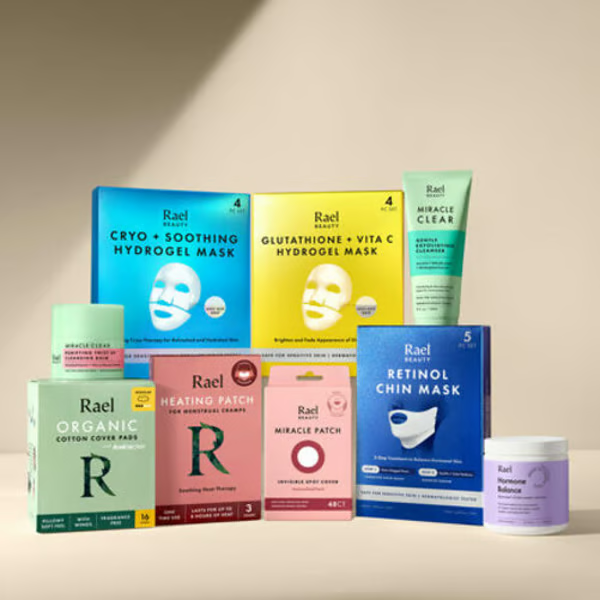
TowerBrook invests in women’s wellness brand Rael

TowerBrook invests in women’s wellness brand Rael

Published

August 25, 2026

TowerBrook Capital Partners has announced a strategic partnership with women’s wellness brand Rael, as the investment firm looks to help expand the business across channels and international markets.

TowerBrook invests in women’s wellness brand Rael. – Rael

Founded in 2017 by three Korean American women, Rael offers feminine care, skincare and hormonal wellness products designed to support women through different stages of life.

As part of the partnership, Rael will work with TowerBrook to expand its distribution, continue developing its product portfolio and reach more consumers globally. The companies also plan to advance education around holistic cycle care.

“We started Rael because we believed women deserved better choices in period care, and that belief led us to pioneer holistic cycle care,” said Yanghee Paik, CEO and co-founder of Rael. 

“From our first conversation, TowerBrook understood the impact of our mission and believed in it as deeply as we do. Their track record of scaling founder-led brands while preserving their uniqueness makes them the ideal partner as we aim to serve more women around the world.”

Rael will continue to be led by Paik. John Replogle has also been appointed chair of the board, bringing experience from leadership roles at natural personal care and consumer brands including Burt’s Bees and Seventh Generation, as well as Unilever’s North American skincare business.

“Rael extends TowerBrook’s track record of investing behind products and services that help consumers live healthier lives and builds on the firm’s experience scaling emerging brands through periods of transformational growth,” said Michael Recht, managing director at TowerBrook. 

“Rael’s products have distinct positioning in women’s wellness, and we are excited to build upon the unique trust the brand has developed with consumers.”

Rael is headquartered in Los Angeles with an office in Seoul and has built an omnichannel presence across the U.S. and South Korea. It is available in more than 40,000 retail doors across the U.S. and Korea, including Target, Walmart, Ulta Beauty, CVS and Walgreens.

Prior to this investment, Rael raised $59 million in funding since launch. 

Copyright © 2026 FashionNetwork.com All rights reserved.

Tags: , , , , ,
Hormones, Fluid Balance & Your Lymphatic System

Hormones, Fluid Balance & Your Lymphatic System

Sometimes perimenopausal changes are obvious. Others are harder to put your finger on. You wake up looking puffier than usual. Clothes that fit comfortably one day feel snug the next. Sliding an Oura ring (or any ring) on and off your finger starts requiring a little more negotiation. Maybe you’ve even noticed that cellulite dimples look more noticeable.

Nothing dramatic happened – your body just seems to be handling fluid differently.

If this sounds familiar, there’s an overlooked part of perimenopause physiology worth talking about: how hormonal changes can influence your lymphatic system.

Estrogen and progesterone both influence how your body manages fluid, and it turns out that estrogen also directly interacts with the lymphatic system in some pretty interesting ways. (1) (2) Researchers are still working out exactly how all of those pieces come together during perimenopause, but we know enough to see that the systems are far more interconnected than previously understood.

Understanding that relationship can make some of these seemingly random changes feel a lot less random – and give us a clearer idea of how to support the body through them.

So let’s take a closer look at what your lymphatic system does, what we know about its relationship with perimenopause, and holistic ways to support healthy lymph flow through hormonal shifts.

As always, this is not medical advice and is not intended to diagnose or treat any condition. None of these statements have been evaluated by the FDA. Now let’s dive in.

Meet Your Other Circulatory System

When we think about circulation, blood usually gets most (if not all) the attention. But running alongside the cardiovascular system is another sprawling network with an equally important job: managing the fluid around your cells.

Your lymphatic system reaches throughout the body through a network of vessels, lymph nodes, tissues, and organs that include the thymus, spleen, and tonsils.

Here’s where the two circulatory systems meet. As blood travels through tiny capillaries, some fluid moves into the surrounding tissues, carrying oxygen, nutrients, hormones, and other substances to your cells. Much of that fluid eventually returns directly to the bloodstream – but not all of it.

The lymphatic system picks up what’s left behind, including excess fluid, proteins, and other material that need to be carried away from the tissues. (3)

Once that fluid enters a lymphatic vessel, it becomes lymph. From there, it travels through an extensive network of vessels and lymph nodes before eventually being returned to the bloodstream.

Even your brain has its own version of a rinse cycle that works closely with the lymphatic system. Called the glymphatic system, it uses cerebrospinal fluid to help carry metabolic waste and other byproducts away from the brain, especially during sleep.

So in a sense, the cardiovascular and lymphatic systems are partners: one delivers, while the other collects, recirculates, and helps keep the fluid environment around your cells in balance.

But fluid balance is only part of the lymphatic system’s job.

More Than a Drainage System

The lymphatic system is also an important part of your immune defenses. Lymph nodes act as gathering places where immune cells can encounter pathogens and other potential threats, helping the body decide when and how to respond.

As lymph moves through the body, it also carries proteins, cellular debris, and inflammatory signaling molecules away from tissues. (4) And in the digestive tract, specialized lymphatic vessels called lacteals absorb much of the dietary fat and fat-soluble nutrients we eat.

Also, although our two circulatory systems work together, they have some pretty unique differences. For example, your cardiovascular system has one central pump – the heart – but your lymphatic system doesn’t.

That doesn’t mean it just sits around waiting for us to move. Walking, muscle contractions, breathing, and changes in pressure throughout the body do all help move lymph along, but larger collecting lymphatic vessels contain smooth muscle of their own and rhythmically contract to help propel lymph forward.

So the lymphatic system is doing a lot more than draining excess fluid. It’s helping regulate the environment around your cells, supporting immune activity, transporting nutrients, and keeping lymph moving through the body.

And that brings us back to perimenopause. Because the lymphatic system is so involved in fluid regulation, changes in the hormones that influence both fluid balance and lymphatic biology may help explain why things can start to feel different during midlife.

What Do Hormones Have to Do With Lymph?

So what does all of this have to do with perimenopause – and why might our bodies suddenly seem to handle fluid differently?

There probably isn’t just one simple answer. Instead, research is uncovering several ways that reproductive hormones, fluid regulation, and lymphatic function connect.

  • Estrogen and progesterone influence fluid regulation. Both hormones affect the systems that regulate water and sodium, although they don’t necessarily do so in the same way. Estradiol can change when the body signals thirst and releases vasopressin, while also influencing blood volume and how fluid is distributed between tissues. Progesterone modifies some of those responses as well. (1)
  • Estrogen directly influences lymphatic biology. Experimental research shows that estrogen signaling – especially through ERα receptors – affects lymphatic endothelial cells (the cells that line lymphatic vessels), encourages new lymphatic vessel growth, helps maintain vessel stability, and supports repair after lymphatic injury. (5)
  • Progesterone interacts with lymphatic cells, too. Human lymphatic endothelial cells can metabolize progesterone and contain receptors that allow them to respond to steroid hormones. We don’t yet know exactly how that plays out during perimenopause, but it’s another indication that the hormonal and lymphatic systems are interacting at a cellular level. (6)
  • Lymphatic function appears to change with age and sex. In a study of 399 healthy adults, leg lymphatic pumping pressure declined with age, with a bigger drop seen in women of postmenopausal age. The study didn’t isolate the role of hormones, but the finding suggests that the menopause/aging transition may influence lymphatic function in women. (7)

There’s one more connection worth mentioning here: inflammation. Changing estrogen levels are associated with shifts toward more pro-inflammatory signaling during the menopausal transition. At the same time, the lymphatic system helps carry inflammatory signaling molecules, immune cells, and excess fluid away from tissues – an important part of resolving a local inflammatory response.

In other words, healthy lymphatic function becomes especially important during midlife – a time when the body may already be navigating a higher inflammatory load.

What This Means During Perimenopause

Taken together, the research suggests that perimenopausal fluid shifts are part of a bigger physiological picture. Our sex hormones influence systems far beyond reproduction, and fluid balance sits at an interesting intersection between fluctuating hormones and lymphatic function.

So while we can’t control every hormonal up and down in midlife, we can support the everyday processes that help the lymphatic system do its job.

Movement, muscle contractions, breathing, and other mechanical forces all help lymph move through the body, and there are other supportive approaches we can layer in as well.

From here, I’ll be sharing several ways to support healthy lymph flow, including herbs traditionally used for lymphatic support, a nourishing lymph-support tea, and simple everyday habits that help keep things moving.

✋ Before You Go, Grab This Free Midlife Guide

If you’ve ever found yourself thinking, “Why doesn’t my body respond the way it used to?” . . . this guide was written for you.

Midlife can change the rules for everything from sleep and energy to workouts, recovery, body composition, and more. Knowing what’s changing can help you let go of strategies that no longer fit – and start focusing on what supports your body now.

Inside, I’ll walk you through 10 things I wish I’d known sooner, so you can make more sense of what you’re experiencing and get clearer about where to go from here.

Enter your email below and I’ll send it right over. You’ll also receive my weekly newsletter with practical wellness tips, recipes, and new guides like this one.

Sources

  1. Stachenfeld, N. S. (2008). Sex Hormone Effects on Body Fluid Regulation. Exercise and Sport Sciences Reviews.
  2. Giersch, G. E. W., Charkoudian, N., Morrissey, M. C., Butler, C. R., Colburn, A. T., Caldwell, A. R., Kavouras, S. A., & Casa, D. J. (2021). Estrogen to Progesterone Ratio and Fluid Regulatory Responses to Varying Degrees and Methods of Dehydration. Frontiers in Sports and Active Living.
  3. Moore, J. E., Jr., & Bertram, C. D. (2018). Lymphatic System Flows. Annual Review of Fluid Mechanics.
  4. Schwager, S., & Detmar, M. (2019). Inflammation and Lymphatic Function. Frontiers in Immunology.
  5. Morfoisse, F., Tatin, F., Chaput, B., et al. (2018). Lymphatic Vasculature Requires Estrogen Receptor-α Signaling to Protect From Lymphedema. Arteriosclerosis, Thrombosis, and Vascular Biology.
  6. Klossner, R., Groessl, M., Schumacher, N., et al. (2021). Steroid Hormone Bioavailability Is Controlled by the Lymphatic System. Scientific Reports.
  7. Unno, N., Nishiyama, M., Suzuki, M., et al. (2012). A Novel Method of Measuring Human Lymphatic Pumping Using Indocyanine Green Fluorescence Lymphography. Journal of Vascular Surgery.

Share with a friend! 👇

Tags: , , , ,
Must-have skincare ingredients for every age group • PhilSTAR Life

Must-have skincare ingredients for every age group • PhilSTAR Life

Every now and then, a new beauty trend dominates our feeds—from must-have launches to formulas promising everything from glass skin to age-defying magic. It’s easy to get swept up when favorite creators swear by a product, but before adding that viral serum to your cart, ask yourself: Is it actually right for your skin—and your age?

Choosing skincare goes beyond picking a popular brand, believing bold marketing claims, or falling for pretty packaging and pleasant fragrances. The key to building an effective routine is paying attention and understanding a product’s ingredients.

If you’re wondering where to start, experts break down the science-backed ingredients your skin craves at every stage of life.

Embracing the journey of aging

Gone are the days when aging was treated like a crisis that needed constant fixing. Dr. Jarische Lao-Ang points out a cultural pivot, noting that people are finally ditching the fear of growing older and instead leaning into self-care that celebrates natural longevity. 

“I think with the advent of an emphasis on the importance of proper skincare or taking good care of yourself, people are now more leaning towards embracing what aging really is,” she told PhilSTAR L!fe.

Board-certified dermatologist Dr. Mai Diño-Yanga shared a similar view, saying, “Instead of treating wrinkles, laugh lines, or volume changes as problems to be erased, the pro-aging mindset treats them as normal, expected evidence of a life being lived, and it puts the focus back on skin health rather than skin ‘perfection.’ Skincare supports that by prioritizing function over correction,” she said.

She added that the focus is more on building healthy, resilient skin through proper care than aggressively treating wrinkles, emphasizing graceful aging over looking ageless.

Essential skincare ingredients for different ages

While you can build healthy habits at any age, early prevention creates the ultimate foundation for skin resilience. During the teenage years, puberty often brings oiliness and breakouts, making a minimalist approach best: a cleanser and sunscreen by day, paired with a cleanser and moisturizer at night. Salicylic acid or mild retinoids can be introduced to keep pores clear, but daily sun protection remains the absolute need.

In your 20s

Entering your 20s is the ideal window to establish habits that safeguard your skin long-term, Diño-Yanga, owner of Pacific Skin Bel-Air and MDY Skincare, said.

Both dermatologists emphasize that daily broad-spectrum SPF 30 or higher is a strict, “non-negotiable” step to prevent premature photoaging.

As natural collagen production quietly begins to slow down, this decade focuses on early defense. Niacinamide helps balance oil and strengthen the barrier, Vitamin C delivers essential morning antioxidant defense, and gentle alpha-hydroxy acids (AHAs) like lactic or glycolic acid keep cell turnover smooth.

In your 30s

By the time you reach your 30s, skincare becomes more targeted toward maintaining barrier strength and smoothing early fine lines, Lao-ang noted. This is often the decade to transition from gentle retinol to stronger retinoids, including prescription tretinoin, based on your skin’s tolerance.

To complement these powerful actives, hydration powerhouses like peptides, polynucleotides, and ceramide-rich moisturizers take priority to keep the skin firm, plump, and deeply nourished.

Meanwhile, Diño-Yanga explained that as collagen production gradually declines, ingredients like retinoids can help support collagen and improve skin texture. She added that vitamin C and peptides can help protect and support the skin, while a ceramide-rich moisturizer and daily SPF 30 to 50 remain important to maintain the skin barrier and prevent further damage.

In your 40s, 50s

In your 40s and 50s, natural collagen loss accelerates, cell turnover slows, and dryness becomes far more common due to hormonal shifts like perimenopause. Barrier repair and deep hydration become the main defense, Lao-ang said.

Look for rich formulas packed with hyaluronic acid, glycerin, and barrier-replenishing lipids like ceramides, cholesterol, and fatty acids. Antioxidants like vitamin C and exfoliating acids provide additional support.

Higher-strength retinoids and exfoliating acids still play a key role in boosting cell turnover, Diño-Yanga said, while tinted sunscreens offer necessary added protection against visible light that triggers stubborn pigmentation. Many individuals may also explore clinic-based treatments such as injectables and lasers, emphasizing that skincare should always be personalized based on each person’s needs and concerns.

Ingredients to use separately and those that work together

When building your daily routine, chemical compatibility is just as crucial as ingredient selection. Both dermatologists advised caution when using multiple strong actives together, as over-layering can lead to irritation and weaken the skin barrier.

Lao-Ang said beginners and those with sensitive skin should avoid combining retinol with hydroxy acids, vitamin C, or hydroquinone in the same routine since they can destabilize one another and irritate sensitive skin. Instead, these ingredients can be separated by time of day, such as using vitamin C in the morning and retinoids at night.

Similarly, ingredients like retinoids should also not be used together with AHAs, BHAs, or benzoyl peroxide, as it can reduce the former’s effectiveness while increasing dryness and irritation.

When paired correctly, certain ingredients can complement each other and improve results. Antioxidants like Vitamin C work synergistically with morning sunscreen to build an enhanced shield against environmental damage.

For improving texture and preventing signs of aging, she also recommended balancing retinoids with gentler ingredients such as niacinamide, cica, centella asiatica, ceramides, and hydrating ingredients like hyaluronic acid and glycerin.

Hyaluronic acid and exfoliating acids also complement barrier repair creams, allowing you to shed dead skin cells without stripping away vital moisture.

To keep things simple, Dr. Diño-Yanga advises separating strong actives by the time of day rather than layering everything into a single step.

“My general rule for patients: separate your strong actives by time of day rather than trying to layer everything into one routine. Antioxidants and SPF belong in the morning; retinoids and acids belong at night,” she said.

Both dermatologists emphasized that skincare is not a one-size-fits-all approach. Overall formulation also matters just as much as key ingredients—fragrances, preservatives, and conflicting active blends can still irritate skin even if a single component seems gentle.

Ultimately, effective skincare requires realistic expectations and a healthy dose of patience. Diño-Yanga dispels the widespread myth that skin becomes “addicted” to retinol, clarifying that stopping its use won’t cause sudden, accelerated aging; your skin simply returns to its natural aging rate.

“I think this myth genuinely keeps people away from ingredients that are well-studied, well-understood, and effective, out of a fear that isn’t backed by any real evidence. That’s the real cost of the myth, not that people age faster, but that they age without the tools that could have helped them,” she told L!fe.

Lao-Ang noted that the right ingredients, procedures when needed, and healthy lifestyle habits all play a role in maintaining skin health.

“Aging is really inevitable. Everyone ages, everyone matures. It’s just a matter of knowing how to take good care of yourself,” she said.

Tags: , , , , , ,
Hailey Bieber’s favourite skin barrier cream is now 43 per cent off

Hailey Bieber’s favourite skin barrier cream is now 43 per cent off

A humble-looking tube of French pharmacy skincare that has earned a cult following for its ability to comfort skin when it is feeling dry, irritated or generally unhappy.

Avene Cicalfate+ Restorative Protective Skin Barrier Repair Cream is currently available for $23.99, down from $41.99, giving shoppers a 43 per cent saving.

And it is already proving popular, with more than 1,000 units bought in the past month.

Know the news with the 7NEWS app: Download today Arrow

The rich repair cream has also attracted plenty of celebrity attention, with Hailey Bieber and Sofia Richie among the names of celebrities who use the cult-favourite formula.

For anyone whose bathroom cabinet is filled with products promising brighter, smoother and more radiant skin, Cicalfate+ takes a different approach. Its job is to help skin recover.

This calming cream creates a protective barrier to lock in moisture. Credit: Instagram

That makes it particularly appealing when your complexion has been pushed a little too far by weather, shaving, beauty treatments or an overenthusiastic skincare routine.

Why everyone keeps reaching for Cicalfate+

The formula is designed to soothe uncomfortable, damaged and compromised skin while helping replenish the skin barrier.

According to Avene, the cream is clinically proven to repair the skin barrier four times faster, with visible improvement reported in as little as two days.

It is also designed to provide immediate hydration after the first application, while its rich, creamy texture spreads across the skin and leaves behind a protective layer.

Sofia Richie Grainge calls the barrier-supporting cream her “holy grail” product for glowing skin. Credit: YouTube/Avene

In other words, this is the sort of product that earns its place in the bathroom cabinet because it can be pulled out whenever skin starts behaving badly.

It can be used on both the face and body, and the brand positions it as a multi-purpose cream for everything from heat-affected skin and razor irritation to the nappy area, after tattoos and following superficial dermatological procedures.

For skincare minimalists, that versatility is a big part of the appeal.

The $24 deal is the part to know about

Right now, the Amazon deal brings the price down to $23.99 from $41.99.

That means shoppers are saving $18, or 43 per cent, on a product that is already attracting serious attention online.

One shopper summed up their experience simply, writing: “Best moisturiser!”

The combination of celebrity approval, strong shopper interest and a substantial discount makes this one of those skincare deals that is easy to understand. You do not need to completely overhaul your routine.

The cream works to support the skin through dryness, irritation and visible damage caused by everyday stressors. Credit: Avene

You simply add a hardworking barrier cream to the shelf for the days when your skin needs a little extra help.

And with more than 1,000 bought in the past month, it seems plenty of shoppers have already made their decision.

The beauty cupboard essential for irritated skin

No elaborate application ritual, no lengthy list of steps and no need to reserve it for one particular skincare concern.

It is a rich protective cream designed for dry, irritated or compromised skin, making it particularly useful for anyone who wants a dependable product to reach for when their complexion needs comfort rather than another active ingredient.

Celebs including Hailey Bieber are said to be fans of the Cicalfate+ Restorative Protective Cream. Credit: Avene

At $23.99, it is also considerably easier to justify than many of the prestige skincare products currently fighting for space on beauty shelves.

Celebrity endorsements and individual skincare experiences are not guarantees that a product will suit every complexion.

If your skin is persistently irritated or damaged, it is worth seeking advice from a qualified healthcare professional.

For everyone else, this could be the skincare bargain worth adding to the next Amazon order, particularly while the 43 per cent discount is still available.

Tags: , , , , , ,
Best oLive
Privacy Overview

This website uses cookies so that we can provide you with the best user experience possible. Cookie information is stored in your browser and performs functions such as recognising you when you return to our website and helping our team to understand which sections of the website you find most interesting and useful.